
Local SEO for home care: how to show up in every city you serve

Valerie VanBoovenFounder and Co-OwnerAugust 19, 2026
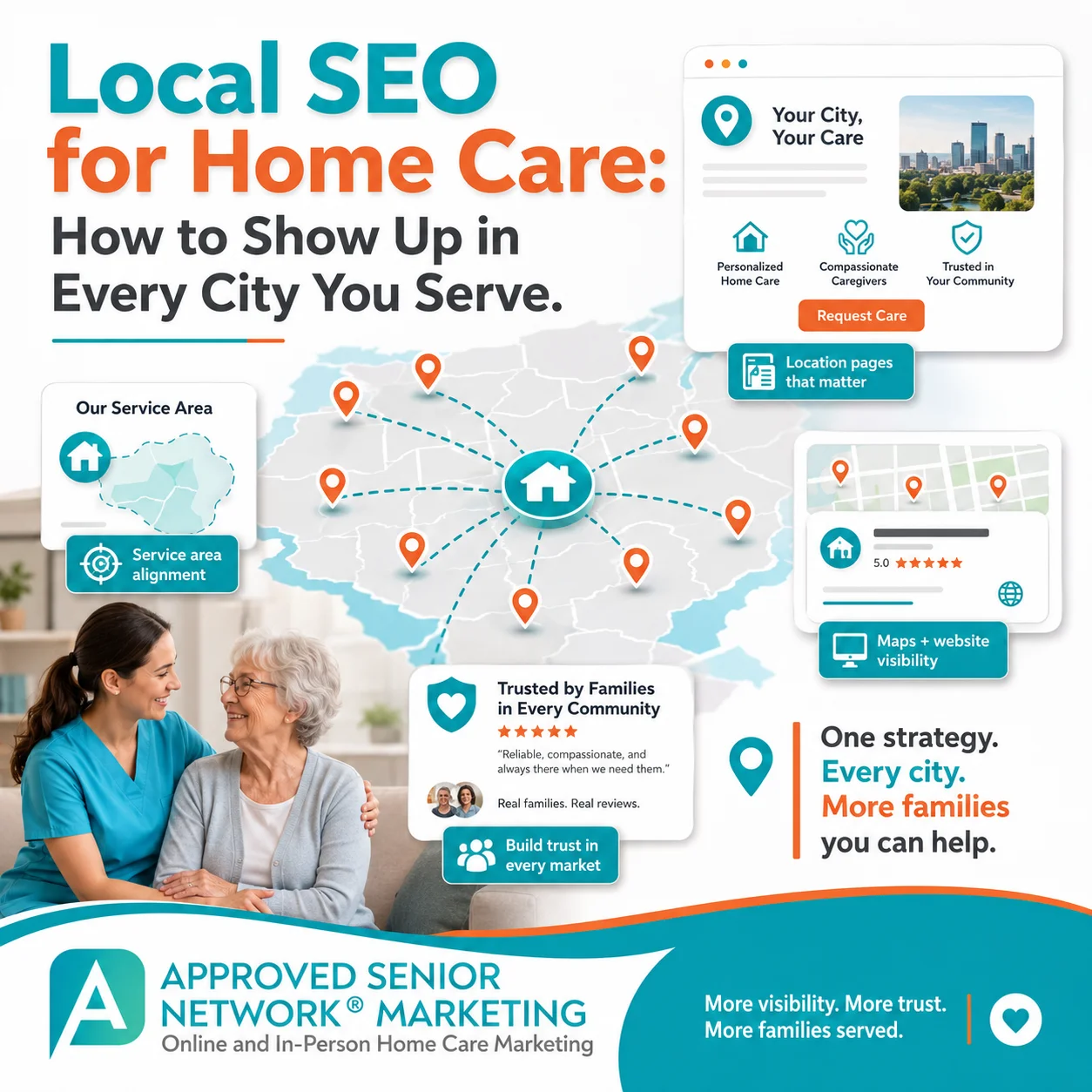
TL;DR: You do not rank in a city because you typed the city name 20 times. Local SEO works when the website, Google Business Profile, service pages, location pages, internal links, reviews, and real-world operating footprint reinforce the same story. The best location pages are useful local resources. The worst are doorway pages with one city swapped for another. Approved Senior Network uses a decision rule: create a city page only when the market matters, the agency truly serves it, and you can add enough local value that the page deserves to exist on its own.
Local SEO has two visible battlegrounds
A family can encounter your agency in the local map results and in the organic website results beneath or around them.
The Business Profile helps Google understand the business entity and service area. The website gives you room to explain services, locations, care situations, costs, questions, and proof in much greater depth.
You want both working together.
For the broader strategy, see what actually works in home care marketing now.
Start with the commercial map, not a list of ZIP codes
Before creating pages, identify the markets that matter to the business.
ASN recommends scoring potential service areas on four dimensions:
| Question | Why it matters |
|---|---|
| Can we reliably staff this market? | Ranking for a place you cannot serve creates bad leads. |
| Is there meaningful demand? | Not every nearby town deserves equal investment. |
| Do we have referral or community presence? | Real local connections can support credibility. |
| Can we create useful local information? | If not, the page is likely to become thin. |
ASN decision rule
Create a dedicated location page when all of these are true:
- The agency legitimately serves the area.
- The market is strategically important.
- The page can answer local questions that a generic service page cannot.
- The page has a clear relationship to relevant service pages.
If the only unique sentence will be the city name, do not create the page yet.
Separate service intent from location intent
A service page answers:
What is dementia care at home, and can this agency provide it?
A location page answers:
Does this agency provide home care in this community, and what should a family here know?
Those pages can support each other without competing.
Example architecture
Service page: /dementia-home-care/
- What dementia home care includes
- Who may benefit
- Common family concerns
- How care starts
- Links to priority service-area pages
Location page: /home-care-fairfax-va/
- Home care in Fairfax
- Services available there
- Real local service details
- Relevant logistics or community context
- Links back to dementia care, personal care, respite care, etc.
Strong home care website design gives each page a job.
Avoid doorway pages
Google's spam policies define doorway abuse as pages created to rank for similar queries that funnel users toward another destination or create substantially similar pages closer to search results than a useful site hierarchy.
This is directly relevant to home care sites with dozens or hundreds of near-identical town pages.
Thin version
"We provide compassionate home care in Springfield. Our Springfield caregivers provide personal care, companion care, respite care and dementia care. Call for home care in Springfield."
Change Springfield to 40 nearby cities and nothing meaningful changes.
Useful version
A useful Springfield page might explain:
- Whether the agency serves the entire city or specific parts of the area
- Which services are commonly requested there
- How quickly the agency can generally evaluate new cases, without making a guarantee
- Real referral or community resources when relevant
- Local hospitals, rehab discharge contexts, senior resources, or travel/logistics details when they are genuinely useful and accurate
- Specific FAQs based on what Springfield-area families ask
- Links to the most relevant service pages
The goal is not to sound local. It is to be useful locally.
Build a location-page template that forces uniqueness
A repeatable layout is fine. Repeated content is the problem.
ASN location-page template
H1: Home care in [city]
Direct answer: One or two sentences confirming the legitimate service area and major types of support.
Who families in this area call us for: Real care situations, not keyword variations.
Services available: Link to the major service pages rather than rewriting each service in full.
How care starts: Explain the agency's real intake process.
Local service notes: Coverage boundaries, travel issues, neighborhoods, community context, or referral relationships only when accurate and useful.
Why this agency: Real differentiators and proof.
Local FAQs: Questions specific enough to earn their place.
Next step: Phone, consultation, or request-care form.
Keep name, address, phone, and service area coherent
Local visibility becomes harder when the website, Business Profile, directories, and social profiles tell different stories.
Maintain a single internal source-of-truth record for:
- Legal and public-facing business name
- Main phone number
- Office address when applicable
- Whether the address should be public
- Service areas
- Website URL
- Hours
- Major categories
- Major services
When something changes, update the source-of-truth document first, then work outward.
Use internal links as a local information network
Internal links help families and search systems understand relationships among pages.
Useful patterns include:
- Location page -> service page
- Service page -> priority location page
- Blog article -> relevant service page
- Blog article -> relevant location page when the geographic connection is real
- Guide -> service page and consultation page
Google's current AI-search guidance continues to recommend strong SEO fundamentals and clear site structure rather than special "AI" tricks.
That is why AI and local search visibility is better understood as an extension of good search architecture, not a separate content silo.
Build citations for accuracy, not volume theater
Directory and citation work is useful when it helps the web reflect the same real business information.
Do not obsess over a giant citation count while the major sources are wrong.
Prioritize:
- Google Business Profile
- Major mapping and business-data platforms relevant to your market
- Important healthcare, aging, chamber, local, or industry listings where the agency legitimately belongs
- Consistency after moves, rebrands, phone changes, mergers, or new offices
The practical goal is a coherent entity footprint.
Do a quarterly local SEO audit
Choose 5-10 priority markets and review:
Eligibility and operations
- Do we still serve this market?
- Can staffing support growth here?
GBP
- Is the service area accurate?
- Are the categories and services current?
Website
- Does the market have an appropriate location page?
- Is the page actually different from neighboring city pages?
- Does it link to the right services?
Search
- Which pages rank for the target location/service combinations?
- Are we accidentally ranking the wrong page?
Content gap
- What questions are local families asking that our page does not answer?
Authority
- Are there legitimate local mentions, partnerships, sponsorships, directories, or community resources that should reference the agency?
Frequently asked questions
Do I need a page for every city I serve?
No. Create pages for commercially meaningful markets where you can produce genuinely useful content. A smaller set of strong location pages is better than a large set of thin city swaps.
How long does local SEO take?
There is no fixed timeline. Results depend on the site's starting point, competition, location, content, authority, technical condition, and consistency of execution.
Is SEO worth it for a small agency?
It can be, especially when the agency focuses on a realistic service footprint and publishes strong pages around the services and markets that actually drive inquiries.
Should every location page use the same layout?
A common layout is fine. The page content, local facts, questions, examples, and decision value should be distinct enough that the page deserves to exist independently.
Can I create an office address just to rank in another city?
Do not use fake, virtual, or otherwise ineligible locations as a ranking tactic. Google has specific eligibility requirements for service-area businesses and real-world business locations.
Primary sources
- Google Search: Spam policies, including doorway abuse: https://developers.google.com/search/docs/essentials/spam-policies
- Google Search: Creating helpful, reliable, people-first content: https://developers.google.com/search/docs/fundamentals/creating-helpful-content
- Google Search: Search Essentials: https://developers.google.com/search/docs/essentials
- Google Search: Generative AI optimization guide: https://developers.google.com/search/docs/fundamentals/ai-optimization-guide
- Google Business Profile: Service-area guidelines: https://support.google.com/business/answer/3038177
- Google Business Profile: Manage service areas: https://support.google.com/business/answer/9157481