
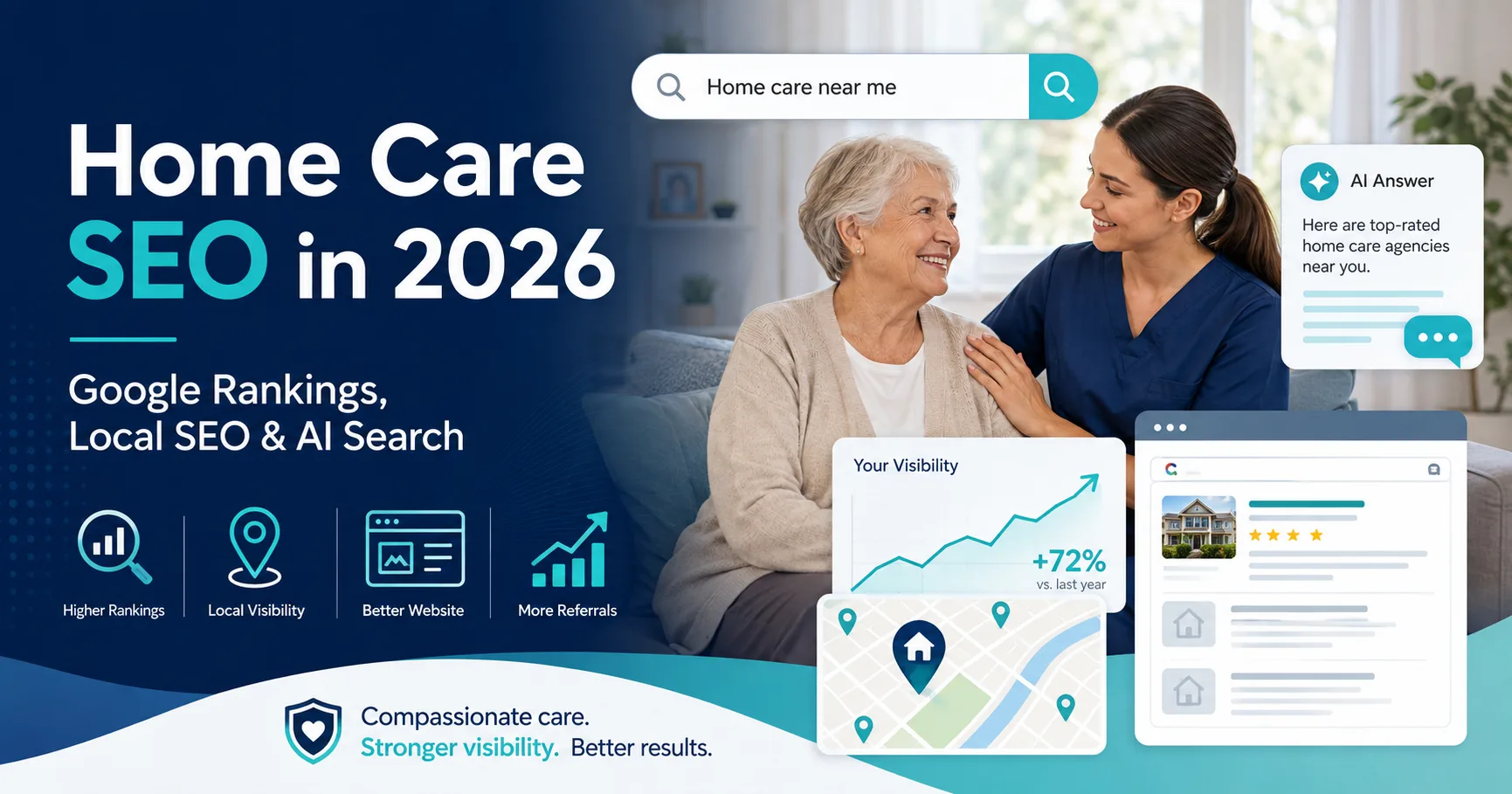

Home care SEO used to be relatively straightforward.
An agency optimized its website for phrases such as “home care near me,” “senior care in [city],” or “dementia care in [city].” It worked on its Google Business Profile, collected reviews, built location pages, published blog posts, earned backlinks, and tried to move higher in Google.
All of that still matters.
But the search experience surrounding it has changed.
Families are no longer always typing a short phrase into Google and choosing from ten blue links. They may ask Google AI Mode a detailed question. They may read an AI Overview without clicking a website. They may ask ChatGPT to compare options. They may use Copilot to research what kind of care their parent needs before they know what services to search for.
That means home care SEO is about more than rankings. It is about becoming one of the trusted sources search engines and AI systems can find, understand, retrieve, cite, and recommend.
The good news is that this does not require abandoning traditional SEO. Google says the opposite. Its current guidance is that the practices helping websites perform in traditional Search remain foundational to visibility inside generative AI experiences such as AI Overviews and AI Mode. Google also cautions businesses against chasing supposed AEO or GEO shortcuts instead of doing solid SEO and publishing unique, useful content.
The agencies best positioned for AI search are largely the same agencies that should have been building strong SEO all along. The quality bar just got higher.
SEO is one channel inside a broader home care digital marketing program, alongside your website, paid advertising, social, and the follow-up that happens after an inquiry arrives.
What is home care SEO?
Home care SEO improves an agency’s visibility when families, caregivers, referral sources, and other consumers search online for information or services related to care at home.
That can include searches such as:
- “home care near me”
- “home care agency in Fairfax VA”
- “24-hour home care in Omaha”
- “dementia caregivers near me”
- “how much does home care cost in San Diego?”
- “can someone stay overnight with my elderly mother?”
- “does Medicare pay for home care?”
- “what kind of help does my dad need after leaving the hospital?”
In 2026, those searches can happen in regular Google results, Google Maps, Google AI Overviews, Google AI Mode, Bing, Microsoft Copilot, ChatGPT Search, and other AI-powered environments.
So when someone searches for AI SEO for home care, or home care AI search optimization, what they are describing is the expansion of traditional home care SEO into newer search surfaces.
It is not a replacement for SEO.
It is the next stage of it.
What a home care SEO program actually includes
Most agency owners reading this page are not trying to learn SEO. They are trying to decide whether to hire someone to do it.
Here is what the work looks like when Approved Senior Network runs it.
Technical foundation. A full crawl and audit of the existing site. Canonicals, redirects, sitemaps, index coverage, orphan pages, Core Web Vitals, crawler access. Nothing else works until this does.
Site architecture. A hierarchy that gives every page a clearly differentiated job, so the homepage, service pages, city pages, and blog posts stop competing with one another for the same phrases.
Local search. Google Business Profile optimization, citation consistency, review generation, and service area structure. This is where most home care leads actually come from, and it runs through GoCareLocal.
Website. If the site cannot support the structure, the structure does not happen. GoCareWebsites handles rebuilds and new builds for agencies whose current site is the bottleneck.
Content. Service pages, location pages, and expert-led educational content written to answer the questions families actually ask, not the generic topics every home care blog already covers.
Reviews and reputation. A repeatable process for earning authentic Google reviews, because review volume affects both local prominence and whether a family calls you or the agency listed beside you. That runs through the review program.
AI search visibility. Tracking whether AI systems can find, understand, and cite your agency, and fixing the gaps when they cannot. That is GoCareSignal.
Follow-up. Visibility that produces inquiries nobody answers is wasted spend. ASNSpark CRM handles the speed-to-lead and follow-up side.
Reporting. Organic performance, local visibility, AI citations, and the number that actually matters: qualified calls and form fills.
Agencies at different stages need different pieces of this. A new agency with a six-page site needs a different first ninety days than an established agency with two hundred reviews and a cannibalization problem.
The biggest change in home care SEO: search has become a conversation
Traditional search encouraged short keyword phrases.
AI search encourages questions.
Someone using traditional Google might search:
dementia home care Fairfax VA
Someone using an AI search tool may ask:
“My 82-year-old mother in Fairfax has dementia and is starting to wander at night. She wants to stay home. What type of home care should we be considering, and what should we ask an agency before hiring them?”
That is an entirely different search experience, and it creates opportunities for agencies that publish genuinely useful information.
Google explains that its generative search features can use a process called query fan-out. Instead of treating a complicated question as one search phrase, Google’s systems may generate multiple related searches to gather the information needed to construct an answer.
For the dementia example above, the system could explore concepts related to dementia home care, nighttime supervision, wandering risk, 24-hour care, agency qualifications, local providers, and the questions families should ask.
This changes how a home care website should be built.
Creating a separate page for every imaginable exact-match keyword is becoming less useful. Building comprehensive topical authority around the questions families actually have is becoming much more important.
Google SEO and AI SEO are becoming the same strategy
There is a growing industry around terms such as AEO, Answer Engine Optimization, and GEO, Generative Engine Optimization.
Those terms are useful for describing a new type of visibility. But be careful when someone claims AI SEO requires an entirely separate set of tricks.
Google’s 2026 guidance is clear on this. Its generative AI search experiences are rooted in core Search ranking and quality systems, and businesses should continue applying foundational SEO best practices. Google specifically recommends unique, expert-driven, non-commodity content over shortcuts designed only to influence AI answers.
In plain English:
If Google cannot crawl your website, understand your business, trust your information, or find a strong page answering the question, AI optimization tricks are unlikely to save you.
For a home care agency, the foundation still starts with a properly structured website.
Local SEO is still critical for home care agencies
Home care is inherently local.
A family does not need the best home care agency on the internet. They need an agency capable of sending a caregiver to a particular community.
That makes Google Business Profile and local SEO especially important.
Google says local rankings are primarily determined by three concepts: relevance, distance, and prominence. Complete business information helps Google understand relevance, location affects distance, and factors including links and reviews contribute to prominence.
An agency cannot simply put the words “home care” on its homepage and expect to cover an entire metropolitan area.
Google needs to understand several things clearly:
- Who is this company?
- Where is it located?
- What geographic areas does it genuinely serve?
- What services does it provide?
- What do customers say about it?
- Does the business have a legitimate presence in the community?
- Does the website reinforce the same information found elsewhere?
Google also explains that Business Profile information can come from several sources, including the company’s official website, publicly available web information, third-party data, and user contributions.
That has implications beyond Google Maps. The more consistently your agency is represented across its website, business listings, directories, reviews, and other trustworthy sources, the easier it is for search systems to understand the entity behind the website.
Local search has enough moving parts that it deserves its own treatment. See local SEO for home care agencies for the Google Business Profile and service area detail.
Your website needs a clear home care SEO architecture
One of the most common SEO problems on home care websites is not a lack of content. It is a lack of organization.
A website may have dozens or hundreds of pages, but Google cannot easily determine which page should rank for which search.
An agency might have a homepage optimized for “home care in Fairfax,” a Fairfax location page targeting the same phrase, a “senior home care Fairfax” page, a Fairfax companion care page that repeatedly uses “home care Fairfax,” and several blog posts competing for the same terms.
Instead of strengthening the website, these pages compete with one another. This is keyword cannibalization.
The solution is not necessarily deleting pages. It is giving pages clearly differentiated jobs.
A strong home care website needs a hierarchy that distinguishes the agency itself, major service areas, individual services, important geographic markets, educational resources, and conversion pages. The goal is for Google, and increasingly for AI retrieval systems, to understand the relationship among these pages without guessing.
Internal linking is part of that structure. A page about dementia care should connect to related resources about dementia warning signs, nighttime safety, respite care, 24-hour care, and the markets where dementia care is available.
That creates topical relationships instead of isolated pages.
City pages still work, but thin city pages are increasingly dangerous
Location pages remain an important part of home care SEO. If your agency genuinely provides care in Alexandria, Arlington, Fairfax, Reston, and Vienna, useful pages about those communities make sense.
The problem begins when the website creates dozens of pages in which nothing changes except the city name.
Google’s spam policies specifically warn against creating substantially similar pages for cities or regions when those pages exist primarily to rank for similar queries or funnel users toward the same destination. Google classifies certain versions of this as doorway abuse.
AI-generated content makes this especially important. It is now technically possible to generate 500 city pages in an afternoon.
That does not mean you should.
A Gainesville home care page should contain information relevant to someone considering care in Gainesville. A Reston page should answer questions relevant to Reston families.
A community page might discuss the types of care provided there, nearby communities served, local aging resources, common care situations, hospital discharge considerations, service availability, caregiver coverage, local office information, and the questions families in that market frequently ask.
The approach varies. The principle does not:
Every indexable page should deserve to exist.
Google’s current spam guidance specifically warns against generating large numbers of unoriginal pages, including using generative AI to create pages that provide little additional value.
Home care content needs to move beyond generic blogs
For years, SEO companies published articles such as:
- “5 Benefits of Home Care”
- “7 Signs Your Parent Needs Help”
- “10 Benefits of Companion Care”
There is nothing wrong with those subjects. The problem is that thousands of websites have already written essentially the same article.
Google’s newer AI-search guidance encourages non-commodity content: information containing original experience, expertise, or perspective rather than material almost anyone could have produced.
A generic article called “Benefits of Dementia Care” adds little to what already exists online.
An experienced agency could publish something far more valuable:
- “How We Help Families Introduce Home Care When a Parent With Dementia Refuses Help”
- “What We Look for During the First Week of Home Care After a Hospital Discharge”
- “When Four Hours of Home Care Is Enough, and When It Isn’t”
- “What Families Often Underestimate About Overnight Dementia Care”
- “Live-In Care vs. 24-Hour Home Care: What Families Need to Understand Before Choosing”
- “What Happens When a Caregiver Calls Off at 6 AM?”
These are subjects where a real home care organization contributes experience that generic AI-generated content cannot easily reproduce.
That is exactly where agencies should lean into their expertise.
How to find the right keywords for a home care website
Keyword research for home care is not a matter of pulling a list of high-volume phrases and building a page for each one.
Most of the highest-volume terms in this industry are national, competitive, and commercially useless to a local agency. The terms that produce calls are usually some combination of service, city, and situation.
A workable process:
Start with what you actually sell. Companion care, personal care, dementia care, respite, 24-hour, live-in, post-hospital. Each of these is a distinct search intent and usually deserves its own page.
Layer in geography. Not every town you would technically drive to. The markets where you have caregiver coverage and would genuinely accept a case.
Add the question layer. Cost, Medicare and payment, how to start, what to ask, how to bring it up with a parent who refuses. These are the searches that reach families months before they call anyone.
Check intent before you build. Search three of your candidate phrases. If the same URLs rank for all three, they belong on one page. If the results diverge, they are separate pages. This one test prevents most cannibalization.
Group, then map. Cluster related phrases and assign each cluster exactly one primary page. Everything else in that cluster becomes a heading, a section, or a supporting post that links up.
The mistake to avoid is treating keyword volume as the ranking criterion. A phrase with 90 searches a month in your county and clear buying intent is worth more than a national term with 5,000 searches you will never rank for and would not want traffic from anyway.
For the full walkthrough, see keyword research for home care websites.
How SEO actually generates home care leads
SEO is a lead channel, not a ranking scoreboard. The chain from search to admitted client has four links, and most agencies only measure the first one.
Visibility. Your pages appear when families and referral sources search. This is the part everyone tracks.
The click. Visibility without a click is nothing. What earns the click is the title, the review count beside your listing, and whether the snippet answers the question. An agency with 173 reviews and an agency with 14 reviews are not competing equally even when they appear side by side.
The inquiry. The page has to make it obvious how to start and easy to do it. Phone number visible without scrolling. A form that asks for three fields, not eleven. A clear next step that is not “contact us.”
The response. This is where most home care SEO spend evaporates. A family that fills out a form at 7 p.m. and hears back at 10 a.m. the next day has usually already called two other agencies. Speed to lead decides more cases than ranking position does, which is why ASNSpark CRM sits inside the same program as the SEO work rather than beside it.
The practical implication: if you are buying SEO and not measuring calls, forms, consultations, and admits, you are buying a report, not a growth channel.
Home health care SEO is not the same work
Agencies often use home care and home health interchangeably. Search engines and families do not, and the SEO strategies diverge in three ways.
The buyer is different. Private duty home care is usually a family decision, funded privately. Home health is usually clinician-driven and Medicare-funded, which means the searches come from a mix of families, discharge planners, and physician offices.
The referral channel carries more weight. Home health visibility has to work for hospital case managers, SNF discharge planners, and physician practices, not just adult children. That changes what content earns links and citations, and it is why search and sales training belong in the same plan.
The compliance frame is tighter. Claims about covered services, eligibility, and outcomes carry regulatory exposure that private duty copy does not. Content needs review before it publishes.
The technical and local foundations are identical. Crawlability, architecture, Google Business Profile, reviews, and schema do not change. What changes is who the content is written for and what a conversion looks like.
Agencies running both lines should not merge them into one set of pages. Separate service hierarchies, separate content, separate measurement.
Senior care and senior living SEO
Senior care is the widest of these terms and the most frequently misused. It covers home care, home health, assisted living, memory care, independent living, and hospice, and a family searching it is usually at the very beginning of the process.
Two implications.
Senior care searches are research searches. Someone typing “senior care options” is not ready to hire. They are trying to understand the category. Content that sells too early loses them. Content that genuinely explains the options earns the relationship and the eventual call.
Multi-line and franchise operators have a structural problem. An organization offering home care, assisted living placement, and care management cannot run all three through one page without confusing both Google and the family. Each line needs its own hierarchy, its own local presence, and its own conversion path, linked by a parent page that explains how they relate.
This is also where AI search changes the most. A family asking an AI assistant what kind of care their parent needs is asking a senior care question, not a home care question. The agencies getting cited in those answers are the ones that published real comparison content instead of a service list.
Home care SEO requires strong trust signals
Home care occupies a sensitive area of search. Families are making decisions involving the safety of someone they love.
Google’s quality guidance says its systems place particular importance on experience, expertise, authoritativeness, and trustworthiness, commonly called E-E-A-T, and that strong E-E-A-T becomes particularly important for subjects affecting health, financial stability, or safety.
A home care website therefore needs to do more than say:
“We provide compassionate care.”
Almost every home care agency says that. Show people why they should believe you.
- Identify agency leadership.
- Explain relevant professional experience.
- Include meaningful staff biographies.
- Explain caregiver screening and training.
- Clearly describe the care process.
- Publish real answers to difficult questions.
- Identify who writes or clinically reviews educational content when appropriate.
- Show real photographs.
- Display accurate contact information.
- Explain where the agency operates.
- Maintain current licensing and credential information.
- Earn authentic reviews.
- Include publication and update dates on educational resources.
- Cite authoritative medical, government, or research sources when making health-related claims.
Trust should not live on one About Us page. It should run through the website.
Reviews matter to both visibility and conversion
Reviews are one of the few SEO assets that influence what happens before and after the click.
Google says review count and positive ratings contribute to local prominence and local ranking. But the value goes beyond rankings.
Imagine two home care agencies appearing next to each other. One has 14 reviews. The other has 173 reviews discussing dementia care, responsiveness, caregivers, communication, and support for family members.
Even on the same results page, they are not competing equally.
Reviews also create independent third-party descriptions of your organization. That becomes increasingly valuable in AI search, because your own website is not the only source available to a system trying to understand your company.
Technical SEO still matters in the age of AI
AI search did not eliminate crawling and indexing.
Google states that a page must be indexed and eligible to appear in Google Search with a snippet before it can be eligible as a supporting link within AI Overviews or AI Mode. There is no separate technical pathway that bypasses the normal search foundation.
Agencies still need to watch for incorrect canonical tags, accidental noindex directives, broken internal links, duplicate URLs, redirect chains, poor XML sitemaps, orphan pages, mobile usability, and page speed.
Page experience matters as well. Google continues to recommend good Core Web Vitals: Largest Contentful Paint for loading, Interaction to Next Paint for responsiveness, and Cumulative Layout Shift for visual stability.
Technical SEO is rarely the most interesting part of a marketing plan. But an excellent dementia care page provides no value if Google cannot index it.
Schema markup clarifies information, but it is not an AI search cheat code
Structured data gives search engines explicit information about the meaning of content on a page. Google says structured data helps its systems understand page content and can make eligible content available for certain enhanced experiences.
For a home care website, appropriate structured data may include organization and local business information plus markup relevant to specific page types. Google recommends using the most specific appropriate LocalBusiness subtype and including real-world information such as name, address, telephone number, URL, and logo.
Schema does not automatically produce higher rankings. Google explicitly states that implementing structured data only makes a page eligible for applicable features. It does not guarantee display.
One 2026 change matters here. Google deprecated its FAQ rich result feature beginning May 7, 2026.
That does not mean stop answering FAQs. Questions and answers remain useful to visitors and help a page comprehensively address a topic. It means stop treating FAQ schema as a trick that buys extra Google real estate.
The information is more important than the markup.
How do you optimize for Google AI Overviews and AI Mode?
The first step is anticlimactic:
Do good SEO.
Google’s generative search systems retrieve information using Google’s Search infrastructure. Google has described retrieval-augmented generation and query fan-out as parts of that process.
For home care agencies, this means the website needs pages that answer important questions clearly and completely.
Suppose a family asks:
“What’s the difference between live-in home care and 24-hour care for someone with dementia?”
An agency has a stronger chance of participating in that answer if it has a page explaining both models, who each is appropriate for, how caregiver shifts work, nighttime considerations, common misconceptions, cost factors, and the questions families should ask.
AI search also makes supporting media more important. Google recommends high-quality images and video where appropriate, because generative experiences can surface media as well as links.
For home care agencies, that might include caregiver education videos, short explanations by a nurse or agency owner, downloadable family guides, care planning videos, and original photographs.
For the family side of this, how people now ask AI tools to recommend an agency and what decides which agencies get named, see AI search and home care marketing.
What about ChatGPT Search?
ChatGPT can search the web and provide citations and links to sources.
OpenAI says public websites can appear in ChatGPT search, and that owners who want their content eligible for discovery should ensure they are not blocking OAI-SearchBot. OpenAI also notes that inclusion and placement are not guaranteed.
This is an easy item to overlook. A perfectly optimized site cannot be retrieved by a crawler that has been blocked.
Beyond crawler access, there is no credible reason to abandon traditional SEO and build a separate ChatGPT website. Focus instead on making information easy to verify.
- Clearly state the agency name.
- Clearly state locations.
- Clearly describe services.
- Keep phone numbers and business information consistent.
- Publish detailed educational content.
- Make important pages crawlable.
- Build real authority outside your own website.
- Earn reviews and reputable mentions.
- Avoid vague marketing language when a concrete answer would be more useful.
In short, give an AI search system fewer reasons to be uncertain about who you are and what you do.
Where Do You Stand?
Find out whether Google and AI search can actually find your agency.
We run a visibility check across your technical foundation, local presence, content depth, reviews, and AI citations, then send you what we found. No call required to get the results.
Get My Visibility CheckBing and Microsoft Copilot are becoming measurable too
Microsoft has also moved toward greater transparency around AI visibility.
In February 2026, Bing introduced an AI Performance area in Bing Webmaster Tools showing how publisher content is cited across Microsoft Copilot, AI-generated Bing summaries, and certain partner integrations. The reporting includes metrics such as total citations and cited pages.
Microsoft has described AI visibility as moving beyond rankings and clicks toward whether content contributes to generated answers and citations.
That is a meaningful shift. Your SEO report should not only ask:
“What position are we ranking?”
It should increasingly ask:
- Where is our brand being surfaced?
- Which pages are appearing?
- What questions are bringing us visibility?
- Are AI search systems citing us?
- Is that visibility producing qualified inquiries?
Google is finally giving websites AI search visibility data
Google announced dedicated Search Generative AI performance reporting in Search Console, designed to show website visibility within generative AI Search experiences such as AI Overviews and AI Mode. The reports include impressions, pages appearing in generative AI features, countries, devices, and dates.
As of August 31, 2026, Google says these insights have rolled out worldwide.
Until recently, most AI search optimization involved testing prompts and manually watching answers. Those activities are still useful, but agencies can now supplement them with actual data.
For home care marketers, the next step is to identify which service pages, town pages, and educational resources are surfacing in AI experiences, then expand the areas where the website already demonstrates genuine authority. That tracking is what GoCareSignal was built to do.
The best home care SEO strategy builds topical authority
Home care websites usually make one of two mistakes. The first publishes almost nothing. The second publishes hundreds of disconnected blog posts.
Neither creates a strong resource.
Think in terms of topic ecosystems instead.
If dementia care is an important service, your website should not contain one 700-word dementia care page. It should contain a primary dementia care service page supported by resources about dementia home safety, sundowning, wandering, respite care, caregiver burnout, nighttime supervision, introducing a caregiver, communication strategies, home care costs, 24-hour care, and when needs have exceeded what can safely be provided at home.
Those resources should connect to one another. Do the same for your other major areas of expertise.
Now Google does not see one page claiming you provide dementia care. It sees a body of useful information showing that dementia home care is a genuine focus of your site.
That helps humans, which remains Google’s stated objective for both classic and AI search.
Do not use AI to fill your website with junk
AI can be useful in home care SEO. It can analyze search data, identify missing topics, organize information, outline articles, improve readability, analyze internal linking, compare competing pages, detect cannibalization, and accelerate research.
It can also destroy a website quickly.
Imagine generating 150 cities multiplied by 12 services. That produces 1,800 pages. Now imagine 90% of the content is identical except for city and service names.
You have not created 1,800 resources. You have created a duplication problem.
Google’s spam policies explicitly state that scaled content abuse can include using generative AI to produce large numbers of pages without adding value.
AI should make your experts more productive. It should not be used to manufacture fake expertise.
What home care SEO should measure in 2026
Rankings still matter, but rankings alone are an incomplete KPI. The goal is business growth.
A program should watch organic impressions and clicks, Google Business Profile activity, local visibility, non-branded search growth, service page performance, phone calls, form submissions, consultation requests, conversion rates, new reviews, referring domains, and qualified leads.
In 2026, add AI visibility:
- Review Google’s Generative AI reporting in Search Console.
- Review Bing Webmaster Tools’ AI citation data.
- Watch referral traffic from AI platforms where it can be identified.
- Periodically test the questions real families would ask AI systems.
Then compare all of it against leads and revenue.
A report showing a keyword moved from position 14 to position 6 is interesting. A report showing organic search generated 27 qualified calls is useful.
A 2026 home care SEO checklist
- A technically crawlable, indexable website with correct canonicals, redirects, and XML sitemaps.
- A clear hierarchy for services, locations, and educational resources.
- Well-developed service pages for the care you actually provide.
- Unique, genuinely useful location pages for important service areas.
- A fully optimized and actively maintained Google Business Profile.
- A consistent process for earning authentic Google reviews.
- Strong internal linking between related services, locations, and resources.
- Expert-led educational content answering real family questions instead of generic SEO topics.
- Clear trust signals including leadership, experience, credentials, screening processes, and real company information.
- Appropriate Organization and LocalBusiness structured data.
- High-quality original images and video where useful.
- Access for legitimate search crawlers, including checking that OAI-SearchBot is not unintentionally blocked.
- Google Search Console and Bing Webmaster Tools monitoring, including their generative AI visibility features.
- Regular audits for duplicate content, cannibalization, thin pages, and outdated information.
- Conversion tracking connecting organic and AI search visibility with calls, forms, consultations, and new clients.
What does not work well in home care SEO anymore
The old volume-first model is increasingly risky.
- Publishing 20 mediocre AI-generated blogs every month is not a strategy.
- Creating nearly identical service pages for every city is not a strategy.
- Changing a few city names to make “unique” pages is not localization.
- Stuffing “home care near me” into paragraphs is not local SEO.
- Adding every possible schema type to a page is not AI optimization.
- Buying hundreds of questionable backlinks is not authority.
Putting an llms.txt file on a weak website does not make it an AI authority. Google’s 2026 generative AI guidance specifically cautions businesses against spending time on unnecessary AI search tactics when foundational SEO and valuable content deserve the attention.
Home care agencies need fewer tricks and more substance.
Common questions about home care SEO
How long does home care SEO take?
There is no universal timeline. An established agency with a strong website, hundreds of reviews, and existing local authority starts from a different position than a new agency with a new domain. Competition, geography, technical condition, existing authority, content quality, and competitor quality all affect the timeline. SEO is a compounding growth channel rather than a short campaign.
Is home care SEO still worth it with AI search?
Yes. AI search does not eliminate the need for information. It increases the need for reliable information that machines can retrieve. Google's guidance says foundational SEO remains relevant to generative AI search, Microsoft reports citations in AI-generated answers, and OpenAI allows public websites to be cited through ChatGPT Search when accessible to its crawler.
Does my home care agency need AI SEO or GEO?
You need to understand AI search, but you probably do not need a separate strategy disconnected from SEO. Google's position is that optimizing for its generative AI experiences remains fundamentally SEO. Traditional SEO asks whether Google can find, understand, and rank a page. AI search optimization adds whether a system can retrieve a specific part of that information confidently enough to use in an answer.
Should home care agencies still use FAQ content?
Yes. Families have questions and answering them clearly creates useful content. What changed in 2026 is Google's treatment of FAQ rich results, which were discontinued in May 2026. Keep publishing questions and answers because they improve the page, not because the schema was expected to increase rankings.
How much does home care SEO cost?
Cost depends on the condition of the existing website, the number of markets served, and whether the work includes a rebuild. An agency with a healthy site in one metro needs a different scope than a multi-location operator whose site cannot support location pages. Be skeptical of any provider quoting a flat monthly figure before reviewing your site.
Longer answers on timelines, competition, and what a first ninety days looks like are the kind of thing we go through on a call. You can also read client results to see what the work has produced for other agencies.
Home care SEO in 2026 is about becoming the source
For years, businesses treated SEO as a contest to reach position one. That goal has not disappeared, but the opportunity is larger.
The strongest home care websites are becoming sources.
- Sources Google can retrieve.
- Sources AI Overviews can reference.
- Sources AI Mode can surface.
- Sources ChatGPT Search can cite.
- Sources families can read.
- Sources referral partners can share.
- Sources that demonstrate expertise before someone ever talks to your agency.
Agencies investing now in technical foundations, local authority, differentiated content, and real expertise will be far better positioned than agencies manufacturing visibility with thousands of generic pages.
The objective is no longer simply:
“How do we rank for home care?”
The better question is:
“How do we become one of the most useful, trustworthy, and understandable home care resources in every market we serve?”
Build that correctly and you are not just optimizing for Google. You are building for the next generation of search.
See how ASN compares to other top rated home care marketing agencies.
Let's Talk
Ready to build a home care website Google and AI search can trust?
Approved Senior Network builds the technical foundation, local authority, and expert-led content that earns visibility in both traditional and AI-powered search. Tell us about your agency and we will tell you where the gaps are.
Schedule a Strategy Call