
A Day in the Life of a Successful Community Liaison: Excellence in Sales Strategies

Annette ZieglerLead Sales and Marketing TrainerAugust 31, 2026
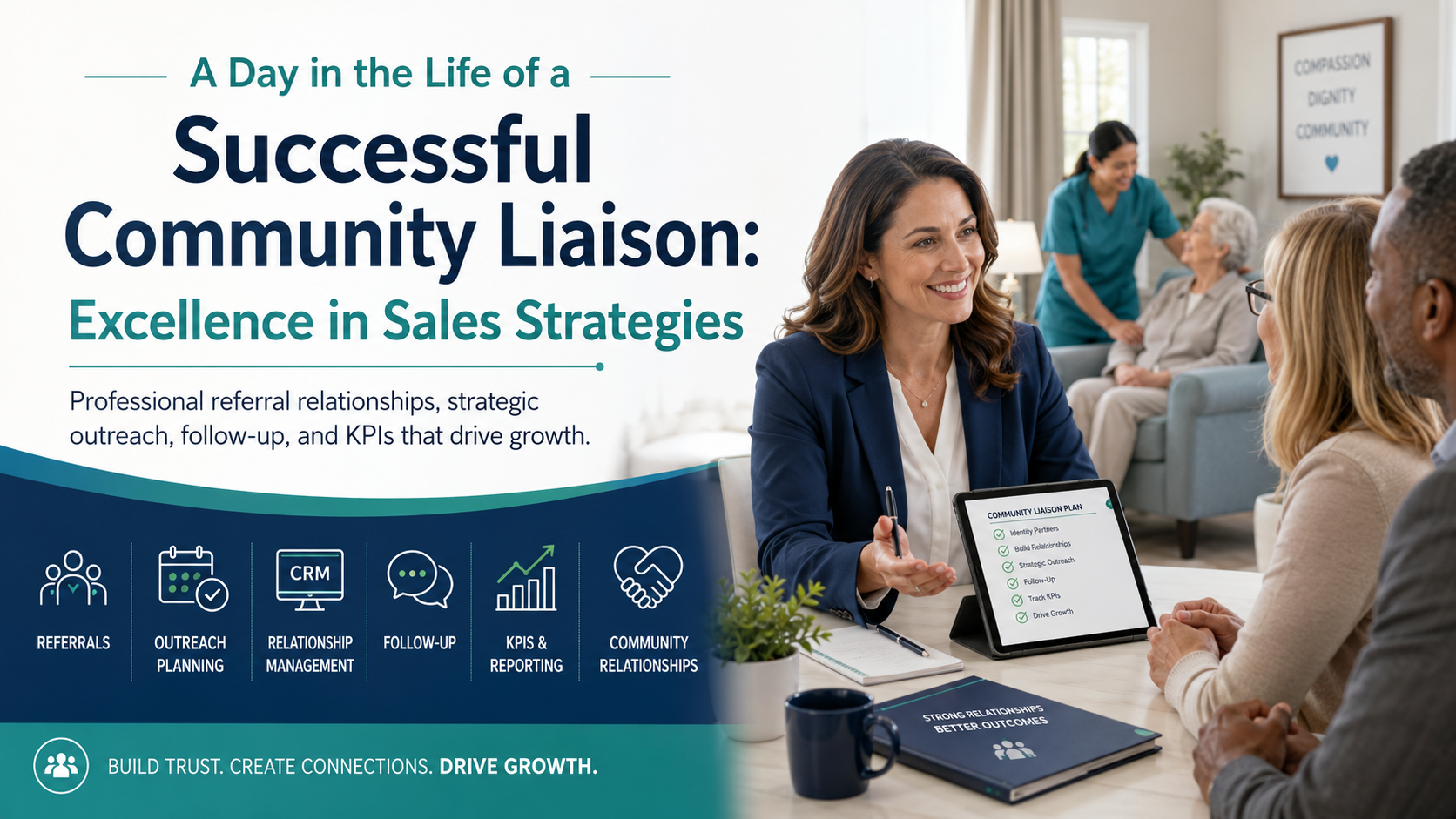
A successful community liaison can be one of the most important growth drivers in a home care organization.
But success in this role is often misunderstood.
It is easy to confuse activity with productivity.
A community liaison can drive 80 miles, visit 15 buildings, hand out dozens of brochures, attend a networking event, post a photograph on Facebook and come back to the office completely exhausted.
That does not necessarily mean the day produced anything of value.
The best community liaisons operate differently.
They know their territory. They know their highest-value professional referral sources. They understand the problems those professionals are trying to solve. They follow up consistently. They track conversations. They know which relationships produce referrals, which referrals become clients and which activities actually produce revenue.
Most importantly, they understand that sales in home care is relationship development—not brochure delivery.
A successful day therefore combines:
- Territory planning
- Professional referral development
- Meaningful face-to-face conversations
- Follow-up
- CRM documentation
- Education
- Networking
- Relationship nurturing
- Internal communication
- Referral tracking
- Sales KPIs
- Strategic prospecting
The result is not simply more sales activity.
It is a repeatable system for generating qualified home care referrals.
Activated Insights' home care benchmarking research reinforces the importance of this approach. Its 2024 findings reported that home-based care providers were placing greater emphasis on strengthening referral-source relationships, with word-of-mouth referrals accounting for almost one-third of revenue. The same research found that organizations tracking every inquiry generated dramatically more revenue than organizations tracking only some or most inquiries.
That tells us something important.
The goal of a community liaison is not:
“Be visible everywhere.”
It is:
Build the right relationships, create qualified opportunities, measure the results and systematically deepen the relationships that produce growth.
Here is what that looks like in practice.
What Does a Home Care Community Liaison Actually Do?
A home care community liaison may also be called a:
- Community relations director
- Business development representative
- Home care marketer
- Community outreach coordinator
- Community relations manager
- Account executive
- Referral development specialist
- Director of business development
- Community sales representative
Titles vary.
The fundamental mission does not.
The liaison develops relationships with people and organizations that encounter older adults and families who may need home care.
Potential professional referral partners include:
- Hospital case managers
- Hospital social workers
- Discharge planners
- Skilled nursing facilities
- Rehabilitation centers
- Home health agencies
- Hospice organizations
- Assisted living communities
- Independent living communities
- Memory care communities
- Physicians
- Geriatricians
- Neurology practices
- Primary care practices
- Aging Life Care Professionals
- Geriatric care managers
- Elder law attorneys
- Estate planning attorneys
- Financial professionals
- Long-term care insurance professionals
- Senior centers
- Veterans organizations
- Faith communities
- Senior-focused nonprofit organizations
- Adult day programs
- Community resource organizations
The liaison's job is to make the agency useful and memorable to these professionals.
That requires much more than periodically asking:
“Do you have anybody who needs home care?”
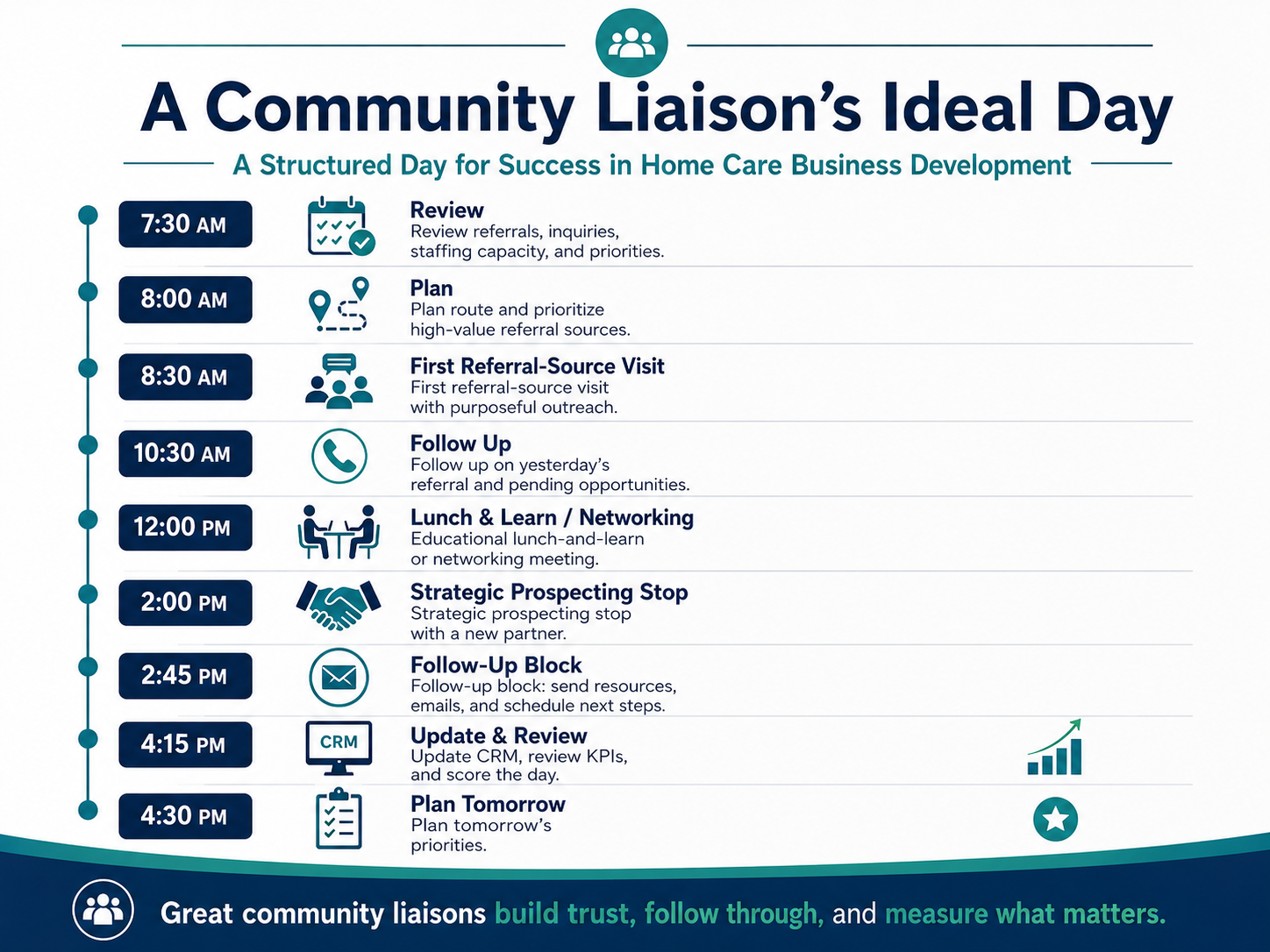
7:30 AM: Start With the Numbers, Not the Windshield
Excellent sales strategies in home care begin before the liaison leaves the office.
A high-performing liaison should know exactly what is happening in the business.
Start the day by reviewing a small sales dashboard.
Look at:
- Referrals received yesterday
- New inquiries
- Referral source
- Assessments scheduled
- Clients started
- Pending prospects
- Referral partners requiring follow-up
- Recent lost cases
- Staffing capacity
- Geographic areas where the agency can accept cases
- Types of cases the agency currently wants
This prevents an enormous business-development mistake:
Selling services operations cannot deliver.
Imagine a liaison spends two months convincing a rehabilitation center that the agency is excellent at handling weekend discharges.
The first Saturday referral arrives.
The agency cannot staff it.
The liaison has not simply lost a case.
They may have damaged a relationship that took months to build.
Sales, recruiting, scheduling and operations must therefore communicate continuously.
Know Today's Capacity
Before entering the field, the liaison should know:
Can we take a new case today?
And more specifically:
- Can we staff overnight care?
- Can we accept 24-hour cases?
- Can we staff weekends?
- Can we serve the entire territory?
- Do we have caregivers with dementia experience?
- Can we handle a Parkinson's case?
- Are transportation cases available?
- How quickly can an assessment occur?
- How quickly can care begin?
This information can actually become part of the liaison's sales message.
Instead of saying:
“We provide great home care.”
the liaison can say:
“We currently have capacity for a quick-start hospital discharge in the western part of the county, including weekend starts.”
That is useful information.
Useful people get remembered.
8:00 AM: Build a Purposeful Route
Successful community liaisons do not simply ask:
“Where haven't I stopped recently?”
They ask:
“Which relationships deserve my attention today?”
A territory should be segmented.
Tier 1: High-Value Referral Relationships
These may include organizations that:
- Already send referrals
- Have sent valuable cases historically
- Have significant referral potential
- Serve exactly the right client population
- Have developed genuine relationships with the liaison
These contacts deserve significant attention.
Tier 2: Developing Relationships
These organizations fit the agency well, but the relationship has not matured.
The liaison may have met the contact several times but has not yet received consistent referrals.
These relationships need purposeful follow-up.
Tier 3: Prospects
These are potential referral partners the liaison is still trying to understand.
Research comes first.
Who works there?
What population do they serve?
What problems do they encounter?
Who makes or influences referrals?
Is the organization genuinely relevant to your agency?
Not every building with senior citizens inside it is automatically an excellent referral source.
8:30 AM: The First Stop Is Not a Sales Pitch
Imagine the first visit is a rehabilitation facility.
A mediocre liaison walks in carrying a stack of brochures.
“Hi! Just wanted to stop by and remind you that we're here if you need home care.”
The social worker smiles.
The brochure goes into a pile.
The liaison leaves.
Technically, a sales call occurred.
Very little was accomplished.
A stronger liaison enters with a reason for the visit.
Perhaps:
“Last time we talked, you mentioned that Friday discharges can be difficult when families discover at the last minute that Mom shouldn't be alone all weekend. We've adjusted our intake process so we can respond more quickly to those situations. I wanted to make sure you knew who to call if that comes up.”
That is a business-development conversation.
There is a problem.
There is a solution.
There is a reason to remember the agency.
Great Community Liaisons Sell Solutions, Not Services
Most home care agencies offer many of the same basic services:
- Bathing
- Dressing
- Meal preparation
- Companionship
- Transportation
- Medication reminders
- Light housekeeping
- Respite care
Simply reciting those services does not create meaningful differentiation.
Instead, learn which situations your agency solves particularly well.
Maybe you are excellent at:
- Rapid hospital discharges
- Dementia care
- Parkinson's care
- Overnight supervision
- 24-hour care
- Difficult-to-staff cases
- Couples care
- Veterans
- Long-distance family situations
- Concierge private-pay care
- Post-surgical assistance
- Weekend starts
- Respite for exhausted family caregivers
Then connect the solution to the referral source.
A neurologist may care about something completely different from an elder law attorney.
A hospital case manager has different pressures than an assisted living executive director.
A hospice social worker may need something different from a rehabilitation discharge planner.
The liaison's job is to understand the difference.
9:30 AM: Visit a Hospital or Discharge Referral Partner
Hospital-to-home transitions are an excellent example of why strong community liaisons need to understand more than sales.
They need to understand the environment in which their referral partners work.
The Agency for Healthcare Research and Quality emphasizes that successful discharge planning requires effective transfer of information from the clinical team to patients and families. Its IDEAL discharge framework specifically addresses what life will be like at home, medication management, warning signs, follow-up and family involvement.
A community liaison who understands these challenges can have much better conversations with hospital professionals.
Instead of:
“We have caregivers available.”
try discussing questions such as:
- What happens when the patient gets home?
- Who will be there that first evening?
- Can the patient safely transfer?
- Is the spouse physically capable of helping?
- Does the family understand how much assistance will actually be needed?
- Is dementia complicating the discharge?
- Does the daughter live out of state?
- Is the patient returning home alone?
- Does the family think Medicare will provide ongoing custodial care?
- Is there a gap between discharge and the start of another service?
You are not attempting to practice medicine.
You are demonstrating that you understand the transition.
That makes the conversation valuable.
10:30 AM: Follow Up on Yesterday's Referral
This may be one of the most overlooked sales strategies for home care agencies.
A referral relationship does not end when the referral arrives.
In many ways, it begins there.
If a professional refers a family to your agency, that professional has placed some degree of trust in you.
Handle that trust carefully.
Subject to privacy rules, authorization and your organization's policies, establish an appropriate process for closing the communication loop.
The referral partner should not be left wondering:
“Did anyone ever call that family?”
Operational responsiveness becomes part of business development.
A liaison should know:
- Was contact made?
- Was an assessment scheduled?
- Did the case start?
- Was the agency unable to help?
- Was another resource more appropriate?
- Is follow-up still occurring?
Even when the referral does not convert, appropriate communication demonstrates professionalism.
11:00 AM: Stop Selling and Start Asking Questions
A successful liaison should spend a significant percentage of every conversation listening.
Try questions such as:
- What kinds of situations are hardest for your families right now?
- What makes a home care referral difficult for you?
- What tends to go wrong after discharge?
- What are families most confused about?
- Are you seeing more dementia-related situations?
- Are families struggling to find overnight care?
- What do you wish home care companies did better?
- What makes you comfortable referring to an agency?
- When you need help quickly, what does an ideal response look like?
- Are there cases you're having trouble finding resources for?
The answers provide sales intelligence.
They also provide marketing intelligence.
If five referral partners tell you families are confused about paying for home care, your agency may need a Paying for Home Care Guide.
If several hospital social workers mention difficult weekend discharges, build a rapid-discharge process.
If elder law attorneys repeatedly encounter families with dementia who have waited too long to arrange help, develop educational material specifically for those families.
The market is telling you what it needs.
Listen.
11:45 AM: Document the Conversation Before the Next Visit
This takes five minutes.
Do it anyway.
A CRM should function as the institutional memory of the business-development organization.
Record:
- Who you met
- Date
- Organization
- Role
- What you discussed
- Problems they mentioned
- Personal or professional details relevant to the relationship
- Resources requested
- Referrals discussed
- Next step
- Follow-up date
Do not rely on memory.
A liaison managing 100 or 200 professional contacts cannot meaningfully remember every conversation.
The CRM should answer:
What happened last time, and what should happen next?
Strong business-development programs connect CRM discipline, KPI accountability and performance. A CRM provides visibility into activity while helping managers connect outreach effort to referrals, admissions and conversion.
12:00 PM: Lunch Is Sometimes a Sales Appointment
A lunch-and-learn can be effective.
But only when the food is not the entire strategy.
A successful educational meeting should leave participants knowing something they did not know beforehand.
Possible topics include:
- Understanding private-pay home care
- Home care versus home health
- Early warning signs that someone may need help at home
- Dementia care at home
- Preparing a family for hospital discharge
- Reducing caregiver burnout
- Paying for long-term care
- Supporting Parkinson's patients at home
- How 24-hour home care works
- Talking with a resistant parent about accepting help
The objective is not to deliver a 45-minute commercial about your agency.
Educate first.
Your expertise becomes the marketing.
1:00 PM: Meet a Geriatric Care Manager or Aging Life Care Professional
Not every referral relationship is transactional.
Some professionals are exceptionally influential because families specifically hire them to help navigate complicated aging situations.
Aging Life Care Professionals, for example, may be involved in assessment, planning, care coordination, advocacy and family caregiver coaching.
That means the conversation with a care manager should be sophisticated.
They may want to understand:
- How caregivers are screened
- How caregivers are matched
- How the agency supervises care
- How problems are escalated
- How care notes are handled
- Whether schedules are reliable
- How communication occurs
- Who is available after hours
- What happens when a caregiver calls off
- Whether the agency can handle complex clients
- Whether management responds quickly
That professional may be evaluating whether placing their client with your organization will make their own job easier—or harder.
Your brochures will not answer that question.
Your performance will.
2:00 PM: Make a Strategic Prospecting Stop
Not every day should consist entirely of existing relationships.
Growth requires new ones.
But prospect intentionally.
Before walking into a new organization, know:
- Who they are
- Who they serve
- Why they might encounter people needing home care
- Who the likely decision-makers or influencers are
- Whether your agency can realistically help their population
Your objective during the first visit does not need to be:
Get a referral.
A better first objective is:
Earn a second conversation.
Learn something useful.
Meet the right person.
Discover a problem.
Identify a future opportunity.
Relationship selling is cumulative.
2:45 PM: The Follow-Up Block
An excellent liaison does not spend the entire day driving.
Protected follow-up time is critical.
Use this block to:
- Send promised resources
- Email new contacts
- Thank referral sources
- Follow up after meetings
- Check on pending opportunities
- Invite partners to educational events
- Share useful articles
- Schedule future visits
- Send introductions
- Confirm lunch-and-learns
- Make targeted phone calls
- Connect professionally on LinkedIn
Here is an important distinction:
Following up is not the same as checking in.
Weak follow-up:
“Hi Susan, just checking in to see if you need anything.”
Useful follow-up:
“Susan, you mentioned yesterday that families frequently misunderstand the difference between home health and private-duty home care after discharge. I attached the one-page explanation we discussed. You're welcome to share it with families if it's useful.”
Give the contact a reason to read your message.
Never Leave a Meeting Without a Next Step
Sales momentum dies in ambiguity.
After a useful conversation, identify what happens next.
For example:
- Send an article
- Provide a guide
- Introduce them to your nurse
- Schedule an educational presentation
- Return with information about a particular service
- Invite them to an event
- Call next Tuesday
- Follow up on a specific case
- Connect them with another community resource
This gives the liaison a legitimate reason to continue the relationship.
3:15 PM: Check the Referral Pipeline
Now return to numbers.
The liaison should know where current opportunities stand.
A basic pipeline might contain:
New Referral → Contacted → Qualified → Assessment Scheduled → Assessment Completed → Client Started
Also track:
Lost / Not Qualified
For every lost opportunity, record why.
Possible reasons:
- Price
- Minimum hours
- Chose competitor
- Family providing care
- Not ready
- Could not staff
- Medicaid
- Medicare misunderstanding
- Needed skilled home health
- Moved to senior living
- Hospitalized
- Unable to contact
- Geography
- Service unavailable
Over time, this information becomes extremely valuable.
If 30% of lost cases are caused by staffing, marketing is probably not your primary problem.
If plenty of assessments occur but very few clients start, examine conversion.
If referrals are declining from historically strong professional sources, investigate those relationships.
If referral volume is low altogether, prospecting and market visibility may need work.
3:45 PM: Make One High-Value Relationship Touch
The best relationship activity may be the least glamorous part of the day.
Perhaps one of your strongest referral partners recently sent a difficult case.
Call them.
Thank them.
Perhaps a hospital case manager was promoted.
Congratulate them.
Perhaps an elder law attorney is holding an educational event.
Attend it.
Perhaps a senior living community needs a speaker.
Offer someone knowledgeable.
Perhaps a hospice partner needs a reputable transportation resource and you know one.
Make the introduction.
This is how networks become valuable.
You are no longer simply trying to extract referrals from the community.
You are participating in the community.
4:15 PM: Update the CRM and Score the Day
This is where excellent community liaisons separate themselves from people who simply “network.”
Do not evaluate the day by asking:
“Was I busy?”
Ask:
“Did I move relationships forward?”
Track meaningful KPIs.
Community Liaison Activity KPIs
These indicate whether enough business-development activity is occurring:
- Face-to-face meetings
- Meaningful conversations
- New contacts
- Follow-up calls
- Follow-up emails
- Educational presentations
- Networking events
- New referral sources contacted
- Existing referral sources visited
But activity metrics are only the beginning.
Relationship KPIs
Track:
- New qualified referral relationships
- Active referral sources
- Referral sources that have referred within 30 days
- Referral sources that have referred within 90 days
- Dormant referral sources
- Reactivated referral sources
- Referrals per source
Outcome KPIs
These matter even more:
- Referrals received
- Qualified referrals
- Assessments
- Clients started
- Referral-to-client conversion rate
- Revenue by referral source
- Weekly billable hours generated
- Client length of service by source
- Average client value by source
This allows leadership to understand the difference between activity and effectiveness.
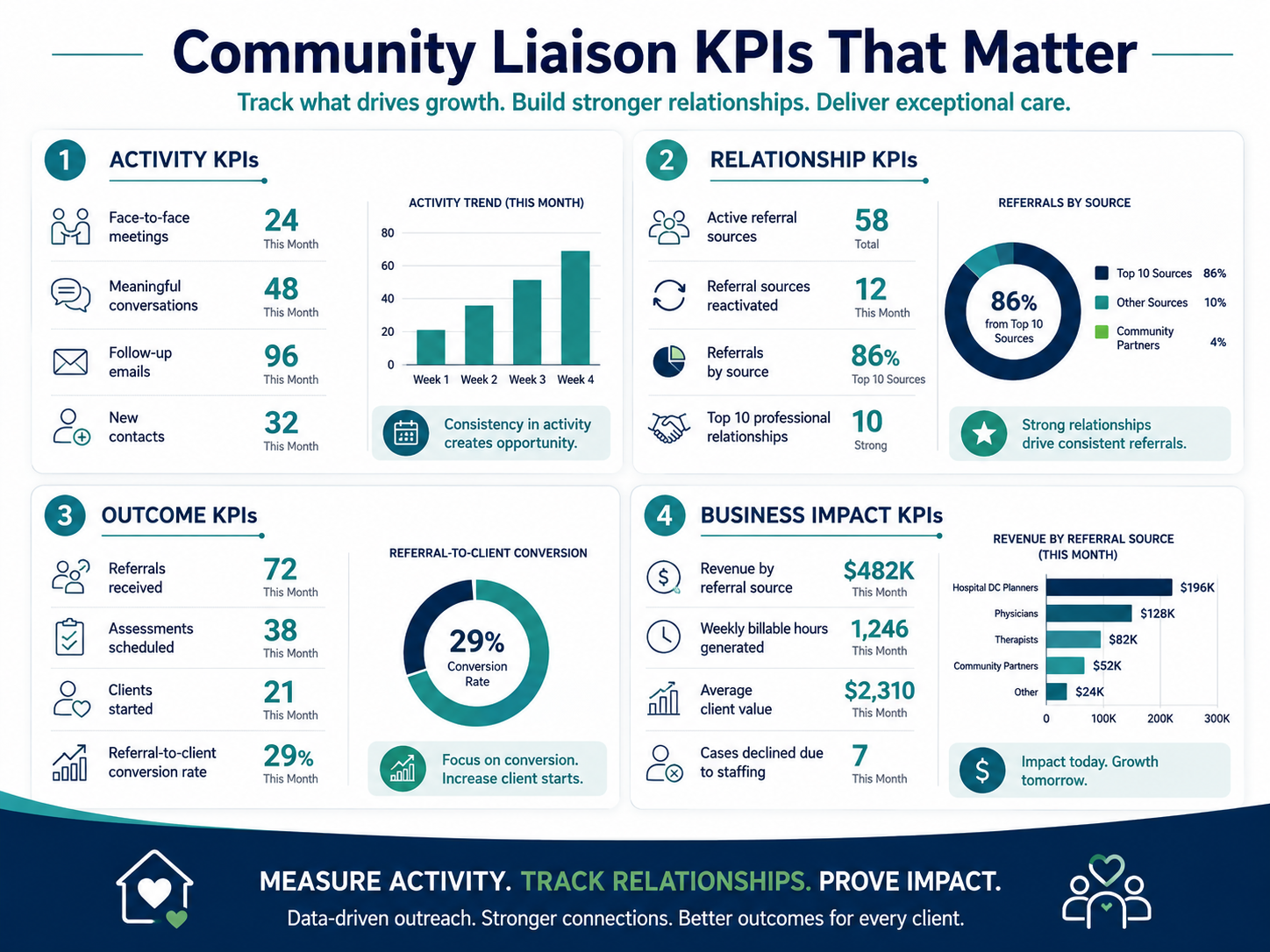
One of the Most Important KPIs: Revenue by Referral Source
Imagine two professional relationships.
Referral Source A
Last quarter:
- 16 referrals
- 4 qualified
- 1 client
- 80 total service hours
- $3,000 revenue
Referral Source B
Last quarter:
- 5 referrals
- 5 qualified
- 4 clients
- 2,200 service hours
- $75,000 revenue
Which relationship deserves more attention?
Referral Source B.
Yet an agency measuring only the number of referrals could easily reach the wrong conclusion.
Track the entire path:
Referral source → Referral → Assessment → Client → Hours → Revenue
Measurement matters.
4:30 PM: Plan Tomorrow Before Going Home
A successful liaison does not wake up the next morning wondering:
“Where should I go today?”
Tomorrow's priorities should already be identified.
Choose:
Three Must-Do Relationships
These deserve meaningful attention tomorrow.
Three Follow-Ups
These conversations already started and need to continue.
One New Prospect
Keep building the future pipeline.
One Internal Issue
Perhaps operations needs to update you on staffing availability or the outcome of a referral.
Then stop.
The goal is not to work 14-hour days.
The goal is to build a repeatable system.
What Does an Excellent Referral-Source Conversation Sound Like?
A good sales conversation should not feel like a sales presentation.
It should sound more like this:
Liaison: “What kind of situations are creating the biggest headaches for your team right now?”
Referral Partner: “We're having a terrible time with Friday afternoon discharges. Families say they'll manage over the weekend and then panic.”
Liaison: “That makes sense. Is the bigger challenge usually getting someone there quickly, or families understanding that they actually need help?”
Referral Partner: “Both. Sometimes we know they shouldn't be going home alone.”
Liaison: “We may be able to help. We have a process specifically for rapid discharge situations. I don't want to promise that every case can be staffed, but if you call us early, our team can usually tell you very quickly whether we can help. Would it be useful if I brought you a one-page sheet explaining that process?”
That conversation accomplished several things.
The liaison:
- Asked about a problem.
- Listened.
- Clarified the problem.
- Connected a relevant solution.
- Avoided making unrealistic promises.
- Created a next step.
That is excellent sales strategy.
What Successful Community Liaisons Do NOT Do
High-performing liaisons generally avoid several common habits.
They Don't Spend the Entire Day Dropping Off Items
Cookies are not a sales strategy.
Neither are:
- Pens
- Notepads
- Candy
- Stress balls
- Coffee cups
- Brochures
There is nothing inherently wrong with thoughtful promotional items.
But they should support a relationship, not substitute for one.
They Don't Treat Every Referral Source Equally
Time is limited.
Some relationships deserve considerably more investment than others.
They Don't Ask for Referrals Every Time They Visit
If every interaction translates to:
“Got anybody for me?”
the relationship becomes exhausting.
Bring value.
They Don't Disappear After Receiving a Referral
Referral partners notice what happens after they trust you with someone.
They Don't Sell Cases the Agency Cannot Staff
Short-term pressure can destroy long-term credibility.
They Don't Keep Their Activity in Their Head
Use the CRM.
They Don't Confuse Networking With Selling
Networking creates connections.
Business development converts relevant connections into trusted professional relationships.
There is a difference.
Become Known for Something
One of the most effective sales strategies for home care agencies is positioning.
Ask:
What do we want referral partners to associate with our agency?
Not ten things.
One or two memorable things.
Maybe:
“They're excellent with dementia.”
Or:
“Call them when you have a complicated discharge.”
Or:
“They're great with Parkinson's families.”
Or:
“They communicate extremely well.”
Or:
“If they say they can staff it, they actually staff it.”
Or:
“They're the company I trust with my difficult private-pay families.”
That is a stronger market position than:
“We provide compassionate care and treat every client like family.”
Every competitor says that.
Own something.
Education Is One of the Best Community Liaison Sales Tools
Educational content gives a liaison reasons to communicate without constantly asking for business.
Develop useful resources around problems referral partners encounter.
For example:
- The Family Guide to Dementia Care at Home
- Hospital-to-Home Discharge Checklist
- 10 Signs an Older Adult May Need Help at Home
- Home Care vs. Home Health
- Paying for Home Care
- Understanding 24-Hour Care
- How to Talk to a Parent Who Refuses Help
- Parkinson's Care at Home
- Fall Prevention Checklist
- Family Caregiver Burnout Guide
- Veterans Home Care Benefits Overview
- Questions to Ask a Home Care Agency
These resources can be used during:
- Sales visits
- Lunch-and-learns
- Email follow-up
- Newsletters
- Social media
- Professional networking
- Website content
- Consumer education
This is where digital marketing and in-person sales for home care begin reinforcing each other.
The liaison hears the questions.
Marketing creates the resources.
SEO helps families discover the resources.
Social media distributes them.
Referral partners share them.
The liaison uses them to deepen relationships.
That is an integrated growth system.
The Community Liaison Should Work With Marketing—Not Separately From It
The liaison is one of the best sources of content ideas in the company.
Why?
Because they hear market questions every day.
If the liaison repeatedly hears:
“Does Medicare pay for this?”
Marketing should create content about it.
If hospitals constantly ask about same-day care:
Create a rapid-start page or resource.
If elder law attorneys encounter families struggling with dementia:
Create dementia educational content.
If assisted living communities have residents who need additional one-on-one care:
Explain how supplemental private-duty care works.
This improves:
- Website content
- SEO
- AI Search visibility
- Newsletters
- Social media
- Email nurturing
- Sales collateral
The strongest community liaison does not operate in a silo.
Their field intelligence should influence the entire home care marketing strategy.
Professional Referral Development Takes Time
A common mistake is expecting an immediate referral after a first meeting.
Professional trust does not usually work that way.
The referral source may need to:
- Meet you.
- Remember you.
- Understand what you do.
- Believe your agency is capable.
- Encounter an appropriate situation.
- Trust you enough to recommend your agency.
- See what happens after the referral.
That may take multiple interactions.
The question is therefore not:
“Why haven't they referred yet?”
The better question is:
“Have we earned enough trust to be considered when the right situation occurs?”
A Weekly Rhythm for a Successful Community Liaison
The exact schedule will vary by territory, but a productive week should contain a balance of:
Existing High-Value Referral Sources
Protect the relationships already producing business.
Developing Referral Sources
Continue moving promising relationships forward.
New Prospecting
Do not allow the pipeline to become dependent on five existing sources forever.
Follow-Up
A large portion of sales success is won here.
Education
Lunch-and-learns, professional presentations, webinars and resources build authority.
Networking
Participate strategically in organizations where useful relationships exist.
CRM and Reporting
Document activity and measure outcomes.
Internal Meetings
Coordinate with scheduling, recruiting, care management and ownership.
The liaison's calendar should reflect this balance.
If 90% of the week consists of driving to random businesses, the sales system needs work.
The 10 Questions Every Community Liaison Should Be Able to Answer
At any given time, a successful liaison should know:
- Who are my top 10 referral sources?
- How many referrals has each sent?
- How many became clients?
- How much revenue has each source generated?
- Which referral relationships are growing?
- Which relationships have gone quiet?
- Which new organizations am I actively developing?
- What problems are referral partners talking about most often?
- What types of cases can my agency accept right now?
- What are my three most important sales priorities this week?
If those answers are readily available, the liaison is managing a territory.
If they are not, the liaison may simply be driving around in it.
Excellence in Sales for Home Care Agencies Means Becoming Trusted Before the Referral Happens
The most successful community liaison is not necessarily:
- The most charismatic
- The loudest
- The person attending the most networking events
- The person distributing the most brochures
- The person buying the most lunches
The strongest liaison becomes known as someone who:
Shows up.
Listens.
Understands the problem.
Responds quickly.
Does what they promise.
Communicates.
Follows through.
Brings useful information.
Connects people with resources.
Knows when their agency can help—and when it cannot.
That creates professional trust.
And professional trust creates referrals.
The Real Goal of a Community Liaison
A community liaison's job is not to collect business cards.
It is not to accumulate miles.
It is not to fill a CRM with meaningless activity.
It is not to make referral sources feel guilty for not sending business.
And it certainly is not to become known as the person who arrives every Thursday carrying cookies.
The real job is to make the home care agency easier to know, trust, remember and refer.
That requires strategy.
It requires measurement.
It requires persistence.
It requires genuine relationships.
And it requires understanding that each referral is not simply a sales opportunity.
Behind the referral is usually a family trying to solve a difficult problem involving someone they love.
The best community liaisons never lose sight of that.
When sales strategies for home care agencies combine professional relationship development, excellent follow-up, useful education, operational reliability and meaningful KPI tracking, community outreach becomes something much more powerful than marketing.
It becomes a sustainable source of growth.
And that is what excellence in community liaison sales looks like.
Frequently Asked Questions About Home Care Community Liaisons
What does a community liaison do for a home care agency?
A home care community liaison develops and maintains relationships with professionals and organizations that may encounter families needing in-home care. These may include hospitals, rehabilitation facilities, home health agencies, hospice organizations, senior living communities, physicians, Aging Life Care Professionals, elder law attorneys and other community partners. The liaison educates referral sources, identifies opportunities, follows up on referrals and tracks the relationships that produce clients.
How many sales visits should a home care community liaison make each day?
There is no ideal number that applies to every territory. Quality matters more than raw visit volume. Five meaningful conversations with relevant referral partners may be considerably more valuable than 15 brochure drop-offs. Agencies should measure both activity and outcomes such as referrals, assessments, clients and revenue.
What KPIs should a home care community liaison track?
Important KPIs include face-to-face meetings, meaningful conversations, new referral contacts, follow-ups, referrals received, qualified referrals, assessments, new clients, referral-to-client conversion rate, active referral sources and revenue generated by referral source.
Who are the best professional referral sources for home care?
Potential referral sources include hospital social workers and case managers, rehabilitation facilities, skilled nursing facilities, home health agencies, hospice organizations, assisted living communities, memory care communities, physicians, Aging Life Care Professionals, elder law attorneys, senior organizations and other professionals working with older adults. The best sources vary based on the agency's service model, geography, payer mix and ideal client.
How can a community liaison get more home care referrals?
Focus on becoming useful to referral partners rather than repeatedly asking for referrals. Learn which problems they encounter, explain clearly which problems your agency can solve, follow up consistently, provide educational resources, respond quickly when referrals occur and communicate professionally throughout the process.
Should a home care liaison use a CRM?
Yes. A CRM helps the liaison document contacts, conversations, follow-up dates, referral history and next steps. It also helps agency leadership connect business-development activity with referrals, admissions and revenue.
How often should a community liaison visit referral sources?
Frequency should depend on the value, potential and maturity of the relationship. High-value partners may deserve frequent contact, while developing prospects may require a different cadence. The objective is consistent, useful communication—not visiting simply to satisfy an activity quota.
Do lunch-and-learns work for community liaison sales?
They can work extremely well when they are genuinely educational. Topics should solve problems for the audience rather than become extended presentations about the home care agency. Dementia, hospital discharge planning, family caregiver burnout, paying for home care and recognizing when additional help is needed are examples of useful topics.
What is the difference between networking and referral development?
Networking creates connections. Referral development turns appropriate connections into trusted professional relationships. A networking event may introduce the liaison to an elder law attorney. Referral development is everything that happens afterward to understand the attorney's clientele, demonstrate value, maintain the relationship and ultimately become a trusted resource.
What makes someone excellent at sales in home care?
The strongest sales professionals in home care combine relationship skills with discipline. They understand their market, ask good questions, listen, communicate clearly, follow up consistently, use a CRM, understand agency capacity, track KPIs and focus on solving problems for referral partners rather than simply promoting services.