
How to Build a Home Care Agency That Lasts: Mark McDermott on Sales, Growth, and Grit

Annette ZieglerLead Sales and Marketing TrainerSeptember 24, 2026
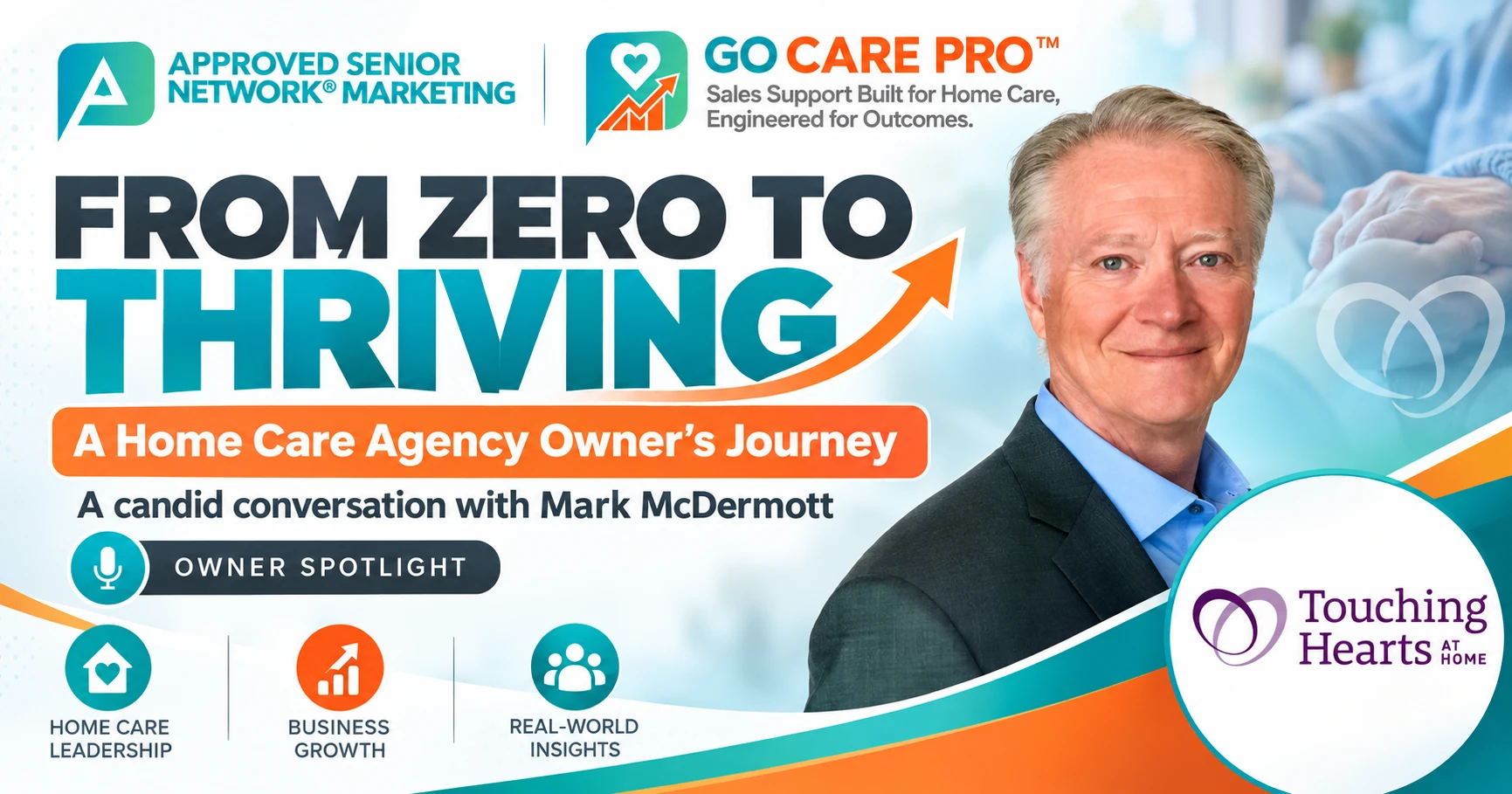
There is a big difference between opening a home care agency and building one that can grow, survive difficult years, develop strong referral relationships, and operate successfully without the owner doing absolutely everything.
Mark McDermott knows that difference well.
Mark entered the home care industry in 2007 with his brother, Tom, through the Touching Hearts franchise system. Before home care, his career had taken him through labor and employment law, corporate human resources (including serving as Director of HR at Converse), and a family manufacturing business.
But home care eventually became personal.
Mark's mother battled ovarian cancer, giving him his first close look at what receiving care at home could actually mean for a family. He saw some caregivers provide extraordinary support. He also saw care that fell short.
That experience helped shape his commitment to building a company known for providing excellent care.
Today, Mark and his team operate four offices across New York State in Rochester, Buffalo, Syracuse, and Albany, with approximately 300 clients and close to 400 caregivers.
His growth did not happen because he discovered a secret marketing tactic.
It happened through focus, relationships, sales discipline, strong people, operational execution, and a lot of perseverance.
Here are some of the biggest lessons Mark has learned along the way.
Lesson #1: Home Care Owners Need to Get Out Into the Community
One of Mark's strongest recommendations for new home care owners is simple:
Do not remove yourself from sales and relationship development too early.
Even if you eventually hire a full-time salesperson, the owner should understand the local senior care ecosystem.
Who are the care managers?
Who are the discharge planners?
Who are the social workers?
Which skilled nursing and rehabilitation facilities consistently discharge people who may need help at home?
Who in the community actually influences a family's decision about home care?
Mark and his brother initially hired people to handle care management, scheduling, and administrative responsibilities while they focused heavily on developing relationships in the community.
That early investment delayed profitability somewhat, but Mark believes it also created the foundation they needed for future growth.
And those relationships eventually began to compound.
By roughly their third year in business, Mark noticed something changing. People were calling Touching Hearts because they had "heard about them," even when they could not remember exactly where.
That was evidence that years of relationship-building were beginning to work.
Lesson #2: Focus Beats Trying to Market Everywhere
If Mark could go back and give his younger self one piece of advice, he could summarize it in one word:
Focus.
Like many new home care owners, Mark and his brother initially looked for leads almost everywhere.
They spent money on direct-to-consumer advertising. They visited senior centers. They pursued opportunities that seemed promising simply because there was a possibility a client might come from them.
Over time, Mark realized that an agency owner only has so many hours available.
And not all marketing activities deserve the same amount of those hours.
The better strategy is to identify referral sources that repeatedly encounter older adults who need home care and concentrate efforts there.
Or, as Mark put it during the interview:
Fish where the big fish are.
The Referral Sources That Produced Mark's Best Home Care Leads
After years of tracking referral activity, Mark identified several categories that consistently produced strong opportunities.
1. Geriatric Care Managers and Care Management Professionals
These have produced some of the highest-quality leads for his organization.
Care managers frequently become involved in complicated situations involving seniors with significant care needs. Home care may be only one part of the solution they are coordinating, but because they already understand the family and the situation, their referral can carry substantial trust.
The volume may not always be enormous.
The quality can be.
2. Skilled Nursing and Short-Term Rehabilitation
Discharge planners and social workers within skilled nursing facilities and rehabilitation settings are another major focus.
These professionals regularly work with patients who are transitioning home and may suddenly need assistance with personal care, supervision, mobility, meals, or other activities of daily living.
3. Continuing Care Communities
Mark also highlighted continuing care communities.
One strong relationship can sometimes lead to introductions to multiple professionals responsible for care coordination and discharge planning throughout the organization.
Interestingly, Mark said his team had less success than expected with elder law attorneys and financial planners.
They certainly can refer.
But in his experience, many attorneys and financial professionals first refer families to private care managers, who then help determine which home care provider should be involved.
The lesson isn't that those professionals should be ignored.
It is that a home care agency must prioritize.
Lesson #3: Networking Is Not the Same as Selling
One of the biggest mistakes home care agencies make is assuming someone who is excellent at networking will automatically be excellent at generating referrals.
Mark learned otherwise.
There are people who are wonderful at community relations.
They attend every event.
Everybody knows them.
They build friendships.
They are highly visible.
But that does not necessarily mean they know how to move a professional relationship toward a referral.
Mark now looks for what he describes as more of a sales mentality than a marketing mentality.
The right person needs to be able to both farm existing relationships and hunt for new business.
That means:
- Identifying high-value targets
- Following up consistently
- Asking meaningful sales questions
- Creating next steps
- Returning repeatedly to important referral sources
- Tracking activity
- Asking for the opportunity to help
- Being accountable for actual results
Community visibility matters.
But visibility alone does not grow a home care agency.
Lesson #4: Mark Wishes He Had Hired a Salesperson Sooner
Mark and his brother handled sales themselves for years.
In retrospect, he believes they waited too long to hire a dedicated salesperson.
They did not make that hire until roughly year five or six.
Mark believes that was a mistake.
He would still encourage an owner to spend the early years personally learning the market, meeting referral sources, and understanding how business development works.
But once the owner understands the local market well enough to manage a salesperson effectively, adding professional sales capacity can be one of the best investments the agency makes.
In fact, when asked about his best investments over the years, Mark came back to people, particularly good salespeople.
Home care is not an industry where buying one piece of technology suddenly gives you an unbeatable advantage.
It is an execution business.
And execution requires good people.
Lesson #5: Stop Hiring Salespeople Based on Who They Claim to Know
Almost every experienced home care owner has heard this in an interview:
"I know everybody."
Or:
"I can bring all my referral relationships with me."
Mark has heard those promises too.
His experience has made him skeptical.
People frequently overestimate how much business will actually follow them to a new organization.
Today, Mark is more interested in a candidate's proven sales ability.
He looks for people who have:
- Worked in true sales environments
- Been accountable for results
- Prospected for new business
- Used a CRM
- Tracked sales activity
- Received professional sales training
- Demonstrated a history of producing results
Industry experience can certainly help.
But a real salesperson from outside the senior care industry may ultimately be more effective than an experienced community relations person who has never actually had to generate measurable sales results.
Lesson #6: Qualified Leads Matter More Than Activity Alone
As Touching Hearts grew, Mark's sales management became increasingly data driven.
If he had to choose one KPI above the others, he would look at:
Qualified leads directly attributable to the salesperson's activity.
His teams also monitor metrics such as:
- New referral sources
- New clients from new sources
- Scheduled meetings
- Presentations
- Sponsorships
- Drop-by visits
- Overall lead volume
Executive directors review sales activity frequently, and the company holds regular meetings to discuss what happened during the previous week and what is planned for the next.
Activity matters.
But eventually, activity has to produce something.
Mark's philosophy when hiring a new salesperson is also realistic.
During the first three months, he is evaluating fit, ethics, work ethic, and whether the person is completing the correct activities.
He does not expect a new salesperson to immediately pay for themselves.
Between three and six months, however, he wants to see evidence that new relationships are generating opportunities.
If all the right activity is happening and no results are appearing, it may no longer be an activity problem.
It may be an effectiveness problem.
Lesson #7: Treat Every New Inquiry Like Someone Just Handed You Gold
Families looking for home care often move quickly.
A hospitalization happens.
A parent falls.
Someone is coming home from rehabilitation.
A family realizes Mom cannot safely stay alone anymore.
The agency that responds quickly has a major advantage.
Mark's goal is to move a phone call or online inquiry toward a face-to-face meeting as quickly as possible.
His team tries to schedule an intake within a day or two and has worked operationally to be capable of beginning new cases extremely quickly, even large cases requiring around-the-clock care.
Mark described the right mindset perfectly:
When an inquiry arrives, everyone in the agency should react as though someone just walked through the door holding a piece of gold.
Because that inquiry is extraordinarily valuable.
The initial conversation also does not need to become an interrogation.
Gather the critical information.
Make a human connection.
Understand the immediate problem.
Then move toward the assessment.
Families in crisis don't want to answer 47 questions before they know whether you can help them.
Lesson #8: You Don't Have to Be the Cheapest Home Care Agency
Early in the business, Mark wanted Touching Hearts to remain very price competitive.
Over time, that changed.
He became comfortable being one of the more expensive agencies in the market.
Why?
Because when a trusted referral professional tells a family, "This is the company I think you should use for your mother," a small hourly price difference becomes significantly less important.
But premium pricing has to be supported by premium execution.
Mark's organization invests in caregivers.
They pay competitively.
They offer benefits.
Those investments cost money.
His philosophy is that owners often leave money on the table because they are too afraid of being priced slightly above a competitor.
Competing solely on price can eventually damage the very quality that differentiates the agency in the first place.
Lesson #9: Growth Is Not Always a Straight Line
Even successful agencies experience bad years.
Mark remembers periods when revenue declined year over year and he could not clearly explain why.
That uncertainty was stressful.
Had the company upset an important referral source?
Was the sales strategy failing?
Was something happening in the community that leadership did not know about?
Looking back, Mark believes there is some natural variability in home care.
Maybe the agency received fewer large 24-hour cases.
Maybe an important referral source changed jobs.
Maybe several unusually large clients ended services during the same period.
A temporary decline does not necessarily mean the agency is fundamentally broken.
Mark's answer is to return to the fundamentals and keep executing.
That requires one characteristic every home care owner eventually develops:
Grit.
Lesson #10: When Growth Stalls, Diagnose Before You Guess
Sometimes a plateau is random.
Other times, something inside the business really is broken.
Mark recommends looking deeper before simply deciding the agency needs more advertising or another salesperson.
Ask:
Are our caregivers happy?
Are our office employees happy?
Are our clients satisfied?
How do we know?
Are our referral sources still happy with our service?
How is the salesperson perceived in the community?
Are leads being handled properly?
Is the problem a person?
Is it a process?
Is it both?
As an agency grows, the owner can no longer rely entirely on intuition.
Eventually, you will not personally know every caregiver.
You will not personally know every client.
You may not know every referral source.
That means surveys, KPIs, CRM data, recurring meetings, reporting systems, and strong managers become increasingly important.
What worked when there were 10 clients will not necessarily work when there are 300.
The Hardest Part of Home Care Ownership Is Often the People
When Mark was asked what no one warns you about when you own a home care agency, his answer wasn't regulation, scheduling software, cash flow, or marketing.
It was disappointment.
A caregiver you trusted doesn't show up.
A promising new employee quits.
A team member gives you inaccurate information.
Someone makes a decision that is inconsistent with the standards of the organization.
Those moments can be devastating for an owner who cares deeply about the business.
And yet the opposite is also true.
The right people can transform a company.
Mark credits much of Touching Hearts' success to the strong leaders, office staff, salespeople, and caregivers who have helped build the organization.
Some members of his Rochester team have now been with the company for 15 years.
That kind of longevity doesn't happen accidentally.
Home Care Growth Requires Sales AND Operations
Perhaps the most important lesson from Mark's story is that home care agencies cannot market their way out of poor operations.
You can generate leads.
You can hire a salesperson.
You can visit every rehabilitation center in town.
You can build an incredible website.
But if clients receive poor care, caregivers are unhappy, phones aren't answered, new cases cannot be staffed, or referral partners stop trusting the agency, marketing will eventually stop working.
At the same time, having wonderful caregivers and excellent operations isn't enough if nobody in the community knows the agency exists.
The two sides have to work together.
Great sales create opportunities.
Great operations turn those opportunities into a reputation.
A great reputation creates more referrals.
And over time, that cycle is what builds a durable home care company.
Mark McDermott's Advice to the Home Care Owner Who Is Just Starting
- Put the right systems in place.
- Get into the community immediately.
- Never completely stop recruiting caregivers.
- Never completely stop marketing.
- Know which referral sources matter most.
- Track what your salespeople are actually doing.
- Respond to inquiries with urgency.
- Invest in good people before your own workload becomes impossible.
- And when growth temporarily slows down, don't abandon the fundamentals that built the business.
Home care may sometimes feel like a crazy train.
But as Mark's experience demonstrates, focus, strong people, disciplined execution, and perseverance can take an agency a very long way.
Mark's team built its formal sales program through GoCarePro sales training for home care agencies.