
Home care marketing and sales KPIs: how to know whether your marketer is actually creating growth

Dawn FialaHome Care Expert, Sales and OperationsAugust 20, 2026
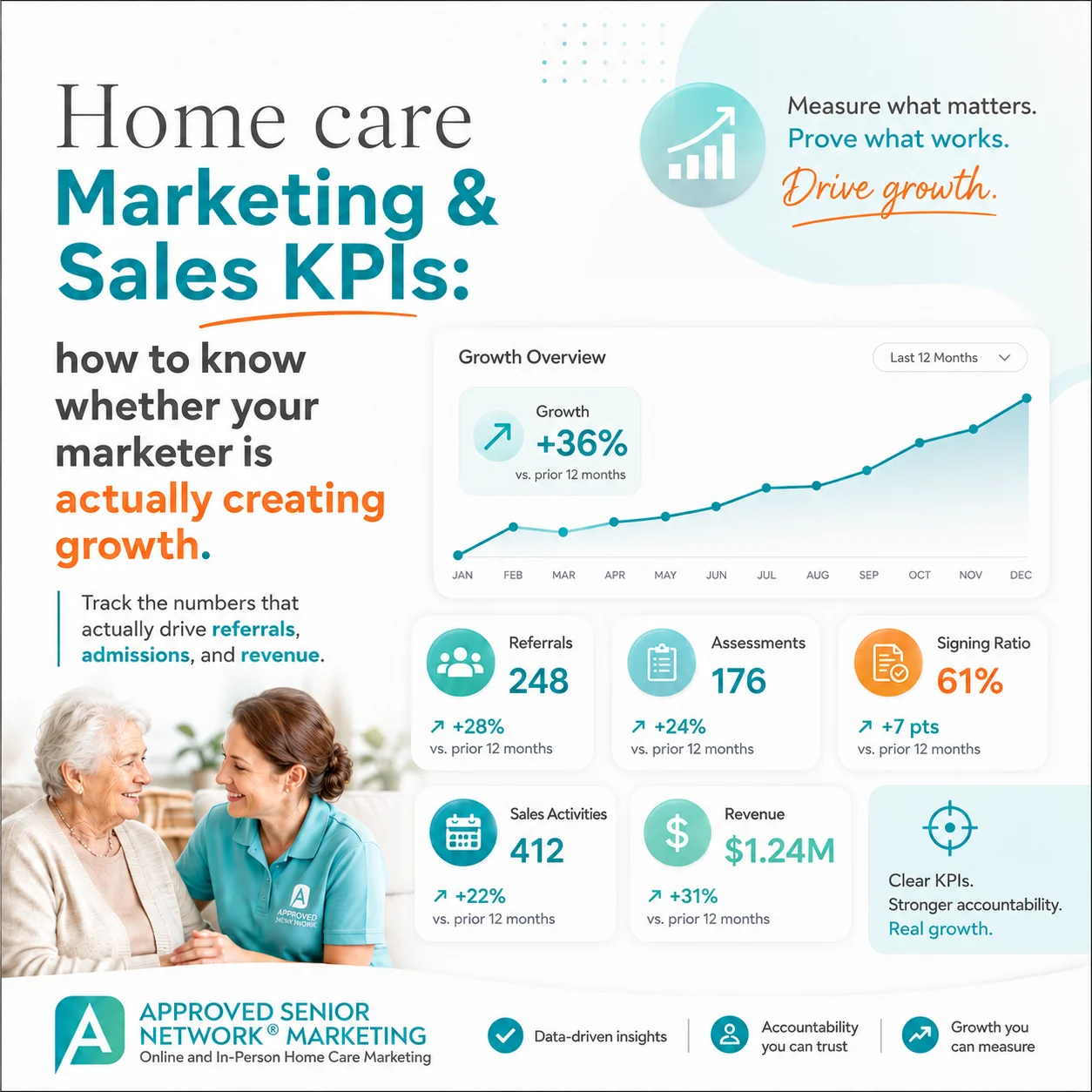
TL;DR: Home care marketing and sales performance should not be judged by how busy a marketer looks. The right KPI system connects field activity to relationships, referrals, assessments, signed clients, hours of care, and revenue. Track both leading indicators, the actions your team can control, and lagging indicators, the business outcomes those actions should create. Approved Senior Network's GoCarePro approach is built around a simple principle: activity matters only when it moves a referral relationship or sales opportunity forward.
The problem with measuring home care marketing and sales by activity alone
A home care marketer can have a full calendar and still produce very little growth.
They can visit facilities, attend networking events, drop off brochures, send emails, make calls, and post on LinkedIn. All of that may be useful. None of it proves the activity is creating qualified referrals or new clients.
That is why home care owners need a sales scorecard, not an activity diary.
The scorecard should answer four questions:
- Are we consistently doing the right sales activities?
- Are those activities creating stronger referral relationships?
- Are those relationships producing qualified opportunities?
- Are those opportunities becoming clients and revenue?
GoCarePro teaches home care marketers to plan routes, track referral sources, ask for the business, measure results, and continuously improve the process. That is the operating system behind GoCarePro sales training, and it is the sales half of the two-playbook system in marketing to referral sources vs. families.
Start with leading and lagging indicators
The easiest way to build a useful KPI system is to separate leading indicators from lagging indicators.
Leading indicators
Leading indicators measure behaviors your salesperson can control today.
Examples include:
- Priority referral-source touches
- Face-to-face conversations
- New qualified referral accounts added
- Follow-up tasks completed
- In-services or lunch-and-learns scheduled
- In-services completed
- Direct asks for the business
- Service inquiries contacted
- Assessments scheduled
Lagging indicators
Lagging indicators measure the outcomes those behaviors eventually produce.
Examples include:
- Referrals received
- Qualified referrals
- Assessments completed
- New clients signed
- New weekly care hours
- Private-pay revenue
- Referral-source conversion rate
- Inquiry-to-assessment rate
- Assessment-to-client signing rate
Owners often make one of two mistakes: they measure only activity, or they measure only revenue.
If you measure only activity, a salesperson can look productive without producing results. If you measure only revenue, you discover problems too late to coach them effectively.
You need both.
The home care marketing and sales KPI funnel
Use this funnel to organize your numbers:
| Stage | KPI | What it tells you |
|---|---|---|
| Territory | Priority accounts | Whether the marketer knows where growth should come from |
| Activity | Meaningful touches | Whether the plan is being executed |
| Access | Face-to-face conversations | Whether the marketer is getting beyond drop-offs |
| Relationship | Qualified active accounts | Whether real relationships are forming |
| Opportunity | Referrals received | Whether relationships are turning into business |
| Sales | Assessments scheduled | Whether opportunities are being advanced |
| Conversion | Clients signed | Whether the sales process is working |
| Economics | Hours/revenue added | Whether sales activity is creating business value |
The word meaningful matters. A quick lobby drop-off and a 20-minute conversation with a discharge planner are not equal events.
The five KPIs every home care owner should review
You can track dozens of fields. Start with five.
1. Qualified referral-source conversations
Do not count every building entered as a win.
Count the number of actual conversations with people who can influence referrals: discharge planners, social workers, case managers, senior living leaders, care coordinators, elder-law professionals, home health or hospice partners, and other appropriate contacts.
This metric shows whether the marketer is creating access.
2. Direct asks for the business
Relationship-building is important, but a relationship without a next step can remain a pleasant professional friendship forever.
Track how often the salesperson actually asks for an opportunity.
Examples:
- "Who are you working with right now who may need extra support at home?"
- "Can I be your first call when a family needs private-duty home care?"
- "Is there an upcoming discharge where our team could make the transition easier?"
GoCarePro explicitly trains marketers to ask for the business rather than relying on vague "checking in."
3. Referrals by source
Every referral should have a source.
Not "professional referral." Not "word of mouth." Not "other."
Record the actual account and, when possible, the actual professional.
Example:
Weak: Skilled nursing facility
Better: Oak Ridge Rehab, Jane Smith, social worker
That lets management see which relationships are producing and which ones are consuming time without movement.
4. Referral-to-assessment conversion
Formula:
Assessments scheduled ÷ qualified referrals = referral-to-assessment rate
If referrals are increasing but assessments are not, the problem may not be field marketing. It may be response time, intake skills, family follow-up, eligibility, service availability, or how the inquiry is being handled.
That distinction keeps management from coaching the wrong problem.
5. Assessment-to-client signing rate
Formula:
New clients signed ÷ completed assessments = assessment signing rate
This tells you whether your team is converting real opportunities after meeting the family.
If this number is weak, review:
- How the assessment is conducted
- Whether the assessor is recommending a clear care plan
- How price is discussed
- Whether objections are handled
- Whether next steps are explicit
- Whether follow-up happens after the assessment
GoCarePro's curriculum includes both asking for the referral and improving inquiry and assessment conversion because the two parts of the funnel affect each other.
Use GoCarePro activity targets as coaching targets, not industry benchmarks
Inside GoCarePro training, participants may work toward weekly execution targets such as 40-50 total touches/stops and 15-20 face-to-face interactions, depending on the training assignment and territory.
Those numbers are useful as structured training targets. They are not universal benchmarks for every home care marketing and salesperson in every market.
A compact urban territory is different from a rural territory. A salesperson responsible only for referral development has a different calendar than a marketer who also handles assessments, community events, recruiting, or operations.
The management question should be:
What level of activity is required in this territory to produce enough quality conversations, asks, referrals, assessments, and signed clients to reach our growth goal?
That is far more useful than blindly copying another agency's number.
Build a one-page weekly sales scorecard
A manager should be able to review the week in five minutes. A home care CRM makes the capture automatic instead of a Friday chore.
Activity
- Priority referral-source touches: ___
- Face-to-face conversations: ___
- New qualified accounts added: ___
- In-services scheduled/completed: ___
- Direct asks for business: ___
Results
- Referrals received: ___
- Qualified service inquiries: ___
- Assessments booked: ___
- Assessments completed: ___
- Clients signed: ___
- New weekly hours added: ___
Pipeline
- Top 5 accounts closest to producing: ___
- Accounts that stalled: ___
- Opportunities needing management help: ___
Next-week commitments
- Three priority accounts: ___
- One skill to improve: ___
- One specific outcome to create: ___
Diagnose problems by where the funnel breaks
A KPI system becomes valuable when it tells you what to coach.
High activity, low face-to-face access
Likely problem:
- Poor account selection
- Gatekeeper difficulty
- Weak opening message
- Bad timing
Management action: Coach facility entry, relationship-building, and targeting.
Good access, few referrals
Likely problem:
- Marketer is not asking for business
- Value proposition is generic
- Follow-up is mostly "checking in"
- Relationship has no next step
Management action: Role-play the ask and improve value-based follow-up.
Good referrals, few assessments
Likely problem:
- Slow response
- Weak intake call
- Poor appointment-setting
- Service mismatch
Management action: Audit inquiry handling and response workflow.
Good assessments, few signed clients
Likely problem:
- Assessment process
- Weak recommendations
- Price/value conversation
- No confident close
Management action: Review assessment and signing skills.
Signed clients, weak hours or revenue
Likely problem:
- Case mix
- Short schedules
- Wrong target accounts
- High-value services are not being pursued
Management action: Revisit referral strategy and ideal-case profile.
The monthly owner-manager sales meeting
Do not spend the meeting reading every activity line.
Use this agenda:
- What did we say we would accomplish last month?
- Which leading indicators improved?
- Which referral sources produced?
- Which opportunities were lost, and why?
- Where is the funnel breaking?
- What are the three most important accounts for the next 30 days?
- What skill does the salesperson need coaching on?
- What does management need to remove or fix?
This is consistent with the broader GoCarePro philosophy: training is only the beginning. Implementation, coaching, tracking, and accountability are what turn the training into behavior.
Frequently asked questions
What are the most important KPIs for a home care marketing and salesperson?
Start with qualified referral-source conversations, direct asks for business, referrals by source, assessments scheduled, clients signed, and new hours or revenue. Add activity metrics only when they help explain those results.
How many referral-source visits should a home care marketer make each week?
There is no universal number. GoCarePro uses structured weekly activity targets during training, including targets for overall touches and face-to-face meetings, but the right ongoing number depends on territory density, job responsibilities, account quality, travel time, and growth goals.
Should we pay bonuses based on number of visits?
Visit volume by itself can reward the wrong behavior. If compensation includes performance incentives, use a balanced model that considers meaningful activity plus qualified outcomes such as referrals, assessments, signed clients, hours, or revenue. Review employment and compensation rules with the appropriate professional before changing pay plans.
How often should sales KPIs be reviewed?
The salesperson should review activity and next steps weekly. Owners or sales managers should review the full funnel at least monthly, with more frequent coaching when a new salesperson is building habits.
What if our marketer is busy but referrals are flat?
Find the stage where the funnel breaks. High activity with low access is a targeting or entry problem. Good conversations without referrals may be a value or asking problem. Referrals without admissions point to intake or conversion. Diagnose before demanding "more activity."