
Marketing to referral sources vs. marketing to families: two playbooks, one agency

George NovosonCo-OwnerAugust 19, 2026
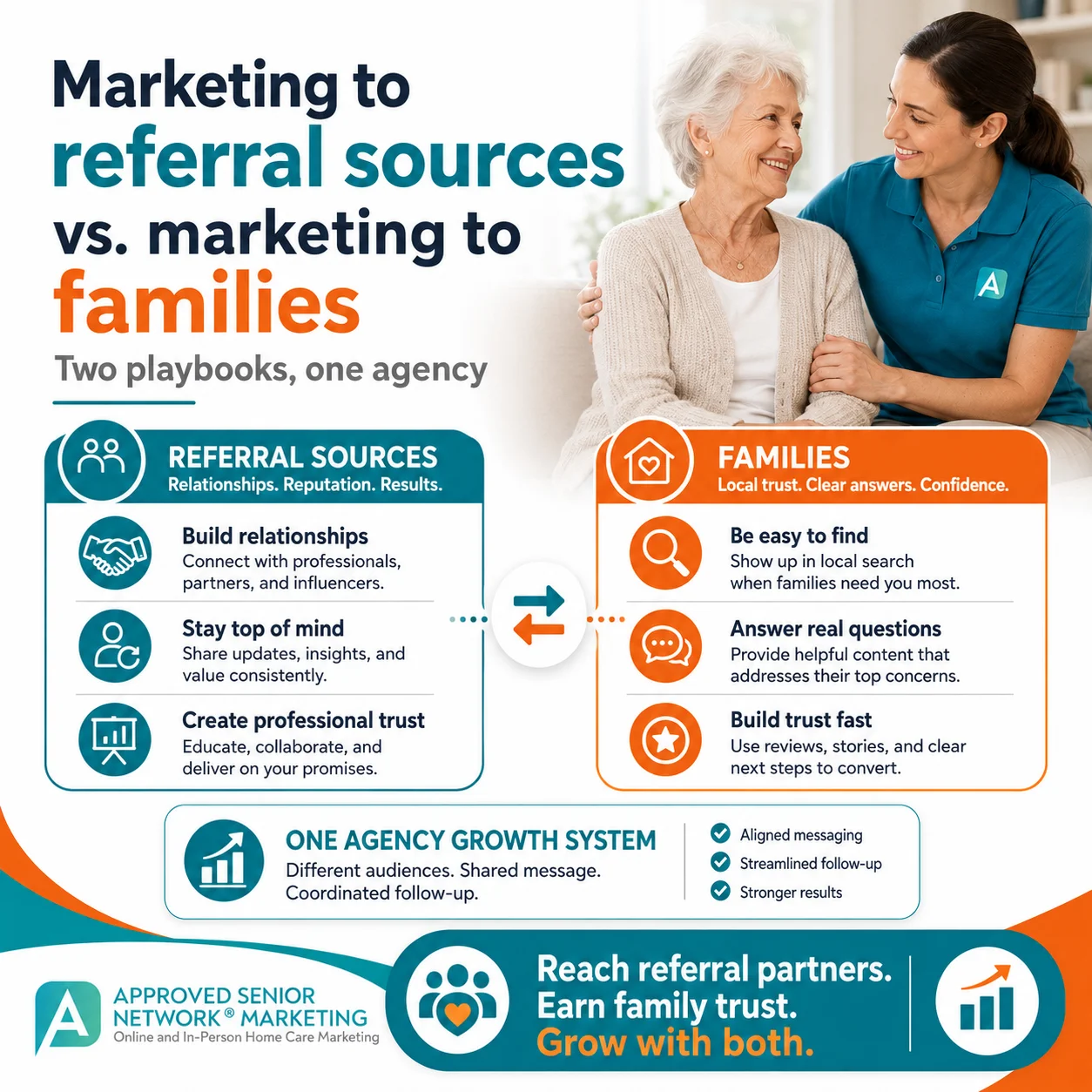
TL;DR: Families and referral sources can both create home care business, but they do not move through the same buying journey. Families need to discover the agency, understand care, trust the people, and find an easy next step. Referral sources need confidence that the agency can take appropriate cases, respond, communicate, and protect their relationship with the family. Approved Senior Network recommends one brand with two playbooks: shared proof and content, different outreach motions, and a structured feedback loop between marketing and the community liaison. For the referral side in depth, see home care referral development.
The two audiences start in different places
A family may begin with:
- Maps
- ChatGPT or another AI search tool
- A friend or relative
- A hospital list
- A review site
- A guide or article
A referral source may begin with:
- A client or patient who needs help now
- A previous successful referral
- A relationship with the liaison
- A service gap
- A discharge problem
- A specialty need
Both ask:
Can this agency help?
But the evidence they need is different.
That is why home care marketing and referral development should reinforce one another without being treated as one activity. The broader home care marketing pillar explains how those channels fit into the full growth system.
The family playbook
A family-facing system should help people move through five stages.
1. Discover
Can the family find the agency in the places they search?
Tools:
- Google Business Profile
- Local SEO
- Service pages
- Location pages
- AI-search visibility
- Reviews
2. Understand
Can the family quickly understand:
- What services are offered?
- Where care is provided?
- What situations the agency handles?
- How care starts?
Tools:
- Website
- Service pages
- FAQs
- Guides
- Videos
3. Trust
Can the family see proof?
Tools:
- Reviews
- Team bios
- Real photography
- Process explanations
- Credentials
- Expert content
4. Act
Is the next step easy?
Tools:
- Tap-to-call
- Short form
- Text/chat when appropriately managed
- Consultation request
- Guide download for people not ready to call
5. Follow up
Does the agency stay connected appropriately?
Tools:
- CRM
- Email nurture
- Assigned tasks
- Helpful resources
The referral-source playbook
Referral sources often care about operational confidence.
They may want to know:
- Will you answer?
- Do you serve this area?
- Can you staff this type of case?
- Do you understand the care situation?
- Will you communicate with the family?
- Will you follow through?
- Will referring to you make me look helpful or create more work for me?
The community liaison's job is not to distribute brochures. It is to become useful and memorable around appropriate cases.
GoCarePro supports that sales and referral-development side of the business.
For the complementary field strategy, link this article to the in-person business development post in the Sales Training category when the final URL is available.
Use shared assets differently
The best marketing assets can serve both audiences without pretending the audiences are identical.
| Asset | Family use | Referral-source use |
|---|---|---|
| Reviews | Trust before calling | Confidence in family experience |
| Service page | Understand care | Verify service fit |
| Dementia guide | Family education | Leave-behind / follow-up resource |
| Hospital discharge guide | Prepare for home | Tool for discharge planners |
| Paying-for-care guide | Understand options | Resource for elder-law/financial partners |
| FAQ article | Answer uncertainty | Support referral conversations |
| Positioning | Why choose us | When should I refer to you? |
This is the efficiency of one agency with two playbooks.
Build referral resources around real partner problems
ASN's connected-content model gives liaisons practical reasons to follow up.
Examples:
Rehab and hospital discharge teams
Useful resource:
- Hospital discharge and recovery support guide
Conversation: "We created a family guide that explains what to think about before a loved one comes home. Would this be useful for families who are worried about support after discharge?"
Memory care and dementia professionals
Useful resource:
- Dementia care at home guide
Conversation: "This may help families who are trying to keep a loved one at home longer or need support before a community transition."
Elder-law and financial professionals
Useful resource:
- Paying for home care guide
Conversation: "We built this to explain the major payment paths families often ask about. We keep the public benefit information sourced and current."
Caregiver support groups
Useful resource:
- Respite care and family caregiver relief guide
Conversation: "This is designed for families who know they are overwhelmed but do not know what respite support can look like."
The resource earns the follow-up. The relationship earns the referral.
Create a marketing-to-liaison handoff
Marketing should give the liaison:
- New guides
- New service pages
- New location pages
- Strong reviews
- New videos
- FAQ answers
- Local search insights
- Campaign talking points
The liaison should give marketing:
- Questions heard in the field
- Objections
- Competitors being mentioned
- Service gaps
- Priority facilities and organizations
- Towns with opportunity
- Changes in discharge or referral patterns
- Materials people actually request
This feedback loop is one of the most valuable sources of original content an agency has.
Use the referral intelligence form
After meaningful field visits, capture five fields:
- Organization/contact
- What problem are they seeing?
- What question did they ask?
- What resource would help?
- What is the next action?
Review those notes monthly with marketing.
If five referral sources ask the same question, that question may belong on the website.
If one service comes up repeatedly, it may deserve a new guide or stronger page.
If partners keep describing a competitor the same way, you just learned something about positioning.
Keep both audiences in one marketing plan
The home care marketing plan should name both audiences.
Family workstream
- Search visibility
- GBP
- Reviews
- Website content
- Guides
- Lead capture
- Follow-up
Referral-source workstream
- Target account list
- Visit/outreach cadence
- Educational resources
- Follow-up tasks
- Relationship notes
- Referral outcomes
Shared workstream
- Positioning
- Reviews
- Service definitions
- Guides
- Videos
- FAQs
- CRM reporting
One agency. Two buying journeys. One coordinated system.
Use different success metrics
Family marketing metrics may include:
- Qualified inquiries
- Assessments
- Admissions
- Cost per qualified inquiry
- Cost per admission
- Search visibility
- Guide downloads
Referral-development metrics may include:
- Target accounts reached
- Meaningful conversations
- Follow-up completion
- Active referral relationships
- Qualified referrals
- Admissions by referral source
Do not evaluate a hospital relationship using social-media engagement metrics.
The monthly alignment meeting
Use 30 minutes.
Marketing shares:
- New content and campaigns
- Search/AI visibility gaps
- Top-performing resources
- New reviews and proof
Liaison shares:
- Questions and objections
- Referral opportunities
- Competitive intelligence
- Resource requests
Together decide:
- Which topic should become next month's campaign?
- Which asset should be created or improved?
- Which referral source should receive it?
- Which family-facing page should link to it?
That is how online and in-person marketing stop competing for attention and start reinforcing each other.
Frequently asked questions
Which audience should a new agency focus on first?
Choose based on market opportunity, team strengths, service capacity, current visibility, and where the agency can build trust fastest. Many agencies need both, but the first 90 days should still have clear priorities.
Do referral sources look at our website?
Some do, and the families they refer often will. Treat the website as proof that supports the referral relationship, not as a replacement for it.
Should the liaison have marketing materials?
Yes, when the materials make the liaison more useful. Prioritize service-specific guides, FAQs, checklists, and proof over generic brochures.
How should marketing and sales share information?
Use a regular meeting and a shared system. Marketing supplies useful assets and visibility intelligence; the liaison supplies real market questions, objections, and referral patterns.
Should families and referral sources receive the same content?
They can share core assets, but the framing and next step should match the audience. A family may download a discharge guide for personal use; a hospital partner may use the same guide as a resource for multiple families.
ASN field-source note
This two-playbook model comes directly from Approved Senior Network's current connected-marketing approach: online visibility, website resources, reviews, CRM follow-up, and community liaison work are designed to reinforce one another rather than operate as separate campaigns.