
How Much Does Home Care Marketing Cost? 2026 Budget Guide

Valerie VanBoovenFounder and Co-OwnerSeptember 10, 2026
If you own a home care agency, you have probably heard wildly different answers to this question.
One person says to spend $500 a month on social media. Another says you need $5,000 a month in Google Ads. An SEO company recommends a year-long contract. A sales consultant tells you to forget digital marketing and hire a community liaison. Meanwhile, every proposal seems to define "marketing" differently.
So, how much does home care marketing really cost?
The short answer
As a practical 2026 planning range, an established, single-location home care agency should often expect to invest about $3,000 to $8,000 per month in outside marketing costs when it wants consistent, measurable growth. That may include strategy, content, local and AI-search visibility, advertising, reputation management, CRM tools, creative work, and sales support.
An agency pursuing aggressive growth, entering a highly competitive metro area, promoting several locations, or using substantial paid media may need $8,000 to $20,000 or more per month.
A newer or smaller agency can begin with $1,500 to $3,000 per month plus significant owner involvement, but it must focus. That budget usually cannot support a strong website, SEO, paid search, social advertising, content, CRM, reputation management, and referral development all at once.
When payroll for an internal marketer, community liaison, or sales director is included, many agencies should plan for a total marketing and sales-development investment of roughly 5% to 10% of gross revenue. An agency launching a new location or pursuing aggressive growth may temporarily invest more.
These are planning ranges, not promises and not an Approved Senior Network® price list. The correct number depends on your market, economics, goals, existing foundation, and capacity to accept new clients.
The more important question is not simply, "How much should I spend?" It is:
What must my agency invest to acquire the right clients profitably and consistently?
That question leads to a far better budget.
What counts as a home care marketing expense?
Before comparing your budget with another agency, make sure you are counting the same things.
Advertising is only one part of marketing. A complete home care growth budget may include:
- Marketing strategy and campaign management
- Website design, hosting, maintenance, and landing pages
- Local SEO and Google Business Profile work
- Content for traditional search and AI-assisted search
- Google Ads and other paid-search media
- Facebook and Instagram advertising
- Photography, video, graphic design, and printed materials
- Reviews and reputation management
- Email, text messaging, call tracking, and CRM software
- Community events, sponsorships, mileage, and referral-source materials
- Sales training and coaching
- Compensation, payroll taxes, incentives, and expenses for an internal marketer or community liaison
- Intake training and lead follow-up
- Analytics, reporting, and data cleanup
This distinction matters. One home care owner may say, "We spend $4,000 a month on marketing," but mean only paid advertising. Another may report the same amount while including SEO, software, content, and staff time.
Those are not comparable budgets.
When reviewing your own investment, use three separate categories:
| Budget category | What it includes | Why it matters |
|---|---|---|
| One-time foundation | Website build, brand work, photography, CRM setup, landing pages, tracking installation | Creates or repairs the assets every channel depends on |
| Recurring marketing | SEO, content, reputation, email, software, consulting, sales coaching, campaign management | Builds visibility, trust, follow-up, and consistency |
| Variable promotion | Google Ads, Meta ads, sponsorships, events, direct mail | Expands reach and can be increased or reduced based on capacity and results |
Track internal payroll and staff time separately, but include them when calculating the true cost of growth.
What percentage of revenue should a home care agency spend on marketing?
A useful starting framework is:
- 5% to 7% of gross revenue: An established agency focused primarily on maintaining visibility, reputation, referral relationships, and its existing market position
- 7% to 10% of gross revenue: An agency pursuing steady growth in its current service area
- 10% to 15% of gross revenue: A startup, new location, major expansion, turnaround, or agency pursuing aggressive growth for a defined period
This percentage should include the full marketing and sales-development system, not just ads.
The latest broad business research provides some context. The Spring 2026 CMO Survey reported that marketing expenses averaged 9.0% of company revenue across respondents. B2C service companies reported an average of 7.2%, while B2B service companies reported 10.1%. Companies with less than $10 million in annual revenue reported an average of 13.3%, although that subgroup was small and the research was not specific to home care.
Home care operates in both worlds. Agencies market directly to families like a B2C service company, while also developing professional referral relationships with hospitals, rehabilitation centers, senior living communities, home health agencies, hospice providers, physicians, elder law attorneys, care managers, and other organizations.
That is why a home care budget may need to support both digital visibility and in-person business development.
Do not treat any national percentage as a rule. Use it as a reasonableness check after calculating what your own growth plan requires.
What those percentages look like in real dollars
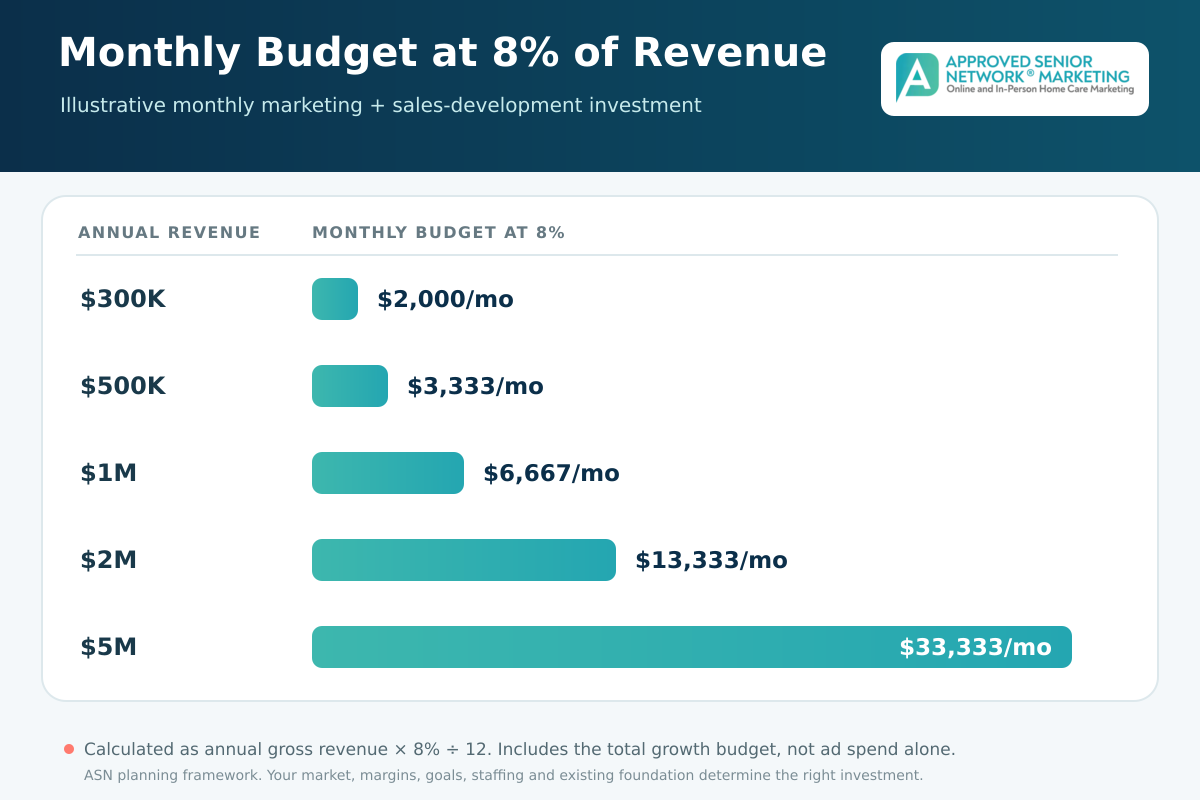
The table below converts three planning levels into monthly dollars. These totals should include internal marketing and sales payroll, outside vendors, advertising, software, materials, and related expenses.
| Annual gross revenue | 5% maintenance budget | 8% growth budget | 12% aggressive-growth budget |
|---|---|---|---|
| $300,000 | $1,250/month | $2,000/month | $3,000/month |
| $500,000 | $2,083/month | $3,333/month | $5,000/month |
| $1 million | $4,167/month | $6,667/month | $10,000/month |
| $2 million | $8,333/month | $13,333/month | $20,000/month |
| $5 million | $20,833/month | $33,333/month | $50,000/month |
At first glance, the higher numbers may feel surprising. Remember that this is the total growth budget. If a $2 million agency employs a full-time community liaison, that person's compensation, payroll costs, mileage, events, tools, and materials may consume a meaningful portion before the agency spends anything on its website, search visibility, or advertising.
Franchise owners should count mandatory brand-fund contributions in the total, but they should also determine what those contributions actually buy locally. National brand advertising does not always replace the need for local SEO, local content, reviews, community relationships, and market-specific lead generation.
How much does each type of home care marketing cost?
There is no regulated price list for marketing services. Scope, quality, geography, competition, and provider experience create wide variation. The ranges below are useful for planning a professional program in the United States in 2026. They are not quotes or guaranteed industry averages.
| Marketing activity | Practical planning range | Important cost variables |
|---|---|---|
| Strategy, audit, and marketing plan | $1,000-$5,000+ one time | Research depth, number of locations, competitive analysis, implementation roadmap |
| Professional home care website | $5,000-$20,000+ one time | Custom design, page count, copywriting, location pages, integrations, accessibility, SEO migration |
| Complex or multi-location website | $15,000-$50,000+ one time | Number of offices, custom functionality, content migration, local architecture, integrations |
| Local SEO and AI-search visibility | $1,500-$5,000/month for one location | Competition, technical condition, content depth, number of services and towns |
| Multi-location SEO and content | $4,000-$12,000+/month | Number of locations, page quality, market size, authority, reporting needs |
| Ongoing content, email, and social distribution | $1,000-$4,000+/month | Originality, frequency, video, local input, design, distribution, compliance review |
| Reputation and review systems | $100-$750+/month | Software, monitoring, response support, number of locations, content |
| CRM and marketing automation | $100-$1,000+/month, plus setup | Users, calling and texting, workflows, database migration, training, integrations |
| Google Ads management | $600-$2,000+/month or a percentage of media | Market complexity, landing pages, call tracking, campaign count, reporting |
| Google Ads media | $1,500-$7,500+/month per market | Search volume, competition, geography, hours, service mix, lead goal |
| Facebook and Instagram management and creative | $750-$2,500+/month | Video production, number of campaigns, creative testing, landing pages, follow-up |
| Facebook and Instagram media | $1,000-$5,000+/month | Audience size, objective, creative quality, geography, testing volume |
| Sales training and coaching | $500-$3,000+/month or project-based | Team size, individual coaching, tools, accountability, field observation |
| Photography and video | $500-$5,000+ per project | Local crew, spokesperson, editing, travel, usage, number of finished assets |
Low-cost options exist in every category. Some are perfectly appropriate. The question is whether the scope matches what your agency believes it is buying.
A $750 monthly SEO package, for example, may cover basic maintenance and reporting. It is unlikely to support deep competitive research, technical improvements, strong service and location pages, original expert content, schema, internal linking, digital PR, and multi-location work every month.
Likewise, a $500 Google Ads budget is not automatically useless. It may test one tightly defined service in a small geographic area. It is unlikely to create enough data or exposure for a broad metropolitan campaign covering several services and dozens of communities.
How much should a home care agency spend on Google Ads?
For a tightly defined service area, $1,500 to $3,000 per month in Google Ads media may provide a reasonable starting test. In a competitive metropolitan market, $3,000 to $7,500 or more per month may be required. Multi-location campaigns can require substantially more.
The advertising platform is only part of the cost. A responsible paid-search budget should also account for:
- Campaign setup and management
- Keyword and negative-keyword research
- A focused landing page
- Call and form tracking
- Call review or lead-quality scoring
- Geographic controls
- Conversion tracking
- Ongoing search-term review
- Intake follow-up
Broad search-advertising data helps explain why very small budgets struggle. WordStream and LocaliQ's 2026 benchmark report analyzed more than 13,000 search campaigns running from April 2025 through March 2026. Across 23 industries, the average cost per click was $5.42, and the average cost per lead was $66.69. The report did not include a dedicated home care category, so those numbers should not be presented as home care benchmarks. They do show that professional search advertising requires enough budget to buy meaningful traffic and learn which inquiries become revenue.
Home care agencies should judge paid search by:
- Qualified private-pay inquiries, not total form fills
- Assessments scheduled and completed
- New clients started
- Billable hours and expected gross profit
- Cost per qualified inquiry
- Cost per assessment
- Cost per acquired client
If your agency is private-pay only, campaigns should actively filter job seekers, free-care searches, Medicaid-only searches, Medicare-only searches, irrelevant services, and out-of-area traffic. Paying for the wrong clicks does not make a campaign successful simply because the platform reports "conversions."
How much should a home care agency spend on Facebook and Instagram ads?
Facebook and Instagram can be valuable for awareness, retargeting, video campaigns, lead generation, recruiting, and staying visible to adult children who may soon need help for a parent.
However, social advertising usually reaches people earlier in the decision process than a search such as "24-hour home care near me." The campaign, offer, creative, and follow-up must reflect that difference.
A practical starting media budget is often $1,000 to $3,000 per month for one market, with additional money for management, creative, landing pages, and follow-up. A small budget can work when the geography and message are focused. It becomes diluted when one campaign attempts to cover an entire metro area, multiple buyer types, several services, client acquisition, and caregiver recruitment simultaneously.
Do not measure a home care social campaign only by impressions, video views, clicks, or inexpensive leads. Determine how many people fit the agency's service area, payment model, care needs, desired start date, and minimum schedule, and then follow those opportunities through assessment and start of care.
How much does home care SEO cost?
For an established single-location agency, professional local SEO and content commonly require a planning budget of $1,500 to $5,000 per month. Multi-location and highly competitive programs may range from $4,000 to $12,000 or more per month.
The cost depends on what the website needs. Home care SEO may include:
- Technical site review and repairs
- Keyword and competitor research
- Google Business Profile optimization
- Service-page improvements
- Useful, original location pages
- Internal linking
- Local citations and business-data consistency
- Reviews and reputation signals
- Content written around real family questions
- Author and reviewer information
- Structured data
- Website speed, mobile usability, and accessibility work
- Content built for traditional and AI-assisted search
- Measurement through search, analytics, call, form, and CRM data
SEO should not be sold as a guaranteed ranking or an instant lead source. It is an asset-building strategy. Strong pages, reviews, local authority, helpful guides, and technically sound website infrastructure can support the agency for years, but meaningful growth usually requires sustained work rather than a one-month project.
Learn more about home care SEO and AI-search visibility.
Do not spend on traffic before fixing the foundation
Advertising magnifies whatever happens after the click.
If the website feels generic, the phone goes unanswered, the form is too long, reviews are weak, the agency cannot explain its difference, or follow-up stops after one attempt, additional traffic may simply create more lost opportunities.
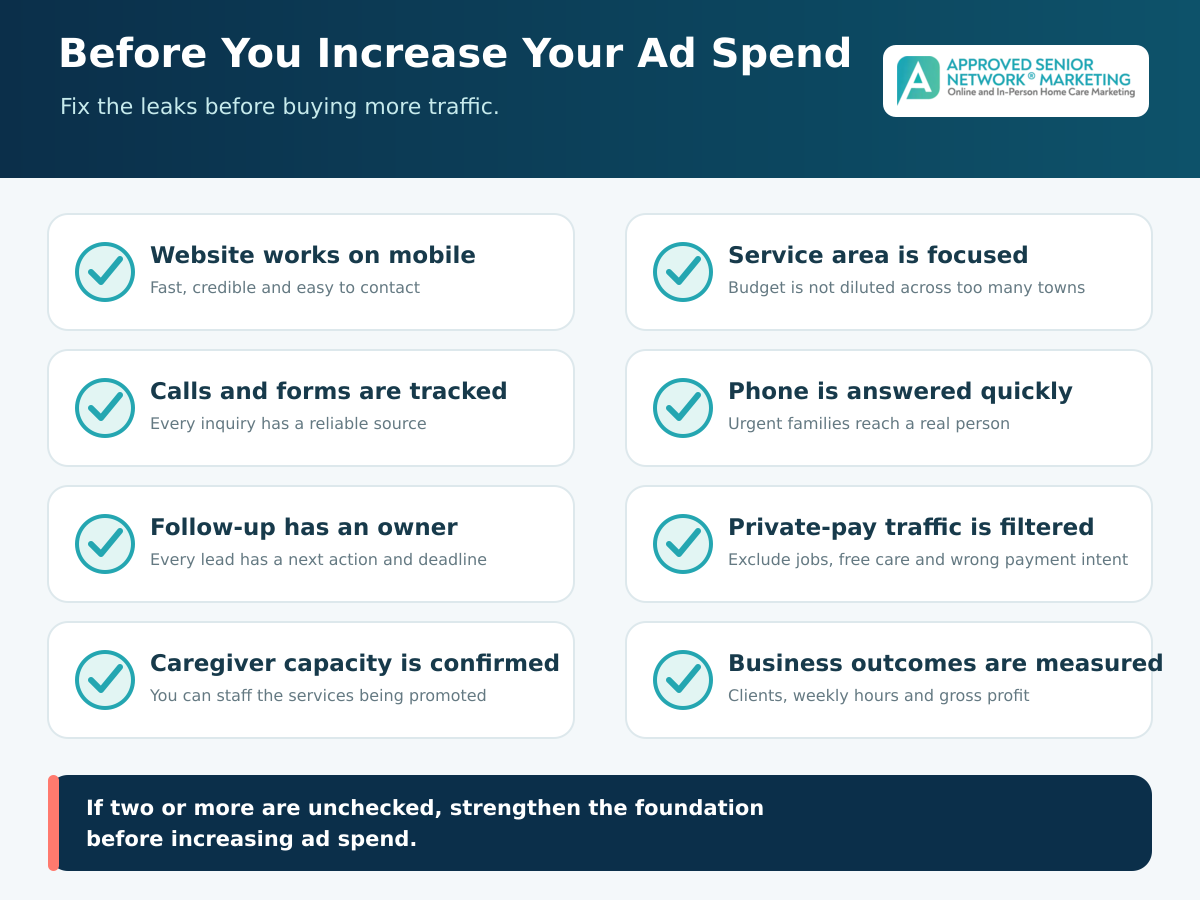
Before increasing promotion, confirm that your agency has:
- A fast, mobile-friendly home care website
- Clear service areas and accurate contact information
- Specific service pages that answer family questions
- Visible proof, including real leadership, credentials, process, reviews, and local experience
- A simple call or consultation request
- Reliable call answering
- A defined intake process
- A CRM and follow-up system
- Accurate source tracking
- Caregiver capacity for the services being promoted
If leads already exist but too few become assessments or clients, the next dollar may belong in intake coaching, response speed, follow-up, or home care marketing and sales training, not in more traffic.
Calculate your budget backward from client value
Revenue percentage is useful for setting an overall budget. Client economics are more useful for deciding how much you can afford to spend acquiring business.
Start with six numbers:
- Average hourly bill rate
- Average weekly hours per client
- Average length of service
- Gross margin
- Percentage of qualified inquiries that become clients
- Amount of gross profit you are willing to invest in acquisition
Use these formulas:
Expected client revenue = hourly bill rate × weekly hours × expected weeks of service
Expected client gross profit = expected client revenue × gross margin
Maximum target client acquisition cost = expected client gross profit × acquisition-investment percentage
Maximum target cost per qualified inquiry = maximum client acquisition cost × inquiry-to-client conversion rate
A home care client-value example
CareScout's 2025 Cost of Care Survey reported a national median consumer rate of $35 per hour for non-medical in-home care. That is not every agency's bill rate, but it provides a current national reference point.
Imagine an agency with the following economics:
- $35 average hourly bill rate
- 20 hours per week
- 26 weeks of average service
- 35% gross margin
- 25% of qualified inquiries become clients
- The agency is willing to invest 20% of expected gross profit to acquire a client
The calculation would be:
- Expected client revenue: $35 × 20 × 26 = $18,200
- Expected gross profit: $18,200 × 35% = $6,370
- Maximum target acquisition cost: $6,370 × 20% = $1,274
- Maximum target cost per qualified inquiry: $1,274 × 25% = $318.50
This does not mean the agency should automatically spend $318 for every inquiry. It provides an economic boundary based on the assumptions used.
Now change the case mix. If the typical client uses only eight hours per week and remains on service for eight weeks, the allowable acquisition cost drops sharply. If the agency attracts longer-duration or around-the-clock private-pay cases, it may be able to pay more to acquire a qualified client and remain profitable.
Use your actual data. Do not use another agency's hourly rate, margin, close rate, or average client duration.
Revenue is not profit
A common mistake is celebrating a campaign that generated $20,000 in billings after $5,000 in marketing spend and calling it a four-to-one return.
The agency still must pay caregivers, payroll taxes, workers' compensation, insurance, scheduling and administrative costs, overtime, recruiting expenses, and other operating costs.
For marketing decisions, track both:
- Revenue return: Revenue attributable to marketing ÷ marketing cost
- Gross-profit return: Gross profit attributable to marketing ÷ marketing cost
Gross-profit return provides the more honest view of whether growth is financially sustainable.
Also measure lifetime value carefully. A 24-hour case that lasts nine months is not economically equivalent to a short respite case, even though both count as one new client.
Three sample monthly home care marketing budgets
The examples below exclude the salary and employment costs of an internal liaison. They are illustrations, not universal recommendations.
Example 1: $3,000 per month, foundation first
This agency has limited cash but an owner who can personally build community relationships.
| Activity | Monthly amount |
|---|---|
| Local SEO, website improvement, and expert content | $1,350 |
| CRM, call tracking, and follow-up tools | $400 |
| Review and reputation system | $250 |
| Referral strategy, coaching, and materials | $700 |
| Creative, local sponsorships, or controlled tests | $300 |
| Total | $3,000 |
This budget does not pretend to fund every channel. It improves the foundation while the owner performs the in-person work.
Example 2: $6,000 per month, focused single-market growth
This agency has a good website, available caregivers, reliable intake, and a defined private-pay service area.
| Activity | Monthly amount |
|---|---|
| Paid-search media | $2,500 |
| Paid-search management, landing page, and tracking | $900 |
| Local and AI-search content | $1,300 |
| CRM and reputation tools | $400 |
| Referral-development support and materials | $600 |
| Creative testing and contingency | $300 |
| Total | $6,000 |
This plan gives paid search enough room to produce useful data without abandoning the organic, reputation, and referral assets that support conversion.
Example 3: $12,000 per month, aggressive multi-channel growth
This agency has strong caregiver capacity and wants to grow several services or priority areas.
| Activity | Monthly amount |
|---|---|
| Google and Meta ad media | $5,000 |
| Campaign management, landing pages, creative, and tracking | $1,750 |
| Local SEO, AI-search visibility, and content | $2,750 |
| Video, email, and social distribution | $900 |
| CRM and reputation systems | $600 |
| Referral strategy, sales coaching, and materials | $1,000 |
| Total | $12,000 |
An internal liaison's compensation, mileage, events, and incentives would be added to this external cash budget.
Which marketing investment should come first?
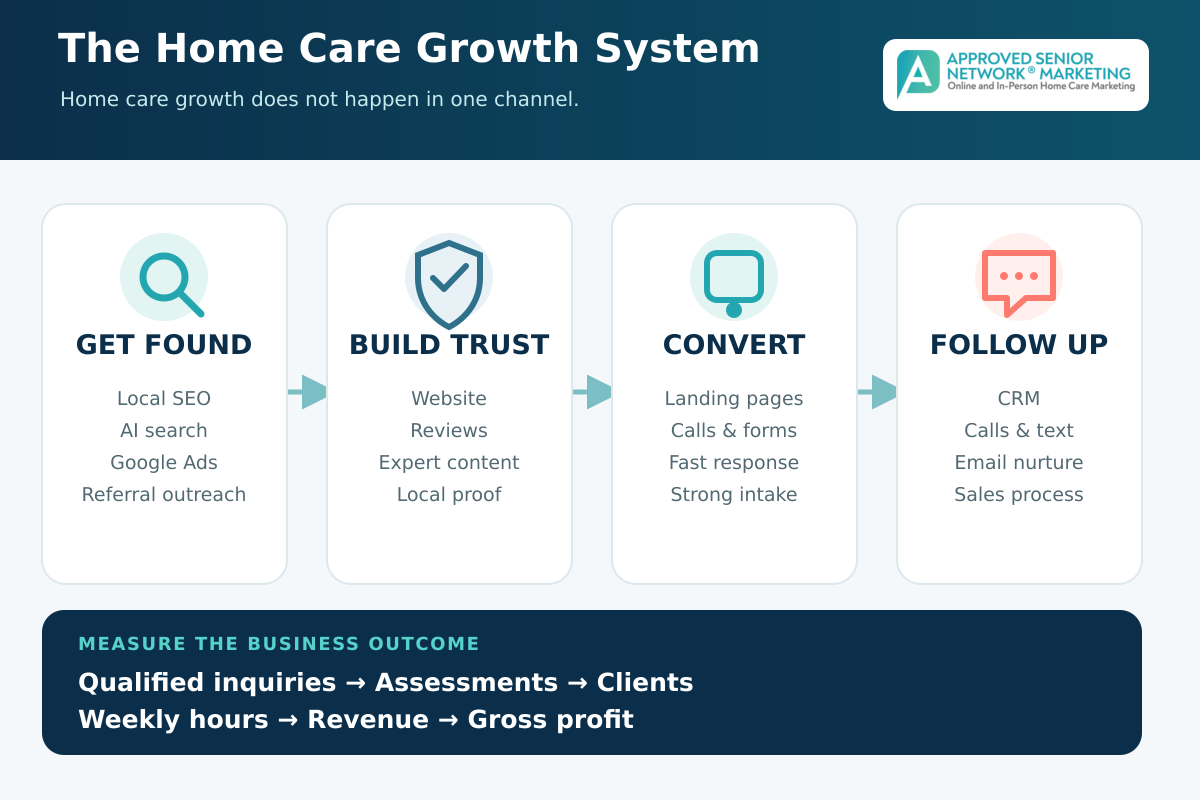
The right priority depends on the bottleneck.
| What is happening now? | Likely first investment |
|---|---|
| Families cannot find the agency | Local SEO, Google Business Profile, content, and carefully targeted paid search |
| People visit but do not contact the agency | Website messaging, proof, conversion paths, service pages, reviews, and landing pages |
| The agency gets inquiries but few assessments | Speed to lead, intake training, call review, qualification, CRM, and follow-up |
| Assessments occur but few clients start | Sales process, care-plan presentation, pricing communication, staffing, and follow-up |
| Professional referrals are inconsistent | Referral-source strategy, field training, route planning, educational resources, and CRM discipline |
| Marketing produces cases the agency cannot staff | Caregiver recruiting and retention before more client promotion |
| One referral source produces most revenue | Diversification across search, reputation, content, and new professional relationships |
| Several locations share one weak campaign | Separate local strategy, pages, profiles, budgets, tracking, and accountability by market |
Your budget should attack the bottleneck. Buying more leads when intake is the problem is expensive. Rebuilding a website when the real problem is inconsistent community outreach will not fix referral development.
How long should you fund a marketing strategy?
Different activities have different timelines. Judge them accordingly.
- Website and tracking improvements: These are foundation projects. Evaluate whether they were completed correctly and whether conversion performance improves over time.
- Google Ads: Expect active optimization. A 60- to 90-day test is often more informative than judging one week, but the appropriate period depends on search volume and lead volume.
- Facebook and Instagram: Allow time and budget for multiple creative and audience tests. Early low-cost leads are not proof of client acquisition.
- SEO and AI-search visibility: Plan in six- to 12-month windows. Technical progress can happen quickly; competitive visibility and authority usually build over time.
- Review generation: Treat it as an ongoing operating process rather than a short campaign.
- Referral development: Measure target-account activity and relationship progress early, but allow months of consistent, useful contact for dependable referral patterns to develop.
Do not keep an ineffective program running simply because "marketing takes time." At the same time, do not cancel a sound long-term strategy before it has a fair measurement window.
Agree in advance on what will be measured, when it will be reviewed, and what evidence will lead you to continue, change, increase, or stop the investment.
What should a home care marketing report include?
A useful report connects activity to business outcomes.
At minimum, review:
- Calls and forms by source
- Qualified consumer inquiries
- Professional referrals
- Response time
- Assessments scheduled and completed
- Clients started
- Weekly hours associated with new clients
- Expected and realized revenue
- Expected and realized gross profit
- Cost per qualified inquiry
- Cost per assessment
- Cost per acquired client
- Inquiry-to-assessment conversion rate
- Assessment-to-client conversion rate
- Lost-opportunity reasons
- Referral sources producing repeat business
- Caregiver capacity in promoted areas
Google Ads call reporting can connect calls with campaign activity. That is useful, but platform reporting is only the first step. The agency's CRM or operating system must show whether a caller was qualified, scheduled an assessment, started care, and generated billable hours.
The cheapest lead is not always the best lead. A $40 inquiry from outside the service area has little value. A $250 inquiry that becomes a profitable, long-duration private-pay client may be an excellent investment.
Seven warning signs that a marketing budget is being wasted
1. Nobody can explain what "marketing" includes
Every proposal should separate vendor fees, advertising media, software, setup costs, creative work, and internal responsibilities.
If you are comparing proposals, our home care marketing agency comparison lists the questions to ask every agency before you sign.
2. The entire budget is spread across too many channels
A small budget divided among SEO, Google Ads, Facebook, video, social media, email, print, and events may be too thin for any one activity to work well.
3. Reports stop at traffic, reach, clicks, or total leads
Those metrics can help diagnose a campaign, but they do not prove business growth. Follow the pipeline through clients, hours, revenue, and gross profit.
4. Consumer leads and caregiver applicants are mixed together
Home care campaigns attract job seekers. Recruiting and client-acquisition campaigns need separate pages, tracking, messages, and reports.
5. Private-pay campaigns pay for the wrong intent
If the agency does not accept Medicaid-funded cases, job seekers, free-care searches, or unrelated medical services, targeting and negative keywords should reflect that.
6. Marketing is disconnected from staffing
Promoting 24-hour care in an area with no caregiver capacity creates missed opportunities and can damage the agency's reputation.
7. Nobody owns follow-up
A CRM cannot compensate for unclear responsibility. Every new inquiry and professional contact needs an assigned person, next action, and deadline.
Questions to ask before hiring a home care marketing company
Before agreeing to a monthly fee, ask:
- Is advertising spend included or separate?
- What exactly will be completed each month?
- Which work is one time, and which work is ongoing?
- Who owns the website, domain, advertising accounts, content, data, and creative assets?
- How do you define a lead and a qualified inquiry?
- How will calls, forms, chats, and professional referrals be tracked?
- Will reporting show assessments, new clients, hours, revenue, and cost per client?
- How will caregiver applicants and nonqualified consumer inquiries be separated?
- What does our team need to provide or complete?
- What will happen during the first 30, 60, and 90 days?
- When should each part of the strategy reasonably be evaluated?
- How can the program be adjusted if staffing capacity or business priorities change?
A good partner should be able to explain the plan in plain language. You should understand what you are buying, why it was selected, how it fits the rest of the growth system, and how the business will judge it.
So, how much should you spend on home care marketing?
Start with these four rules:
- Use 5% to 10% of gross revenue as an initial total-budget range, then adjust for growth stage, market competition, margins, and capacity.
- Separate foundation, recurring marketing, promotion, and internal payroll so you know what the number includes.
- Fund fewer priorities well instead of many priorities poorly. A focused $3,000 plan can be more productive than $3,000 scattered across eight disconnected tactics.
- Measure qualified opportunities, clients, hours, revenue, and gross profit, not activity alone.
For many established single-location agencies, that leads to an outside marketing budget in the range of $3,000 to $8,000 per month, plus internal staff costs. More competitive, aggressive, or multi-location plans often require $8,000 to $20,000 or more per month.
The right amount is not the cheapest number you can find. It is the smallest responsible investment that can execute the strategy, produce enough data to guide decisions, and acquire the right clients at a sustainable cost.
Approved Senior Network® has focused on home care marketing since 2008. We connect online marketing, websites, local and AI-search visibility, reputation, CRM follow-up, and in-person sales development so agency owners do not have to assemble a growth plan from disconnected vendors and conflicting advice.
If you want help building a budget around your actual service area, staffing capacity, growth goal, and client economics, schedule a home care marketing consultation or call 888-404-1513.
Frequently asked questions
Is $1,000 per month enough for home care marketing?
It can fund one narrow priority, basic software, or professional guidance combined with substantial owner effort. It is generally not enough for a complete website, ongoing SEO, paid advertising, content, reputation management, CRM, and referral development at the same time. Choose the most important bottleneck and do that work well.
How much should a new home care agency spend on marketing?
A new agency may begin with approximately $1,500 to $3,000 per month plus owner-led referral development, after budgeting separately for licensing, operations, insurance, recruiting, and a credible website. The exact amount should reflect available cash, service area, client value, and caregiver capacity. Avoid signing up for many disconnected services before the foundation and target market are clear.
How much should an established home care agency spend on marketing?
An established single-location agency pursuing steady growth may need $3,000 to $8,000 per month in outside marketing costs. When internal marketing and sales compensation is included, a total budget around 5% to 10% of gross revenue is a useful planning range.
Should Google Ads spend be included in the marketing company's fee?
Sometimes it is bundled, but it should always be disclosed separately. Ask how much pays for actual media, how much pays for management, and whether landing pages, call tracking, creative work, and reporting are included.
How much should a home care agency spend on Google Ads?
A tightly targeted market may begin around $1,500 to $3,000 per month in ad media. Competitive metropolitan or multi-service campaigns may require $3,000 to $7,500 or more per month. Management, landing pages, and tracking are additional unless explicitly included.
Is home care SEO worth the cost?
SEO can be valuable because it builds assets the agency owns: stronger service pages, useful local content, reviews, authority, and a technically sound website. It should be measured over an appropriate period and connected to qualified inquiries and revenue, not sold as guaranteed rankings.
Should a home care agency invest in digital marketing or referral marketing?
Most established agencies need both. Families and professionals evaluate agencies online, while trusted professional relationships remain an important source of referrals. Digital visibility, reputation, in-person development, and follow-up should reinforce one another.
How can I tell whether my marketing is working?
Track qualified inquiries, assessments, new clients, weekly hours, revenue, gross profit, cost per acquired client, and conversion rates by source. Traffic, impressions, clicks, and total leads are supporting metrics, not the final result.
Does hiring a community liaison count as marketing spend?
Yes. Include compensation, employer payroll costs, incentives, mileage, events, printed materials, software, training, and management time when calculating the true cost of referral development.
Can AI make home care marketing cheaper?
AI can improve research, production, analysis, and workflow efficiency, but it does not remove the need for accurate local information, genuine expertise, original insight, human review, strong creative judgment, relationship development, or follow-up. Cheap generic output can create compliance, credibility, and search-quality problems.
Research and sources
- The CMO Survey: Spring 2026 results, sponsored by Duke University's Fuqua School of Business, Deloitte, and the American Marketing Association
- The CMO Survey: 2026 Highlights and Insights Report
- WordStream and LocaliQ: 2026 Google Ads Benchmarks
- CareScout: 2025 Cost of Care Survey results
- Google Ads Help: About call reporting