
How Can I Grow My Home Care Business?
Dawn FialaHome Care Expert, Sales and OperationsAugust 31, 2026
Growing a home care business requires more than getting your name in front of more people. Sustainable growth happens when your agency can consistently generate demand, earn trust, convert inquiries into clients, build productive professional referral relationships, recruit enough caregivers to accept new cases, and measure what is actually producing revenue.
That means the answer to “How can I grow my home care business?” is not simply “do more marketing.”
A successful growth strategy brings together:
- Home care marketing
- Professional and consumer home care referrals
- A strong home care website
- Search engine optimization
- AI Search visibility
- Digital marketing for home care
- In-person sales for home care
- Social media
- Reputation and review management
- Email newsletters and lead nurturing
- Sales follow-up
- Caregiver recruitment and retention
- Clear KPIs that connect activity to revenue
The opportunity is substantial. The U.S. Census Bureau has projected that by 2030 all baby boomers will be older than 65, putting roughly one in five Americans at retirement age. At the same time, AARP research found that 75% of adults age 50 and older want to remain in their current homes as they age, while 61% would prefer to receive care at home through a combination of family and paid help.
Demand exists.
The challenge for a home care agency is becoming the organization families and professionals actually find, trust, remember and choose.
Home Care Growth Is a System, Not a Marketing Campaign
Many home care owners look for a single growth tactic.
Should we invest in SEO?
Should we run Google Ads?
Should we hire a salesperson?
Should we visit hospitals?
Should we post more on Facebook?
Should we send newsletters?
Usually, the answer is not choosing one of these. It is understanding how the pieces work together.
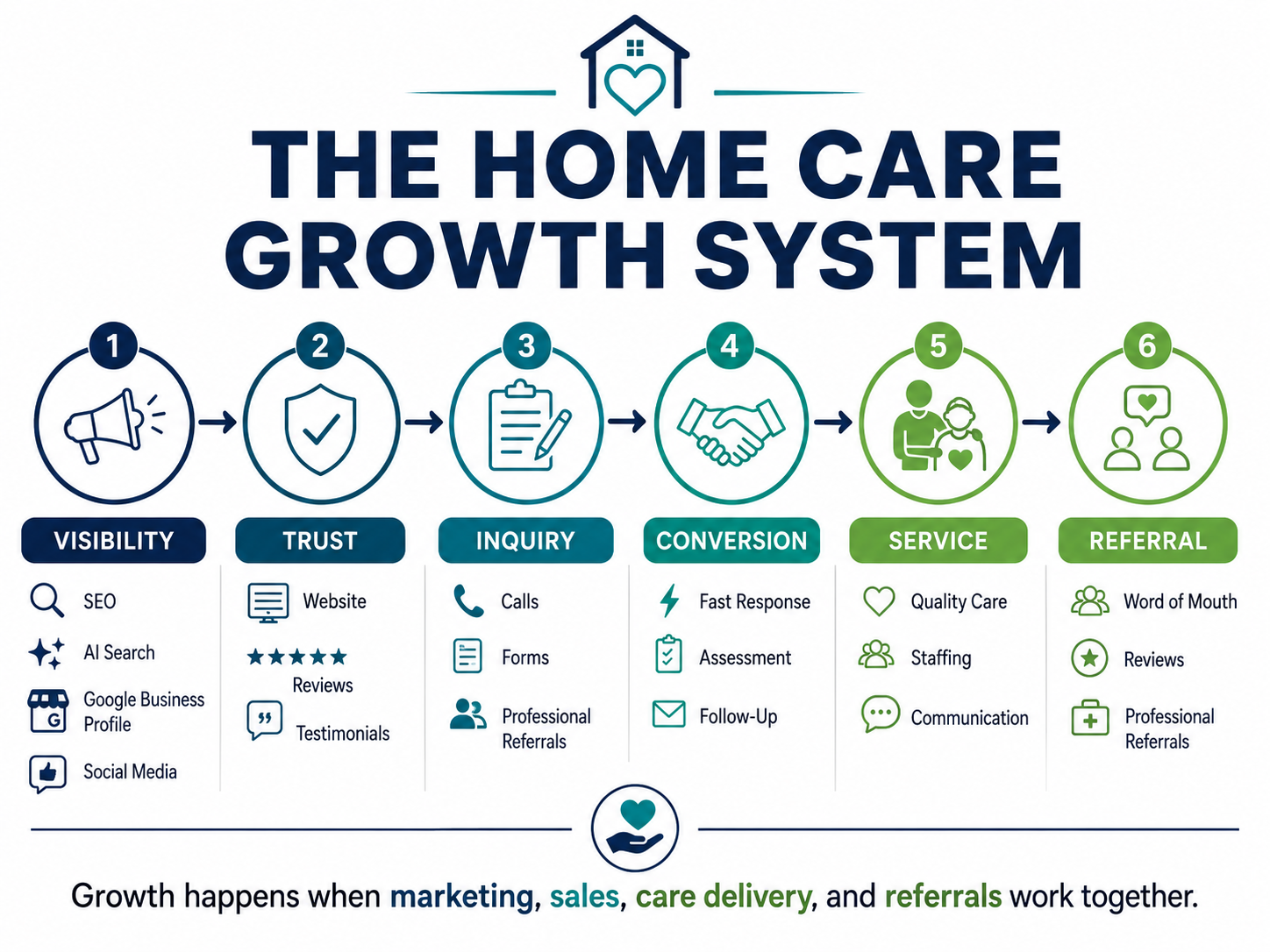
A home care growth system can be thought of as six connected stages:
Visibility → Trust → Inquiry → Conversion → Service → Referral
Your agency must first become visible to potential clients and referral partners. It must then give them enough evidence to trust you. Someone must respond effectively when an inquiry occurs. Your sales process must convert qualified inquiries into assessments and clients. Operations must deliver an excellent experience. That experience then produces reviews, word-of-mouth recommendations and professional referrals that feed the system again.
When growth stalls, the first question should therefore be:
Where is the system breaking?
An agency with plenty of leads but poor conversion does not primarily have a marketing problem.
An agency with excellent conversion but no inquiries probably does.
An agency generating new cases but turning them away because it cannot staff them has a recruiting or operational capacity problem.
An agency getting dozens of referral-source visits but few actual referrals may have a sales strategy problem.
Knowing the difference can save tens of thousands of dollars.
Start With the KPIs That Actually Drive Your Home Care Business
One of the most important principles in home care marketing is this:
Do not measure marketing activity without measuring business outcomes.
Website traffic is useful.
Facebook engagement is useful.
Google rankings are useful.
Email opens are useful.
Sales visits are useful.
But none of them, by themselves, tell you whether your agency is growing.
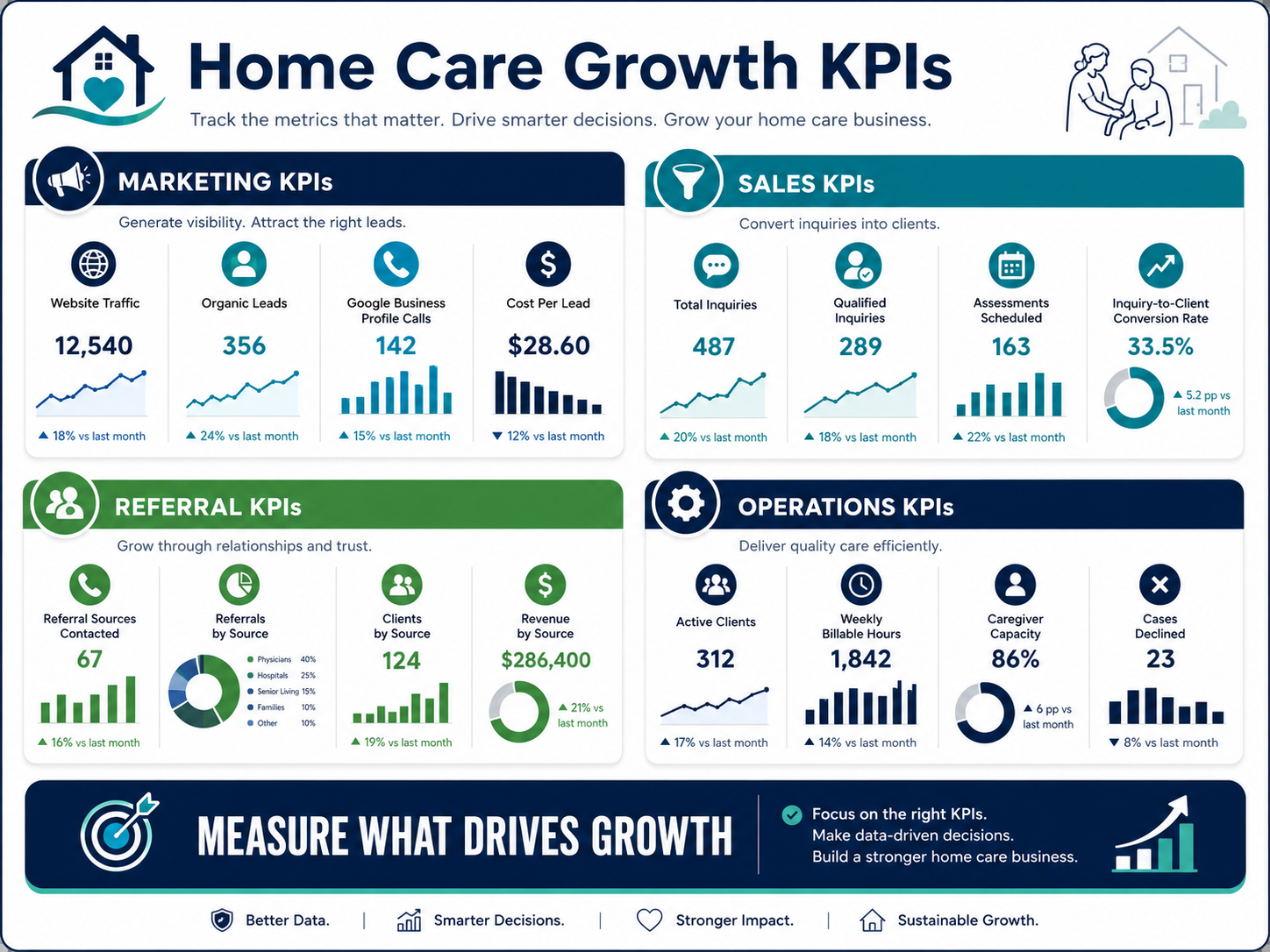
Your home care KPI dashboard should connect marketing and sales activities all the way to revenue.
Home Care Marketing KPIs
Track at least:
- Website visitors
- Organic search traffic
- Google Business Profile interactions
- Calls from search
- Website form submissions
- Paid advertising leads
- Cost per lead
- Email inquiries
- Social media inquiries
- Chat inquiries
- Traffic and leads from AI platforms when identifiable
Sales KPIs for Home Care Agencies
Track:
- Total inquiries
- Qualified inquiries
- Inquiry source
- Response time
- Assessments scheduled
- Assessments completed
- Clients started
- Inquiry-to-assessment conversion rate
- Assessment-to-client conversion rate
- Overall inquiry-to-client conversion rate
- Lost-lead reason
Professional Referral KPIs
For in-person sales for home care, track:
- Referral sources contacted
- Face-to-face visits
- Follow-up contacts
- New referral relationships established
- Referrals received by source
- Qualified referrals by source
- Clients admitted by source
- Revenue generated by referral source
- Time since last referral
- Top 10 and top 20 referral partners
Operational Growth KPIs
You should also track:
- Active client census
- Weekly billable hours
- Average hours per client
- Revenue per client
- Client length of service
- Client acquisition cost
- Client lifetime value
- Gross margin
- Caregiver applicants
- Caregivers hired
- Caregiver turnover
- Open shifts
- Cases declined because of staffing
These numbers reveal the health of the entire growth engine.
Activated Insights has repeatedly emphasized the value of measurement in its home care benchmarking research. Its 2024 benchmarking findings reported that providers tracking every inquiry generated substantially more revenue than providers tracking only some or most inquiries. The organization's 2025 benchmarking program continues to focus heavily on client acquisition costs, inquiry tracking, marketing sources and measurable growth.
Three Conversion Rates Every Home Care Agency Should Know
Inquiry-to-assessment rate
Assessments scheduled ÷ qualified inquiries
Assessment-to-client rate
New clients ÷ completed assessments
Inquiry-to-client rate
New clients ÷ qualified inquiries
If inquiries increase dramatically but starts do not, stop blaming marketing until you understand what is happening in the sales process.
Build a Home Care Website That Answers Real Buying Questions
Home care websites should not function as digital brochures. That is the principle behind our website design for home care agencies.
They should function as trust-building, educational and conversion platforms.
A family looking for care is rarely researching something trivial. They may be trying to determine:
- Whether Mom can safely remain home
- Whether Dad needs dementia care
- What overnight care costs
- Whether Medicare pays for home care
- Whether a parent needs 24-hour assistance
- How quickly care can begin
- What happens after a hospital discharge
- Whether the agency can handle Parkinson's disease
- Whether a caregiver can provide transportation
- Whether respite care is available
- How to convince a resistant parent to accept help
A high-performing website answers these questions.
Your Core Service Pages Should Be Specific
Instead of one generic page saying your agency provides “quality senior care,” create substantial pages explaining services such as:
- Personal care
- Companion care
- Dementia care
- Alzheimer's care
- Parkinson's care
- 24-hour home care
- Overnight care
- Respite care
- Hospital-to-home care
- Post-surgical assistance
- Veterans home care
- Transportation
- Meal preparation
- Medication reminders
Explain who the service is appropriate for, what problems families are usually trying to solve, what care might look like, how the process works and how someone can get started.
Answer Financial Questions
Cost is one of the biggest unanswered questions on many home care websites.
You do not necessarily need to publish a single hourly rate that applies to everyone, but families should not have to search ten pages to understand how private-pay home care works.
Explain:
- What influences the cost of home care
- Minimum-hour requirements, when applicable
- Hourly versus live-in or around-the-clock arrangements
- Long-term care insurance
- Veterans benefits
- Private pay
- Medicaid programs when applicable to your agency
- What Medicare does and does not cover
This last point is especially important.
Medicare states that it does not pay for 24-hour-at-home care, homemaker services unrelated to an eligible home health care plan, or custodial/personal care such as bathing and dressing when that is the only care a person needs.
A private-pay home care company that explains this distinction clearly can become far more useful to families than a website filled with vague marketing language.
Build Local Authority
If you serve multiple communities, your website should clearly demonstrate where you provide care.
Strong local pages should contain meaningful information rather than simply changing a city name in otherwise identical content.
For example:
Home Care in Naperville, Illinois should actually discuss serving families in Naperville, relevant local circumstances, nearby medical and senior resources, the services your agency commonly provides there, and how families in that community can access care.
Thin, mass-produced location pages are not a sustainable strategy.
Google's own guidance says its systems prioritize helpful, reliable, people-first content and specifically encourages substantial, comprehensive content containing original information, research or analysis. Google also warns that producing large quantities of AI-generated pages without adding meaningful value can violate its policies on scaled content abuse.
SEO Still Matters—Including in the Age of AI Search
There has been a great deal of discussion about whether AI is replacing SEO.
It is more accurate to say that search is expanding.
Traditional search results still matter. Google Maps matters. Google Business Profiles matter. AI Overviews matter. Google's AI Mode matters. ChatGPT search matters. Bing and Copilot matter.
Your agency now needs to be understandable and trustworthy across this wider search ecosystem.
Google has been unusually clear about this.
Its current guidance states that the same SEO best practices used for traditional Google Search remain relevant for AI Overviews and AI Mode. There is no secret AI schema or special file required to appear in these experiences. Pages still need to be crawlable, indexable, useful and eligible to appear in search.
Bing offers similar guidance, stating that traditional SEO fundamentals also support eligibility for Bing's AI-powered and grounding experiences.
So don't abandon SEO.
Improve it.
A Home Care SEO Strategy Should Include
Technical SEO
Make sure search engines can efficiently crawl and understand the website.
Review:
- Indexing
- Canonical URLs
- Robots.txt
- XML sitemaps
- Page speed
- Mobile usability
- Broken links
- Redirects
- Duplicate pages
- Internal linking
- Structured data
- HTTPS
- Core website architecture
Service SEO
Build excellent pages around what people actually need:
- Dementia care
- 24-hour care
- Companion care
- Personal care
- Respite care
- Overnight care
- Parkinson's care
- Hospital discharge assistance
Local SEO
Home care is fundamentally local.
Google says local search visibility is primarily influenced by relevance, distance and prominence. Business information, website signals, links and reviews can all contribute to local visibility.
That makes your Google Business Profile a core business asset.
Keep it accurate and complete.
Monitor:
- Primary and secondary categories
- Services
- Address or service area
- Phone number
- Website URL
- Hours
- Photos
- Reviews
- Review responses
- Business description
- Questions and answers where available
Content SEO
Create content around actual family questions instead of publishing generic “5 Tips for Seniors” articles that could belong to any agency in America.
Useful topics include:
- How do I know when my parent needs home care?
- What does dementia care at home cost?
- Can someone with dementia safely live alone?
- How many hours of home care does my mother need?
- What happens when an elderly parent refuses help?
- Does Medicare pay for a caregiver?
- What is the difference between home care and home health?
- What should I look for when hiring a home care agency?
- What questions should I ask a home care company?
- How can I prevent caregiver burnout?
- Is 24-hour home care less expensive than assisted living?
- How quickly can home care begin after hospital discharge?
These are the kinds of questions humans ask—and increasingly the kinds of full, conversational questions they ask AI systems.
Optimize for AI Search by Becoming a Source Worth Citing
AI Search changes an important part of search behavior.
Instead of typing:
dementia care omaha
someone might ask:
“My mother has early-stage dementia and lives alone in Omaha. She is still independent but forgets medication and becomes confused in the evening. What type of home care should I consider?”
Google has explained that AI Mode can break complicated questions into multiple related searches through a technique it calls “query fan-out.”
That has major implications for home care content.
You no longer want to build pages around one keyword only.
You want to build resources that demonstrate deep understanding of a topic and its related questions.
What Makes Home Care Content More Useful for AI Search?
Create pages containing:
Clear answers. Do not bury the answer under six paragraphs of marketing copy.
Specific expertise. Explain what your organization sees in real families, care situations and transitions.
Original insight. Add observations, examples, processes, checklists or local information that does not appear on every competitor's page.
Strong topical depth. A dementia care page can naturally cover wandering, sundowning, medication reminders, caregiver respite, safety, resistance to care and when 24-hour supervision may become necessary.
Clear business identity. Make it obvious who you are, where you operate, what you provide and how to contact you.
Consistent information across the web. Your website, Google Business Profile, directories, social profiles and other authoritative references should not contradict one another.
Evidence of real-world trust. Reviews, leadership information, credentials, community involvement, professional relationships, awards, media mentions and original educational resources all reinforce that your agency is a real entity.
What About ChatGPT Search?
OpenAI states that public websites can appear in ChatGPT search and recommends allowing its OAI-SearchBot crawler if publishers want content to be discovered, summarized and cited. Placement is not guaranteed, but crawlability is a basic prerequisite for consideration.
For a home care company, that means technical teams should verify that firewalls, bot-blocking systems and robots.txt rules are not unintentionally preventing legitimate search crawlers from accessing important public content.
The larger lesson is simple:
You cannot manufacture authority with an “AI optimization trick.” You build authority by becoming one of the best available sources on the questions your market asks.
Use Digital Marketing for Home Care to Capture Existing Demand
SEO builds long-term visibility.
Paid digital marketing can capture demand that already exists today.
A strong digital marketing for home care strategy may include:
- Google Ads
- Microsoft Ads
- Retargeting
- Facebook and Instagram advertising
- Educational landing pages
- Guide downloads
- Email nurture
- Video
- Local search optimization
- Reputation marketing
But different channels serve different purposes.
Google Ads: Capture Intent
Google Ads can be extremely valuable when someone is actively searching:
- home care near me
- dementia care near me
- 24 hour home care
- caregivers for elderly parents
- home care agency in [city]
Those searches suggest immediate or emerging need.
But campaign quality matters.
A home care agency should monitor:
- Search terms
- Geographic targeting
- Cost per qualified lead
- Cost per assessment
- Cost per new client
- Phone call quality
- Conversion tracking
- Negative keywords
- Time of day
- Landing-page conversion
A campaign producing 50 cheap leads from job seekers, Medicaid inquiries your private-pay agency cannot serve, and unrelated medical searches is not better than a campaign producing 12 qualified family inquiries.
Optimize for qualified clients, not lead volume.
Do Not Confuse Social Media With Direct-Response Advertising
Social media is important, but home care agencies sometimes expect it to perform a job it was not designed to perform.
A family rarely scrolls Facebook on Tuesday morning thinking:
“I hope an advertisement reminds me to hire someone for Dad.”
The value of social media is often cumulative.
Families may see your videos, staff, articles, educational posts, testimonials and community involvement several times before ever needing you.
Then something happens.
Dad falls.
Mom is discharged from the hospital.
A sibling calls and says the current situation cannot continue.
The family suddenly begins researching care.
Now your brand is familiar.
That familiarity matters.
Which Platforms Matter?
Pew Research Center's 2025 social media data found that Facebook and YouTube remain unusually broad across age groups. Facebook is used by 74% of adults ages 50–64 and 57% of adults 65+, while YouTube is used by 85% and 64% of those respective age groups.
That makes Facebook and YouTube especially difficult to dismiss in a category involving older adults and their adult children.
Your content can include:
- Caregiver introductions
- Short educational videos
- Dementia tips
- Family caregiver support
- Local community information
- Employee recognition
- Frequently asked questions
- Client stories with proper permission
- Veteran information
- Hospital discharge advice
- Safety tips
- Behind-the-scenes company culture
- Links to substantial educational resources
Social media should make people think:
“These people understand families like mine.”
Professional Referrals Are Still One of the Most Important Home Care Growth Channels
Digital marketing receives enormous attention, but professional home care referrals remain essential.
Activated Insights' benchmarking research has repeatedly identified referral relationships and word-of-mouth as major home care growth drivers. Its 2024 report found that word-of-mouth referrals generated almost one-third of revenue among surveyed home-based care providers, while its 2025 sales and marketing benchmarking continued to emphasize referral-source growth, client acquisition costs, inquiry tracking and reputation.
Professional referral sources may include:
- Hospital case managers
- Hospital discharge planners
- Skilled nursing facilities
- Rehabilitation facilities
- Home health agencies
- Hospice organizations
- Assisted living communities
- Independent living communities
- Memory care communities
- Physicians
- Geriatricians
- Neurologists
- Elder law attorneys
- Estate planning attorneys
- Geriatric care managers
- Aging Life Care Professionals
- Senior centers
- Veterans organizations
- Faith communities
- Social workers
- Financial professionals
- Long-term care insurance professionals
- Community organizations
But getting professional referrals requires more than dropping off brochures.
In-Person Sales for Home Care Must Be Systematic
Effective in-person sales for home care is not:
“Stop by 20 buildings and hand everyone a cookie.”
It is professional business development.
Your salesperson should know:
- Who the organization serves
- Who influences referrals
- Which patients or residents are appropriate for your agency
- What problems the professional encounters
- How quickly your agency can respond
- Which difficult cases you can accept
- What differentiates your care model
- What happens after they send a referral
- How you communicate outcomes back to the referral source
Stop Asking Referral Sources for “Any Referrals”
Give professionals reasons to remember you.
For example:
“We have several caregivers specifically experienced with Parkinson's disease, and we can usually respond quickly when a family needs additional help after therapy or home health visits end.”
That is more useful than:
“Just stopping by to see whether you have anybody who needs home care.”
Become associated with specific solutions.
Perhaps your agency becomes known for:
- Dementia cases
- Difficult hospital discharges
- Parkinson's care
- 24-hour care
- Couples care
- Veterans
- Weekend starts
- Rapid-start cases
- Long-distance family caregivers
- High-touch concierge care
Specificity makes referral relationships stronger.
Build a Referral Follow-Up System
Every important professional relationship belongs in a CRM.
Document:
- Organization
- Contact
- Role
- Last visit
- Previous conversations
- Referrals
- Outcomes
- Follow-up date
- Interests
- Educational needs
- Next action
Your goal is not simply to “visit.”
Your goal is to become trusted enough that when the right situation occurs, your agency comes to mind.
Newsletters Keep Your Agency Present Between Referrals
Most referral sources will not have a case for you every week.
Most consumers on your email list will not need care today.
That is precisely why newsletters matter.
A good newsletter maintains the relationship between moments of immediate need.
Professional Referral Newsletters
Send useful information to referral partners such as:
- New services
- New geographic coverage
- Dementia resources
- Hospital-to-home checklists
- Caregiver availability
- Client success stories
- Veterans benefit education
- Community events
- Staff introductions
- Educational webinars
- Downloadable resources
Avoid sending an endless stream of:
“We have caregivers available! Send us referrals!”
Give people something worth opening.
Consumer Newsletters
Consumer newsletters can address:
- How to talk to a parent about home care
- Fall prevention
- Caregiver burnout
- Dementia behavior changes
- Signs a parent may need additional assistance
- Paying for care
- Long-distance caregiving
- Preparing for a hospital discharge
- Holiday visits and warning signs
- Home safety
A daughter may download your dementia guide in October and not hire care until February.
Your nurturing system helps ensure she still remembers you in February.
Reviews and Reputation Influence Both Humans and Search Engines
Home care is a trust purchase.
Families are inviting a stranger into the home of someone they love.
Reputation therefore matters enormously.
Google confirms that review quantity and ratings can influence local visibility.
Consumers also use reviews as part of a broader verification process.
BrightLocal's 2025 consumer research found that only 4% of surveyed consumers said they never read online business reviews, and most consumers researching reviews used more than one source.
AI is now becoming part of that discovery process too.
BrightLocal reported in 2026 that 45% of consumers surveyed had used AI tools for local business recommendations within the prior year, although most still verified the information they received.
This means reputation increasingly travels across platforms.
Your agency should have a systematic, ethical process for asking satisfied clients and families for reviews and responding appropriately to feedback.
Do not fabricate reviews.
Do not make every review sound scripted.
Real experiences are more persuasive than perfect marketing language.
Build Marketing Around Questions, Not Around Your Agency
One of the most common mistakes in home care marketing is making the company the subject of every piece of content.
“We provide compassionate care.”
“Our caregivers are the best.”
“We treat you like family.”
“We are committed to excellence.”
Families are not opposed to hearing those things.
They simply have more urgent questions.
They are thinking:
Is Mom safe?
How much is this going to cost?
How do I convince Dad to accept help?
What happens at night when we're not there?
Is this dementia or normal aging?
Can someone start tomorrow?
Do we need four hours of care or 24-hour care?
What if Mom refuses the caregiver?
Build your content around those questions.
Then show how your agency solves them.
That approach creates better content for human readers, better long-tail SEO opportunities and better source material for AI-generated search answers.
Create Content That Demonstrates Actual Home Care Expertise
AI makes producing average content extraordinarily easy.
That means average content becomes less valuable.
A useful content strategy should include knowledge that originates inside your organization.
Interview:
- Owners
- Nurses
- Care managers
- Schedulers
- Recruiters
- Caregivers
- Community liaisons
- Clients or family members when appropriate and authorized
Ask them:
- What mistakes do families commonly make?
- What questions do they ask before starting care?
- What situations cause families to call urgently?
- What makes a case difficult to staff?
- What does a good dementia caregiver do differently?
- When do four hours of care stop being enough?
- Why do some parents initially reject care?
- What should families expect during an assessment?
- What happens during the first week of service?
- What makes hospital-to-home transitions fail?
Those answers contain something AI-generated commodity content does not automatically possess:
your organization's experience.
Use AI to help organize, research, edit and repurpose that expertise.
Do not use AI as a replacement for having expertise.
Your Sales Process Matters as Much as Lead Generation
Marketing creates opportunity.
Sales turns opportunity into clients.
Every inquiry should have a clear process.
For example:
- Answer or return the inquiry quickly.
- Identify the situation and urgency.
- Determine whether the prospect fits your service model.
- Understand who is involved in the decision.
- Explain the next logical step.
- Schedule the assessment.
- Confirm the appointment.
- Follow up when the family is not ready.
- Record the outcome.
- Continue nurturing legitimate future opportunities.
The person answering the phone should not merely quote an hourly rate and wait for the family to decide.
Home care is consultative.
Families often do not know exactly what they need.
The agency that helps them understand the problem has a major advantage.
Do Not Grow Faster Than Your Caregiver Capacity
There is an uncomfortable reality in home care:
Marketing can work too well.
If an agency generates 20 new qualified inquiries but cannot staff evenings, weekends or 12-hour shifts, increasing advertising may simply increase frustration.
Marketing and recruiting must therefore be coordinated.
Before aggressively expanding into a new market or service line, ask:
- Do we have enough caregivers?
- Where do our caregivers live?
- Which shifts are hardest to staff?
- Which skill sets are available?
- How quickly can we onboard?
- What cases do we routinely decline?
- What is our caregiver turnover?
- Can operations absorb another 500 or 1,000 weekly hours?
The 2025 Activated Insights benchmarking findings reinforce the importance of the workforce side of growth. HCAOA's summary of the report noted that median home-care customer growth rose to 2.9% in 2024 while professional caregiver turnover, although still extremely high, decreased from 79.2% to 75%.
Client acquisition without caregiver capacity is not sustainable growth.
Measure Every Referral Source by Revenue, Not Popularity
A source that sends 40 inquiries may be less valuable than one that sends six.
Suppose:
Source A
- 40 inquiries
- 5 qualified
- 1 client
- $8,000 revenue
Source B
- 6 inquiries
- 6 qualified
- 4 clients
- $70,000 revenue
Which referral source deserves more attention?
Obviously Source B.
Yet agencies frequently make marketing decisions based on lead counts because they have not connected referral-source data to admission and revenue data.
Every client record should ideally preserve the original acquisition source.
Over time you should be able to answer:
- Which referral source creates the most clients?
- Which creates the most revenue?
- Which creates longer-term clients?
- Which produces the highest average weekly hours?
- Which produces poor-fit inquiries?
- Which marketing campaigns produce private-pay cases?
- Which locations generate the best clients?
- Which salesperson develops the most productive referral relationships?
This is how home care marketing becomes a business discipline instead of guesswork.
What Should a Home Care Agency Do During the Next 90 Days?
If growth has stalled, do not launch 25 disconnected tactics.
Build the foundation first.
Days 1–30: Diagnose
Audit:
- Current census
- Weekly billable hours
- Revenue
- Caregiver capacity
- Inquiry sources
- Conversion rates
- Referral-source performance
- Website
- Google Business Profile
- SEO visibility
- Online reviews
- Existing advertising
- CRM usage
- Lead follow-up
- Sales activity
Identify the biggest constraint.
Days 31–60: Fix the Foundation
Depending on the findings:
- Repair website conversion problems.
- Improve key service pages.
- Fix technical SEO issues.
- Strengthen local pages.
- Optimize Google Business Profiles.
- Correct tracking.
- Build CRM stages.
- Establish a review process.
- Create referral-source target lists.
- Train phone staff.
- Develop sales messaging.
- Improve lead follow-up.
- Build caregiver recruiting capacity.
Days 61–90: Expand
Then increase activity:
- Publish substantial educational content.
- Build service-specific local content.
- Run targeted paid search campaigns.
- Launch or improve newsletters.
- Produce video.
- Visit high-value professional referral sources.
- Hold educational events.
- Develop downloadable consumer resources.
- Build referral follow-up sequences.
- Test AI Search visibility.
- Monitor KPIs weekly.
At the end of 90 days, ask:
What created qualified opportunities?
What converted into clients?
What created revenue?
Do more of that.
The Home Care Growth Scorecard
A home care owner should be able to review a simple dashboard every week containing:
| Category | KPI |
|---|---|
| Demand | Total inquiries |
| Quality | Qualified inquiries |
| Sales | Assessments scheduled |
| Sales | New clients |
| Conversion | Inquiry-to-client percentage |
| Referrals | Professional referrals received |
| Marketing | Organic leads |
| Marketing | Paid leads |
| Marketing | Cost per acquired client |
| SEO | Qualified organic traffic |
| Local | Google Business Profile calls/actions |
| Reputation | New reviews |
| Operations | Active clients |
| Operations | Weekly billable hours |
| Operations | Cases declined |
| Recruiting | Caregivers hired |
| Recruiting | Open shifts |
| Finance | Revenue |
| Finance | Gross margin |
You can add dozens of additional metrics later.
Start with the ones that reveal whether the business is actually becoming healthier.
So, How Can I Grow My Home Care Business?
Build a growth system rather than chasing tactics.
Invest in home care marketing, but measure it.
Develop professional home care referrals, but track which relationships turn into clients.
Improve your home care websites, but make them educational resources rather than online brochures.
Use digital marketing for home care, but optimize campaigns for qualified clients instead of inexpensive leads.
Commit to in-person sales for home care, but treat it as professional relationship development rather than brochure delivery.
Invest in SEO because families still search.
Prepare for AI Search because the way people ask questions is changing rapidly.
Use social media to demonstrate expertise and familiarity.
Use newsletters to remain present between moments of need.
Ask for reviews because reputation affects both trust and local visibility.
Track KPIs because activity without measurement produces false confidence.
And above all, make your agency genuinely useful.
The home care businesses most likely to win the next era of search and referrals will not necessarily be the companies publishing the most pages, running the most advertisements or making the most sales visits.
They will be the companies that repeatedly demonstrate:
We understand this problem. We know this community. We can explain your options. We can respond when you need us. And we can deliver the care we promised.
That is what families are looking for.
It is what professional referral partners are looking for.
And increasingly, it is exactly the type of reliable, specific, authoritative information that modern search engines and AI-powered search systems are attempting to surface.
If you would rather not assemble that system yourself, home care marketing covers how we build and run it.
Frequently Asked Questions About Growing a Home Care Business
What is the fastest way to grow a home care business?
There is no universally fastest channel. Start by identifying your current bottleneck. Agencies with low inquiry volume may need stronger SEO, paid search, referral development or local visibility. Agencies receiving inquiries but converting few clients should improve sales follow-up. Agencies turning away cases need caregiver recruiting and operational capacity before increasing marketing.
Are professional home care referrals still important?
Yes. Professional relationships with hospitals, rehabilitation centers, home health agencies, hospices, senior living communities, physicians, elder law attorneys, care managers and other community professionals remain important sources of qualified home care referrals. The strongest agencies systematically track which relationships create referrals, clients and revenue.
Does SEO still work for home care agencies?
Yes. Google explicitly states that conventional SEO fundamentals remain relevant even for its AI-powered search experiences. Home care agencies should maintain strong technical SEO, service pages, local content, Google Business Profiles, reviews, internal linking and useful educational resources.
How do I get my home care agency to appear in AI Search?
There is no guaranteed shortcut. Publish useful, original and authoritative information; make your business identity and service areas clear; maintain accurate information across the web; ensure search crawlers can access your site; strengthen your reputation; and answer the detailed questions consumers actually ask. OpenAI also recommends allowing OAI-SearchBot if you want public website content to be eligible for discovery in ChatGPT search.
Should a home care agency use social media?
Yes, but social media should generally be treated as part of a larger trust and visibility strategy rather than the agency's only lead-generation channel. Facebook and YouTube remain particularly relevant because they reach substantial percentages of adults in the age groups commonly involved in senior care decisions.
What KPIs should a home care agency track?
At minimum, track inquiries, qualified inquiries, inquiry source, assessments, new clients, conversion rates, client acquisition cost, professional referrals, active clients, weekly billable hours, caregiver capacity, revenue and gross margin. Marketing KPIs should always be connected to actual client and financial outcomes.
How often should I contact professional referral sources?
There is no single appropriate frequency for every relationship. The goal is consistent, useful contact without becoming repetitive. High-value referral partners may deserve frequent personal follow-up, while others may remain engaged through periodic visits, email, newsletters, educational resources and events. Track the relationship in a CRM so follow-up is deliberate rather than random.
Are newsletters worth doing for a home care agency?
Yes. Newsletters help your agency remain visible to both consumer prospects and professional referral partners who may not need your services today. Focus on useful information—dementia education, hospital discharge guidance, caregiver support, local resources, service updates and practical family advice—rather than repeatedly asking for referrals.
Should I use AI to create home care content?
AI can be an excellent research, organization, editing and production tool. It should not replace your agency's original expertise. Google's guidance specifically cautions against generating large volumes of low-value content simply to manipulate search visibility. The strongest strategy is to combine AI assistance with real expertise from your owners, clinicians, care managers, caregivers and community team.
What is the most important home care marketing strategy?
The most important strategy is building a measurable system that connects visibility to qualified inquiries, inquiries to clients, clients to excellent outcomes, and outcomes to repeat referrals and reputation. No single marketing channel can compensate indefinitely for weaknesses elsewhere in that system.