
How to ask for reviews (and what the FTC rule means for home care)

Dawn FialaHome Care Expert, Sales and OperationsAugust 19, 2026
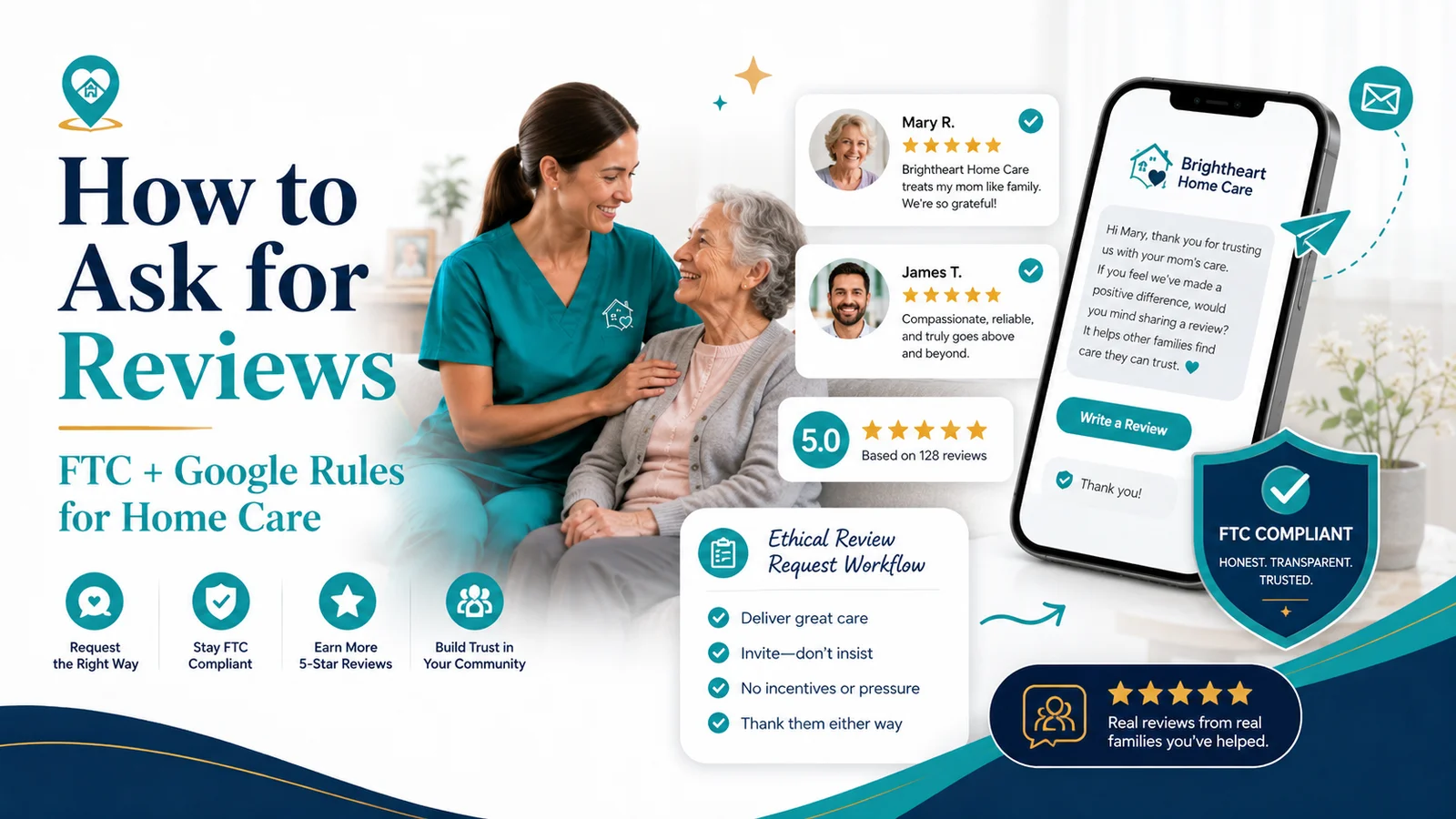
TL;DR: Home care agencies can ask real clients and families for honest reviews, but the request process needs guardrails. The FTC's Consumer Reviews and Testimonials Rule took effect October 21, 2024. It prohibits fake or false reviews and prohibits paying or incentivizing people for reviews conditioned on a particular positive or negative sentiment. Google is stricter in an important way: it treats incentives in exchange for reviews as fake engagement. The safest operational approach for a home care agency is simple - ask for honest feedback, do not buy sentiment, do not gate who gets asked, protect private information in public replies, and make the process consistent.
Reviews decide whether an agency feels trustworthy
Families often compare agencies that use similar language: compassionate, reliable, experienced, personalized. Reviews can make the difference because they describe what interacting with the business actually felt like.
That is why reviews belong inside your home care marketing system rather than being treated as a once-a-year campaign. For the broader strategy, see what actually works in home care marketing now, and use the Google Business Profile guide to connect review work to the rest of the local profile.
The goal is not to "get five stars." The goal is to make it easy for people with a genuine experience to share it.
Start with the moment, not the automation
A review request is most natural after the family has already expressed satisfaction.
Examples:
- A daughter emails to thank the scheduler for solving a weekend problem.
- A spouse praises a caregiver during a care-plan check-in.
- A family says the first week of care has gone better than expected.
- A referral partner says the agency communicated exceptionally well.
Those are signals of satisfaction, not guarantees of a positive review.
ASN decision rule
When a client or family expresses appreciation, the staff member should do one of two things:
- Ask directly for an honest review, if that fits the relationship; or
- Trigger the agency's standard review-request workflow.
Do not ask, "Would you give us five stars?" Ask whether they would be comfortable sharing their experience.
Assign one owner to the process
Review systems fail when everyone is responsible.
Decide:
- Who recognizes review opportunities?
- Who sends the request?
- Which review link is used?
- Who monitors new reviews?
- Who drafts responses?
- Who handles an escalation?
The people involved can vary by agency. Ownership cannot.
Review-request templates
Verbal request
"Thank you for saying that. It means a lot to our team. If you are comfortable sharing your experience, would you be willing to leave us an honest Google review? I can text or email you the direct link."
Text message
"Thank you for trusting [Agency]. If you are comfortable sharing your experience, here is our Google review link: [link]. We appreciate honest feedback and read every review."
Subject: Would you share your experience?
"Thank you for allowing us to support your family. If you are comfortable doing so, we would appreciate an honest review of your experience with [Agency]. Your feedback helps our team and helps other families understand what working with us is like. You can leave a review here: [link]."
Notice what is missing: no promised gift, no required rating, and no language that implies only positive feedback is welcome.
Make it effortless
Google now provides businesses with a review link and QR code. Use the direct path rather than asking someone to search for the agency and find the right profile themselves.
Put the link where staff can access it quickly:
- CRM template
- Saved text response
- Email template
- Printed leave-behind
- Client satisfaction workflow
A review program can centralize that process.
What the FTC rule actually prohibits
The FTC's Consumer Reviews and Testimonials Rule went into effect on October 21, 2024. Among other things, it addresses fake or false reviews, buying reviews conditioned on positive or negative sentiment, certain undisclosed insider reviews, company-controlled review sites presented as independent, review suppression, and fake social-media indicators.
For home care agencies, four rules matter operationally:
-
Do not create or buy fake reviews. A review should come from a real person with a real experience.
-
Do not condition an incentive on sentiment. The FTC says businesses cannot provide compensation or another incentive when it is expressly or implicitly conditioned on a positive or negative review.
-
Disclose material connections. If an employee, owner, relative, or other insider provides a testimonial or review in a context where the connection is not obvious, the relationship may need disclosure and other FTC rules may apply.
-
Do not use intimidation or groundless threats to suppress negative reviews. The rule addresses certain review-suppression practices.
The FTC and Google are not the same rulebook
This is an important distinction.
The FTC's Q&A says incentives for reviews are not categorically prohibited under the federal rule as long as the incentive is not conditioned on sentiment, although disclosure requirements and other FTC law can still apply.
Google's Business Profile policy is more restrictive: Google says offering incentives such as free or discounted goods or services in exchange for customers posting reviews is fake engagement and is prohibited.
ASN decision rule
For Google reviews, do not offer an incentive at all.
That is simpler for staff to follow, easier to audit, and aligned with Google's platform rules.
Do not use review gating
Review gating is a process that sends happy customers to a public review site while diverting unhappy customers to a private feedback form.
Even when the workflow feels clever, it creates a distorted picture of customer sentiment and can create platform or legal risk depending on how it is implemented.
A better workflow is:
- Ask everyone in the defined eligible group for honest feedback.
- Give them the same public review option.
- Provide a private service-recovery path separately, not as a condition for public review access.
How to respond to positive reviews
Keep it short and human.
Example: "Thank you for taking the time to share this. We appreciate your kind words about our team and are grateful for the opportunity to support your family."
Do not confirm sensitive care details just because the reviewer mentioned them.
How to respond to negative reviews
The public response is for two audiences: the reviewer and every future family reading it.
Use this sequence:
- Acknowledge the concern.
- Avoid debating facts publicly.
- Do not disclose private health, care, scheduling, or family information.
- Invite an offline conversation when appropriate.
- Flag the review only when it violates platform policy, not merely because it is critical.
Example: "Thank you for sharing your concern. We take feedback seriously and would welcome the opportunity to discuss this directly. Please contact our office so the appropriate team member can review the situation with you."
A simple review operating procedure
Trigger: Client or family expresses appreciation, completes a positive check-in, or reaches another agency-defined satisfaction point.
Owner: Assigned staff role.
Action: Send the standard honest-review request with the direct link.
Tracking: Record request date and channel in the CRM or review tracker.
Response: Review new public feedback at least weekly.
Escalation: Negative reviews that raise a service, privacy, safety, or legal concern go to leadership before a detailed response is posted.
Frequently asked questions
Is it legal to ask clients for reviews?
Yes. Businesses can ask customers for honest reviews. The request should reflect a genuine experience and should not require a particular positive or negative sentiment.
Can we offer an incentive?
For Google reviews, do not. Google treats incentives in exchange for reviews as fake engagement. The FTC rule has a different standard for incentives generally, but Google controls what is allowed on its own platform.
What should we do about an unfair review?
Respond professionally, protect confidential information, and flag the review if it violates Google's content policies. A review being negative or inaccurate from your perspective is not, by itself, a guarantee that Google will remove it.
How fast do reviews affect visibility?
There is no reliable fixed timeline. Google says local ranking is driven mainly by relevance, distance, and prominence, and reviews can contribute to prominence. Treat reviews as an ongoing trust and local-visibility asset, not a short-term ranking trick.
Primary sources
- FTC: Consumer Reviews and Testimonials Rule - Questions and Answers: https://www.ftc.gov/business-guidance/resources/consumer-reviews-testimonials-rule-questions-answers
- FTC: Final rule announcement: https://www.ftc.gov/news-events/news/press-releases/2024/08/federal-trade-commission-announces-final-rule-banning-fake-reviews-testimonials
- Google Business Profile: Request reviews with link or QR code: https://support.google.com/business/answer/16816815
- Google Business Profile: Prohibited and restricted content / fake engagement: https://support.google.com/business/answer/7400114
- Google Business Profile: Report inappropriate reviews: https://support.google.com/business/answer/4596773