
Is Your Home Care Website Ready for AI Search? | Home Care Marketing

Valerie VanBoovenFounder and Co-OwnerAugust 27, 2026
TL;DR
AI has changed search, but it has not changed the fundamentals of successful home care website design.
Your website still needs to do three things extremely well:
- Help people find you
- Build trust when they arrive
- Make it obvious what they should do next
Good SEO, strong local content, accurate business information, structured data, useful answers, and a trustworthy website are also the foundation for visibility in AI search.
You do not need to throw away everything you have because someone tells you that you suddenly need an “AI website.”
If you own a home care agency, you've probably noticed something happening in your inbox.
Everyone suddenly has an AI solution.
AI websites.
AI SEO.
GEO.
AEO.
ChatGPT optimization.
Special AI markup.
AI agents.
And, apparently, whatever you were doing six months ago is now completely obsolete.
Not so fast.
During our recent Approved Senior Network Home Care Marketing Mastermind, we opened the session to the entire home care industry to talk about exactly this:
What should a home care agency website look like in the new search era — and what should agency owners actually be paying attention to?
The answer is considerably less dramatic than some marketers would have you believe.
AI search absolutely matters. If you plan to hire outside help for it, see how the best AI search agencies for home care compare.
But building a good website for AI does not mean abandoning everything we know about websites, search engines, local visibility, trust, and conversion.
In fact, many of the things that help you perform well in traditional search are the same things that make it easier for AI systems to understand, trust, and reference your agency.
Your Home Care Website Has Three Jobs
Before worrying about ChatGPT, Gemini, AI Overviews, GEO, AEO, or the acronym somebody invents next week, start with the basics.
Your website has three primary jobs.
1. Help Families Find You
Search engines, Google Maps, AI platforms, and other discovery tools need to understand:
- Who you are
- What services you provide
- Where you provide them
- Who you serve
- Why your agency is relevant to a particular search
If your website doesn't clearly communicate those things, AI isn't going to magically solve the problem.
You need strong service pages.
You need clearly defined service areas.
You need accurate business information.
You need useful content.
And you need a website structure that search engines and AI systems can understand.
2. Build Trust
Getting traffic is not enough.
Imagine that a hospital social worker recommends your agency to a family.
The daughter pulls out her phone and searches your company.
What does she find?
A modern, professional website that clearly explains your services and demonstrates expertise?
Or a website that looks like somebody's cousin built it in 1999?
Referral relationships and online marketing are not separate worlds anymore.
Families verify referrals online.
Referral partners look at your website.
Consumers read reviews.
People search your company name.
They visit your Google Business Profile.
They ask ChatGPT questions.
They compare agencies.
Your online presence either reinforces the trust created offline — or undermines it.
3. Create Action
A family arriving on a home care website is often not casually browsing.
Something may have happened.
Mom fell.
Dad is coming home from the hospital.
A parent with dementia can no longer safely stay alone.
The family is overwhelmed.
They don't need a clever website.
They need help.
Your website needs to answer:
What do I do next?
Call.
Schedule a consultation.
Request information.
Download a guide.
Talk with someone.
Whatever your desired next step is, make it clear.
A beautiful website that generates no action is not doing its job.
Your Website Should Be the Hub of Your Marketing
One of the themes we discussed during the webinar is something we've taught at Approved Senior Network for years:
Your website should be the hub of your marketing.
That includes your online marketing and your community outreach.
If your Community Liaison attends a health fair, take pictures.
If you hold a lunch-and-learn, document it.
If your team participates in a community event, share it.
If your owner speaks to a local senior organization, talk about it.
If your agency earns an award, publishes a resource, records a video, supports a nonprofit, or participates in the local community, that activity belongs on your website.
Why?
Because these are real signals that you are a real organization serving real people in a real community.
That information can then support:
- Google Search
- Google Maps
- AI search
- Social media
- Email marketing
- Referral relationships
- Reputation
- Brand recognition
- Consumer trust
Online marketing and in-person business development should reinforce each other.
They should not operate in separate silos.
What Does AI Search Actually Need From Your Website?
AI systems don't experience your website the same way a human visitor does.
A person sees your beautiful photographs, colors, layout, fonts, and branding.
Machines are trying to understand information.
That means your website needs clarity.
Your services should be clearly identified.
Your locations should be clearly identified.
Your contact information and hours should be accurate.
Your business information should remain consistent throughout your website and across the web.
And behind the scenes, your website should include appropriate structured data.
Why Schema Markup Matters
Schema markup is information added behind the scenes to help machines better understand the content on a webpage.
Visitors normally never see it.
Search engines do.
AI systems may use structured information as part of understanding entities, services, locations, FAQs, organizations, and relationships between information.
For a home care agency, your website should make it exceptionally easy for machines to determine:
This is the agency.
These are its services.
These are the communities it serves.
This is its contact information.
These are the questions this page answers.
There is nothing particularly glamorous about that.
But it matters.
Your Website and Google Business Profile Should Tell the Same Story
Local visibility is especially important in home care.
Your website may say you provide home care in ten communities while your Google Business Profile, service structure, business categories, citations, or other online information tells Google something different.
That inconsistency creates confusion.
Your website and local presence should reinforce one another.
The services you emphasize on the website should make sense compared with the services associated with your business.
Your locations should be accurate.
Your service areas should make sense.
Your contact information should remain consistent.
Again, this sounds suspiciously like traditional local SEO.
That's because it is.
Good SEO and AI Search Are Not Enemies
One of the biggest misconceptions developing around AI search is that SEO somehow stopped working.
It didn't.
Search is changing.
The way consumers interact with search engines is changing.
Google is showing AI-generated answers.
People are searching through ChatGPT, Gemini, Claude, Perplexity, and other tools.
But AI systems still need information.
They need sources.
They need context.
They need businesses and entities they can understand.
Strong SEO gives them much of that foundation.
Done well, SEO and AI search optimization complement each other.
Three AI Search Claims Home Care Agencies Should Be Skeptical About
The growth of AI has also created an entirely new collection of things agencies can be sold.
Some are useful.
Some are being dramatically oversold.
Myth #1: “You Need a Special GEO/AEO Website Rebuild”
You may need a new website.
But don't rebuild a perfectly good website simply because somebody tells you that your current website isn't an “AI website.”
Websites do become outdated.
A three-, four-, or five-year-old website may have old technology, unnecessary plugins, outdated architecture, poor mobile performance, or an inefficient backend.
Those are legitimate reasons to rebuild.
Technology changes.
The way we build websites today is different from the way we built them several years ago.
But a salesperson telling you that your entire website must be replaced specifically because of “GEO” or “AEO” should lead to more questions.
Ask exactly what is technically wrong with the existing site.
Myth #2: “You Must Pay for an LLM.txt File”
You may hear more about llms.txt files.
They are simple text files designed to provide AI systems with concise information about a website.
There continues to be debate about how important they will ultimately become.
Can your website have one?
Certainly.
Should somebody charge you thousands of dollars because they've presented it as a magical AI optimization technique?
No.
It is one small technical element — not an AI search strategy.
Myth #3: “We Can Guarantee That ChatGPT Will Recommend Your Agency”
Be extremely cautious.
No reputable marketing provider can guarantee that your agency will appear in every ChatGPT answer, AI Overview, Claude response, Gemini result, or other generative answer.
These systems change constantly.
Their answers vary by query.
Their underlying data and ranking mechanisms continue to evolve.
A good marketing company can improve the signals AI systems use to discover and understand your agency.
They can strengthen your content.
Improve your local authority.
Build better website architecture.
Improve structured data.
Develop useful resources.
Strengthen your broader web presence.
But they cannot legitimately promise control over another company's AI system.
WordPress vs. AI-Built Websites
AI website builders are getting better.
And that is a good thing.
AI can dramatically speed up website creation.
It can help generate layouts.
Assist with content.
Suggest design elements.
Create code.
Accelerate repetitive development tasks.
We use AI too.
The important question isn't:
“Was AI used to build this website?”
The better questions are:
- Who controls the website?
- Can it grow with the agency?
- Can individual pages be optimized properly?
- Can structured data be implemented?
- Can technical issues be diagnosed and corrected?
- Can the website support hundreds of pieces of local and service content?
- Can the owner move the website if needed?
- Can experienced developers work on it?
- Can it integrate with your CRM, analytics, advertising, forms, tracking, and other marketing systems?
For many established home care businesses, WordPress remains a very strong platform because of its flexibility and ecosystem.
AI should make good website development faster and smarter.
It shouldn't remove your control over one of your company's most important marketing assets.
Don't Build Your Marketing Around the Algorithm of the Month
AI search will continue changing.
What works in August 2026 will evolve.
A year from now, we may be discussing search features that don't even exist today.
That is exactly why home care agencies should avoid chasing gimmicks.
Build the foundation.
Create useful information.
Demonstrate expertise.
Make your services clear.
Build strong local pages.
Answer the questions families actually ask.
Keep your Google Business Profile accurate.
Earn reviews.
Show your involvement in the community.
Publish original photos, videos, interviews, guides, and educational resources.
Maintain a technically healthy website.
Make it easy for people to contact you.
Those things survive algorithm changes.
Your 30-Day Home Care Website Checkup
If you're wondering where to begin, spend the next 30 days looking at your website through three lenses:
Can Families Find Us?
Search for your important services and communities.
Look at your Google Business Profile.
Review your service pages and location pages.
Make sure search engines can clearly understand what you do and where you do it.
Can Families Trust Us?
Look at the site through the eyes of an adult daughter searching for help for Mom at 10:30 at night.
Does your website feel current?
Does it look credible?
Does it demonstrate your experience?
Are there reviews, team information, useful resources, real photos, videos, and evidence that your agency is active in the community?
Do Families Know What to Do Next?
Look at every major page.
Is the next step obvious?
Don't make people hunt for help.
The New Search Era Is Still About People
It is easy to become distracted by technology.
AI.
Search algorithms.
Schema.
ChatGPT.
Google.
Website platforms.
But home care remains deeply personal.
Behind nearly every search is a person trying to solve a problem for someone they love.
Technology's job is to help that family discover the right organization.
Your website's job is to make it easier for them to find you, trust you, and take the next step.
Everything else is a tactic.
Watch the Webinar Replay
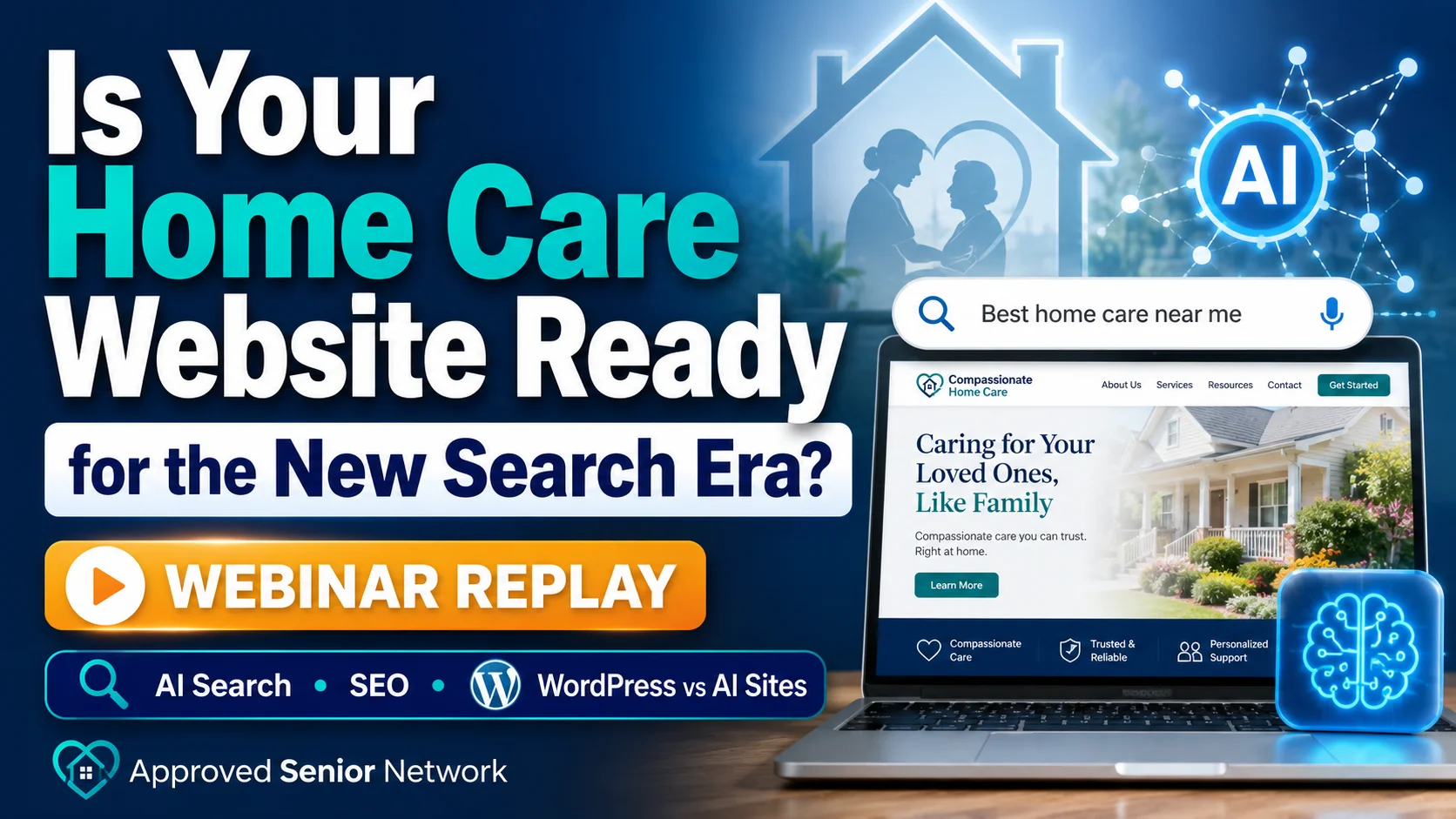
In our Home Care Marketing Mastermind: Is Your Home Care Website Ready for the New Search Era?, the Approved Senior Network team breaks down what home care agencies should understand about websites, SEO, AI search, WordPress, local visibility, and the rapidly changing search landscape.
If you've been wondering what matters, what doesn't, and what you should actually be doing next, watch the full replay.
Approved Senior Network® helps home care agencies combine strong online marketing with effective in-person business development so families and referral partners can find them, trust them, and choose them.