
Sales Training in Home Care: Why In-Person Business Development Still Drives Referral Growth
Annette ZieglerLead Sales and Marketing TrainerAugust 18, 2026
TL;DR: In-person business development remains one of the most effective ways for home care agencies to build trust with referral partners, strengthen professional relationships, and generate qualified referrals. Effective sales training in home care helps Community Liaisons and Business Development professionals move beyond brochure drop-offs by teaching them how to identify the right referral sources, ask better discovery questions, provide useful education, follow up consistently, ask for referrals confidently, and track results. The strongest agencies combine face-to-face relationship building with digital marketing, CRM tracking, role-playing, coaching, and measurable accountability. For how the pieces fit together as one system, see home care referral development.
_______________________________________
Digital marketing has transformed how families research care. Search engines, online reviews, websites, social media, email, and AI-powered search tools can all influence which agencies families discover.
But there is another side of agency growth that remains remarkably human.
A hospital social worker has a family that needs help after discharge.
An assisted living community has a resident who suddenly requires more one-on-one support.
A hospice organization is working with a family overwhelmed by caregiving responsibilities.
An elder law attorney has a client trying to determine how an aging parent can remain safely at home.
A geriatric care manager needs a dependable provider for a difficult case.
In situations like these, the organization that gets the call is not necessarily the one with the prettiest brochure, the most social media posts, or the salesperson who made the greatest number of drop-in visits.
It is often the organization the referral professional knows, understands, remembers, and trusts.
That is why effective sales training in home care must go beyond teaching people to make more visits.
The real goal is to teach Community Liaisons, marketers, owners, and Business Development professionals how to turn in-person activity into meaningful professional relationships—and those relationships into appropriate referral opportunities.
Home Care Is Growing, but So Is the Competition for Attention
The demographic case for in-home care is strong.
AARP's 2024 Home and Community Preferences Survey found that 75% of adults age 50 and older want to remain in their current homes as they age, while 73% want to remain in their communities. (AARP)
The U.S. Census Bureau has projected that by 2030, one in five Americans will be 65 or older. (Census.gov)
The Bureau of Labor Statistics also projects employment of home health and personal care aides to grow 17% between 2024 and 2034, substantially faster than the average for all occupations. (Bureau of Labor Statistics)
Those numbers point toward increasing demand.
But increasing demand does not guarantee that any individual agency will grow.
Families still have to discover the agency. Referral professionals still have to remember it. Prospective clients still have to understand why they should choose it. And the agency must still build enough confidence for someone to make a recommendation when a real need arises.
That is where professional relationship development becomes a competitive advantage.
Referrals Are Fundamentally Relationship-Driven
Professional referral sources have long played an important role in private-duty care.
Industry benchmarking cited by Activated Insights has identified hospital discharge planners, Medicare-certified home health agencies, skilled nursing facilities, hospices, geriatric care managers, Area Agency on Aging case managers, and assisted living communities among the sources generating referrals for agencies. Past and current clients and their families were the largest category in the benchmark. (Activated Insights)
The percentages will differ significantly by agency, payer mix, market, service model, and geography. The important point is the diversity of the referral ecosystem.
A strong Community Liaison may need to develop relationships with:
- Hospital social workers and discharge professionals
- Skilled nursing and rehabilitation facilities
- Assisted living communities
- Memory care communities
- Home health organizations
- Hospice providers
- Physicians and specialty practices
- Geriatric care managers and Aging Life Care professionals
- Elder law attorneys
- Estate and financial professionals
- Senior centers and community organizations
- Veterans organizations
- Faith communities
- Social service organizations
- Past clients and their families
Those relationships rarely become productive because someone delivered a brochure once.
They develop when a referral professional repeatedly sees evidence that the agency is responsive, useful, credible, knowledgeable, and reliable.
Why In-Person Interaction Still Has an Advantage
There is no credible reason to abandon email, LinkedIn, phone calls, digital marketing, or automated follow-up. A modern agency should use all of them.
But face-to-face interaction offers something those channels cannot completely reproduce.
Research on interpersonal requests provides an interesting example. In experiments comparing requests made face-to-face with requests made by email, researchers found that people tended to underestimate the effectiveness of asking in person while overestimating the effectiveness of email requests. The researchers pointed to factors including suspicion and reduced empathy in email communication. (eCommons)
That study was not about senior care referrals, so it should not be interpreted as a direct measurement of agency business development.
But the underlying principle is relevant: communication channels change how people perceive the person making the request.
Healthcare research reinforces the importance of relationships.
A study of clinician coordination found that specialists who personally knew a greater proportion of their referring primary care clinicians reported better overall coordination, relationships, role clarity, communication, and data transfer. (PubMed Central (PMC))
A 2026 scoping review examining trust-building strategies across 327 studies found that interpersonal communication was among the recurring approaches used to build, maintain, or repair trust. (PubMed)
Again, these studies are not measurements of private-duty referral development.
They do, however, point toward an important lesson for agencies:
Relationships matter in healthcare ecosystems because people are being asked to trust other people with consequential decisions.
Referral Professionals Are Protecting Their Own Reputation
It is easy for a Business Development representative to think about a referral primarily as an opportunity for the agency.
The person making the referral may see it very differently.
Imagine a social worker recommends an agency to a family.
If no one answers the phone, the family may call the social worker again.
If the agency takes two days to complete an assessment, the social worker may hear about it.
If the family is confused about pricing, scheduling, or what services are actually available, the person who made the recommendation may feel that frustration.
A referral source therefore has something at stake.
Their own credibility is attached to the recommendation.
This is one reason simply explaining that an agency provides "high-quality compassionate care" has limited value. Virtually every agency makes similar claims.
A referral professional wants evidence that answers practical questions:
- Will you answer when I call?
- Can you help this type of client?
- How quickly can you respond?
- What happens after I send someone to you?
- Will you communicate professionally with the family?
- Do you serve the location where this client lives?
- Can you staff the hours being requested?
- What situations are not a good fit for your agency?
- Who do I contact when there is a problem?
- Will referring this family to you create another problem for me—or solve one?
Effective sales training for home care teaches representatives to understand those concerns before they start talking about themselves.
Relationships Can Influence Healthcare Referral Decisions
Recent research involving post-acute home health provides another useful perspective.
A 2026 study published in The American Journal of Managed Care interviewed leaders from Medicare Advantage plans, care management companies, and home health agencies about post-acute referrals. Participants reported that hospitals prioritized factors including responsiveness, ease of working with a provider, ability to begin care quickly, and prior relationships. Relationships between providers were reported as playing a significant role in decision-making. (AJMC)
This research concerns Medicare-certified skilled home health rather than private-pay non-medical services, so the two markets should not be treated as identical.
However, the findings illustrate something Community Liaisons encounter every day:
Referral decisions do not happen in a vacuum.
Operational capabilities matter.
Responsiveness matters.
Reputation matters.
Past experiences matter.
And professional relationships matter.
This is why Business Development cannot be separated completely from operations. A great representative may open a referral relationship, but the agency must deliver the experience that gives that professional a reason to refer again.
The Problem With "Brochure Drop" Business Development
Agency owners sometimes describe a marketer as being extremely busy.
They leave the office every morning.
They attend networking events.
They bring lunches.
They visit facilities.
They distribute promotional materials.
They stop by physician offices.
They return with business cards.
But months later, referral volume has barely moved.
The problem is not necessarily effort.
The problem is that activity and progress are not the same thing.
A representative can make 30 visits and accomplish very little if those visits consist primarily of:
"Hi, I'm just checking in. Here's our latest flyer. Let me know if you need anything."
That interaction gives the referral partner almost no new reason to remember the agency.
Productive in-person business development has an objective.
The representative should know:
- Why this account matters.
- Which person inside the organization matters.
- What that person's challenges are.
- What the agency could legitimately help them solve.
- What happened during the previous interaction.
- What the next step should be.
- How the relationship is progressing toward a referral opportunity.
Without that structure, a Community Liaison can be extremely active while producing very little measurable growth.
The Community Liaison Should Be a Resource, Not a Walking Advertisement
One of the most important changes sales training in home care can produce is a shift in how the representative sees the job.
The goal is not simply to "promote the agency."
The goal is to become useful to the community surrounding the agency.
Consider the difference.
A promotional representative asks:
"How can I get them to send us referrals?"
A relationship-focused Community Liaison asks:
"What problems does this organization encounter involving older adults and families, and where can we legitimately help?"
That change affects the entire conversation.
Instead of opening with a speech about the agency, the representative begins asking questions.
What challenges are families experiencing after discharge?
Are residents struggling because they need assistance beyond what the community provides?
Are adult children calling the facility because they do not understand the difference between different types of care?
Are there times of day when residents need extra one-on-one assistance?
What tends to make outside providers difficult to work with?
What information would make it easier for staff to explain care options to families?
The Community Liaison learns first.
Then the agency's services can be positioned in the context of an actual problem.
Seven Ways In-Person Business Development Can Impact an Agency
1. It Builds Familiarity Before the Need Occurs
Referral professionals frequently make decisions under time pressure.
The worst time to introduce an agency may be the exact moment a social worker desperately needs a solution.
Consistent relationship development allows familiarity to exist before the urgent situation occurs.
The agency is no longer an unknown name on a list.
It becomes:
"I know Sarah from that agency. Let me call her."
That is a fundamentally different competitive position.
2. It Allows the Representative to Read the Room
Face-to-face conversations provide contextual information that is difficult to gather through email.
Is the contact engaged?
Are they rushed?
Did a particular topic get their attention?
Are several employees asking the same question?
Does the organization misunderstand what non-medical services can provide?
Is there a problem no one has explicitly articulated yet?
Strong representatives learn to observe, listen, and adapt.
3. It Makes Complex Services Easier to Explain
Families and professionals do not always understand where one type of senior service ends and another begins.
A knowledgeable liaison can explain:
- What the agency does
- What it does not do
- Who is an appropriate client
- How services begin
- What families can expect
- How care coordinates with other providers
- When another type of organization would be more appropriate
That educational role builds credibility.
4. It Creates Opportunities for In-Services and Education
One-on-one introductions can develop into larger educational opportunities.
An effective in-service can position an agency as a knowledgeable community resource rather than another organization asking for referrals.
Topics might include:
- Recognizing when an older adult may need additional support
- Planning for a safer transition home
- Supporting family caregivers
- Understanding companion and personal care options
- Reducing caregiver burnout
- Preparing families for changing care needs
- Dementia-related caregiver education
- Questions families should ask when evaluating providers
The objective is to teach something valuable while allowing the referral organization to experience the agency's expertise.
5. It Creates a Natural Path Toward Asking for the Referral
Many representatives become comfortable building relationships but never become comfortable asking for business.
That creates a different problem.
They become well liked but commercially ineffective.
A relationship should eventually progress.
When there is appropriate fit and sufficient credibility, a trained representative should be able to say, in natural language:
"The next time you work with a family who needs this type of support, would you be comfortable introducing us?"
Asking does not need to feel aggressive.
But it does need to happen.
6. It Produces Real-Time Market Intelligence
A good Business Development professional becomes an agency's eyes and ears in the community.
They hear:
- What families are asking for
- Which competitors are being discussed
- Where staffing gaps exist
- Which organizations have changed leadership
- What objections families are raising
- Which referral sources are underserved
- Which services the market is struggling to find
- How the agency's reputation is perceived
That intelligence can influence far more than referrals. It can help guide operations, service offerings, content, messaging, recruitment, pricing conversations, and strategic planning.
7. It Creates a Feedback Loop Between Referrals and Operations
Referral relationships become stronger when communication does not end after the introduction.
When permitted and appropriate, referral partners benefit from knowing that the agency responded promptly and handled the inquiry professionally.
Likewise, the Business Development team needs to know what happened after a referral entered the agency.
Was the prospect reached?
Was an assessment scheduled?
Did services begin?
Why was the case lost?
Was the requested schedule impossible to staff?
Without that information, representatives cannot learn which relationships are producing the right opportunities—or identify operational issues affecting conversion.
What Sales Training in Home Care Should Actually Teach
Generic persuasion techniques are not enough.
Someone representing an agency in hospitals, senior living communities, rehabilitation facilities, physician offices, hospices, and community organizations needs industry-specific skills.
A comprehensive training program should address at least the following areas.
Territory and Account Prioritization
Not every possible referral source deserves equal time.
Representatives should learn how to identify high-value accounts, map territories, group visits efficiently, distinguish strategic accounts from low-potential stops, and allocate their time accordingly.
Identifying the Right Decision-Makers
The first person encountered is not necessarily the person who influences referrals.
A Community Liaison needs to understand organizational structures and determine who actually interacts with families experiencing the problems the agency can solve.
Navigating Gatekeepers Professionally
Trying to "get past" a gatekeeper should never mean disrespecting them.
Receptionists, office managers, administrators, and support staff often know exactly how an organization works.
Professionalism at every level matters.
Discovery Questions
Representatives should be trained to ask questions before presenting solutions.
Good discovery uncovers needs.
Poor discovery turns every meeting into the same memorized speech.
Communicating a Clear Value Proposition
Why should this referral source remember your agency rather than another provider?
The answer should be specific, credible, and relevant to that particular audience.
Conducting Effective In-Services
A successful presentation should educate.
Representatives need to know how to select useful topics, engage participants, demonstrate expertise, collect follow-up opportunities, and create a logical next step.
Following Up With Purpose
"Just checking in" is not a strategy.
Every follow-up should have a reason.
That could include a useful resource, an answer to a previous question, an invitation, an educational opportunity, an update, or a relevant conversation.
Asking for Referrals
Representatives need practice recognizing when a relationship has developed far enough to make an appropriate ask.
They also need language that feels confident without becoming pushy.
Handling Objections
"We already have providers."
"We don't keep a preferred list."
"Families choose their own agencies."
"We don't get many people who need that."
"We're happy with who we use."
Training should prepare representatives to continue productive conversations rather than become defensive or immediately retreat.
Tracking Relationships
Human relationships are at the center of the strategy, but data should guide the process.
Representatives should document contacts, interactions, opportunities, referrals, outcomes, and next actions so the agency can see what is progressing.
Why Role-Playing and Coaching Matter
Knowing what to say conceptually is different from being able to say it when standing in front of a hospital social worker or executive director.
Skills improve through practice.
Research into deliberate practice across professional learning environments emphasizes repetitive performance, clear objectives, assessment, and specific feedback rather than simple exposure to information. Research involving simulation-based healthcare education similarly identifies repeated practice and directed feedback as important components of skill development. (PubMed Central (PMC))
The exact context is different, but the learning principle translates well to Business Development.
A representative can practice:
- Opening a conversation
- Explaining the agency in 30 seconds
- Responding to a gatekeeper
- Asking discovery questions
- Transitioning from conversation to opportunity
- Handling a common objection
- Asking for an in-service
- Asking for a referral
- Following up after a meeting
Then a coach can identify what sounded natural, what created confusion, and what should change before the representative encounters the situation in the field.
That is far more actionable than simply telling someone to "go build relationships."
Management Must Know How to Manage the Process
Training the Community Liaison while leaving management without a framework creates another common failure point.
An owner asks:
"How did this week go?"
The representative says:
"Great. I made a lot of visits."
That tells management almost nothing.
Managers should understand the difference between leading indicators and business outcomes.
Leading indicators might include:
- Target accounts visited
- Meaningful decision-maker conversations
- New contacts established
- Follow-ups completed
- In-services scheduled
- In-services delivered
- Previously dormant accounts reactivated
- Referral asks made
- New accounts progressing through the relationship pipeline
Outcome metrics might include:
- Referrals by source
- Qualified inquiries
- Assessments
- New clients
- Referral-to-client conversion
- Initial weekly service hours
- Revenue associated with referral sources
- Growth from newly activated referral partners
- Referral concentration by account
The purpose is not to micromanage every movement.
It is to determine which activity produces results.
More Activity Is Not Always the Answer
Imagine two Community Liaisons.
Representative A makes 60 facility stops during the month.
Representative B makes 35.
At first glance, Representative A appears more productive.
But suppose Representative B also:
- Met 18 actual decision-makers
- Conducted four in-services
- Activated three previously non-referring accounts
- Generated eight qualified referrals
- Identified a recurring transition problem at a major facility
- Documented every next step
- Followed up on each referral
Meanwhile, most of Representative A's visits were brochure drop-offs.
The number of stops alone would tell management the wrong story.
Effective sales training in home care therefore teaches people not only what to do, but what to measure.
Digital Marketing and In-Person Business Development Should Work Together
This should not be framed as digital versus in-person.
The strongest strategy connects them.
Before a Community Liaison visits an account, they might research the organization and key contacts on LinkedIn.
After an introduction, the referral professional may visit the agency's website.
After an in-service, the representative might send a useful article.
The contact may begin seeing the agency's educational posts online.
An automated CRM workflow may remind the representative when follow-up is due.
Strong Google reviews may reinforce credibility.
A helpful email may keep the agency visible between visits.
Digital channels reinforce the relationship.
The relationship gives the digital communication context.
The result is an integrated system rather than a collection of disconnected marketing activities.
How Long Does It Take for Relationship Development to Work?
Agency owners frequently want to know how quickly a newly hired Community Liaison should generate referrals.
There is no universal number.
Results depend on:
- Existing agency reputation
- Market competition
- Territory size
- Referral source mix
- The representative's experience
- Existing relationships
- Agency responsiveness
- Staffing capacity
- Service offerings
- Follow-up consistency
- Quality of training
- Management support
Some relationships may produce an opportunity quickly.
Others take repeated interactions.
The more useful question is:
Are the right relationships moving forward?
Within the first several months, management should be able to see evidence of progression even when every account has not yet produced revenue.
The representative should be gaining access to decision-makers, scheduling educational opportunities, improving conversations, discovering needs, receiving introductions, generating initial referrals, and learning which accounts deserve additional investment.
Signs Your Agency May Need Better Business Development Training
Sales training for home care may be worth evaluating when:
- Your representative is making many visits but producing few referrals.
- Most visits consist of dropping off promotional materials.
- The salesperson struggles to explain what makes the agency different.
- Referral sources know the representative personally but rarely send opportunities.
- The representative is uncomfortable asking for business.
- Follow-up is inconsistent.
- Management does not know what the representative does each week.
- Referral relationships disappear when one employee leaves.
- Your CRM contains contacts but little useful relationship history.
- In-services are presentations with no follow-up plan.
- New Business Development hires receive very little structured onboarding.
- You cannot connect field activity to referrals, clients, service hours, or revenue.
- The team spends equal time on high-value and low-value accounts.
- Your agency relies excessively on one or two major referral relationships.
These problems are rarely solved by simply telling someone to "work harder."
They usually require a clearer system.
Compliance Must Be Part of Professional Referral Development
Relationship building in healthcare must also remain ethical and compliant.
For business involving federal healthcare programs, the federal Anti-Kickback Statute prohibits knowingly offering, paying, soliciting, or receiving remuneration to induce or reward referrals or generate business reimbursable by federal healthcare programs. HHS OIG notes that remuneration can include things of value beyond direct cash payments. (HHS Office of Inspector General)
State laws and payer requirements can create additional obligations.
Agencies should therefore establish appropriate policies around meals, gifts, referral arrangements, compensation, events, and other relationship-development activities and obtain qualified legal guidance when necessary.
The purpose of professional Business Development is to earn trust through service, education, expertise, communication, and reliability—not to buy access to referrals.
The Bigger Lesson: Agencies Need a Repeatable Relationship System
The most important impact of in-person business development may not be any single referral.
It is the creation of a repeatable system through which the agency becomes connected to the professional community around it.
That system should help a Community Liaison consistently:
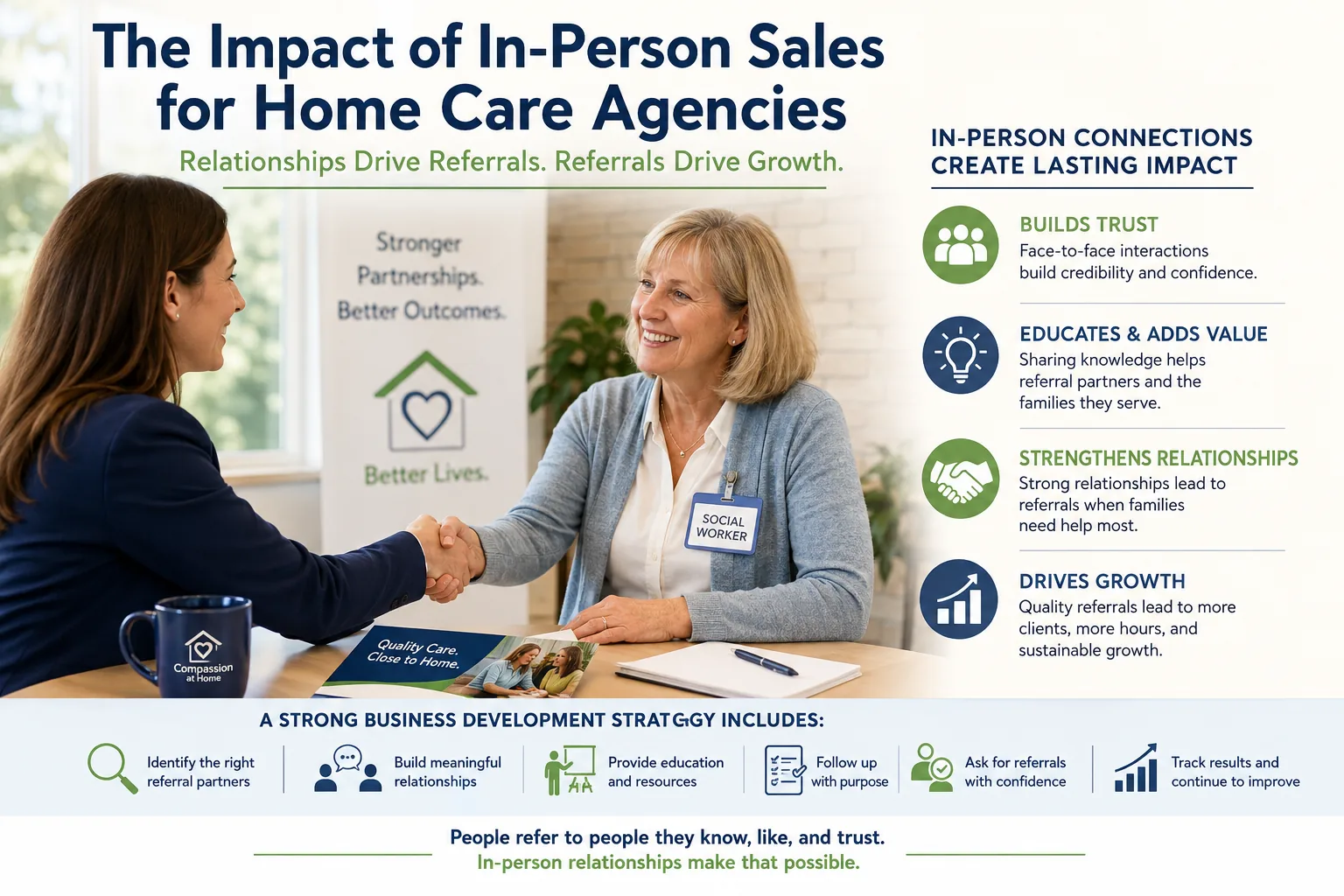
Identify → Research → Approach → Discover → Educate → Follow Up → Ask → Track → Improve
When those steps are taught, practiced, measured, and coached, Business Development becomes less dependent on personality and improvisation.
A new representative has a process to follow.
An experienced representative has benchmarks against which to improve.
Management has greater visibility.
Referral relationships become organizational assets instead of information stored inside one employee's head.
And the agency can make better decisions about where to invest its time.
Where GoCarePro Sales Training Fits
Approved Senior Network developed GoCarePro Sales Training specifically around the real situations agency representatives face in the field.
The program combines structured live instruction with role-playing, implementation assignments, referral tracking, field tools, ongoing coaching, and accountability. The curriculum includes referral-source prioritization, gatekeepers, skilled nursing facilities, assisted living and memory care communities, home health and hospice relationships, in-services, referral asks, LinkedIn support, and performance tracking. (Approved Senior Network)
The emphasis is not simply on learning more about selling.
It is on improving what Community Liaisons and Business Development professionals actually do when they walk into a referral source.
Recommended internal link: Link the phrase GoCarePro Sales Training above to the main GoCarePro page.
In-Person Business Development Still Matters Because Trust Still Matters
Technology will continue changing how agencies market themselves.
AI search will change discovery.
Automation will change follow-up.
CRM systems will improve tracking.
Digital advertising will become more sophisticated.
But none of those technologies eliminate the human question occurring inside a hospital, senior living community, physician office, hospice organization, or elder care practice:
"Who do I trust to help this family?"
That is why in-person relationship development still matters.
And it is why effective sales training in home care should not focus merely on making representatives busier.
It should make them more strategic, more useful, more confident, more accountable, and better at building the professional relationships that ultimately create referral opportunities.
Frequently Asked Questions About Sales Training in Home Care
What is sales training in home care?
Sales training in home care teaches owners, Community Liaisons, marketers, and Business Development professionals how to identify referral opportunities, develop professional relationships, communicate an agency's value, conduct productive meetings and in-services, follow up consistently, ask for referrals, and measure results.
Industry-specific training is particularly valuable because selling a personal service through healthcare and senior-service referral networks is different from selling a traditional consumer product.
Why is in-person business development important for home care agencies?
In-person interaction can help agencies develop familiarity, credibility, and professional relationships with the people who regularly encounter older adults and families needing support.
It also allows representatives to learn about referral-source needs, answer questions, provide education, gather market intelligence, and establish a human connection that digital communication can reinforce later.
What does a Community Liaison do for a home care agency?
A Community Liaison develops relationships with organizations and professionals that serve older adults and their families.
Depending on the agency and market, that may include hospitals, senior living communities, rehabilitation facilities, home health providers, hospices, physician practices, geriatric care managers, elder law attorneys, senior organizations, and other community partners.
The strongest Community Liaisons do more than make introductions. They research accounts, identify needs, provide useful education, maintain relationships, create referral opportunities, and communicate information between the market and agency leadership.
How should an agency measure Business Development performance?
Agencies should monitor both activity and outcomes.
Activity metrics can include decision-maker conversations, account visits, follow-ups, in-services, referral asks, and new relationships.
Outcome metrics can include qualified referrals, assessments, new clients, conversion rates, service hours, revenue, activated referral accounts, and referral trends by source.
The goal is to determine whether field activity is progressing toward meaningful business results.
Can digital marketing replace in-person relationship development?
Usually not completely.
Digital marketing and field-based relationship development serve different purposes.
A website, search visibility, reviews, social media, email, CRM automation, and educational content can help build awareness and credibility. In-person interaction can deepen relationships with professional referral sources.
For many agencies, the strongest approach is an integrated strategy in which digital channels support relationships before and after face-to-face interaction.
What should sales training for home care include?
A comprehensive program should include territory planning, referral-source prioritization, decision-maker identification, gatekeeper strategies, discovery questions, value propositions, in-service presentations, objection handling, asking for referrals, follow-up strategy, relationship tracking, role-playing, KPIs, and ongoing coaching.
Training should also help management understand how to evaluate progress and connect field activity to referral and revenue outcomes.
Is GoCarePro designed for new or experienced Community Liaisons?
GoCarePro Sales Training is designed to support both newer representatives who need a structured foundation and experienced Business Development professionals who need stronger systems, accountability, coaching, or new approaches to referral relationships. The current GoCarePro program combines 12 weeks of live instruction with field implementation, tools, referral tracking, role-playing, and ongoing coaching. (Approved Senior Network)
Research Sources
This article draws on research and data from the U.S. Bureau of Labor Statistics, U.S. Census Bureau, AARP, The American Journal of Managed Care, PubMed-indexed research on trust and professional communication, Cornell University research on face-to-face requests, healthcare coordination research, HHS Office of Inspector General guidance, and industry referral benchmarking reported by Activated Insights. (Bureau of Labor Statistics)
Compliance information in this article is provided for general educational purposes and is not legal advice.