
Schema markup for home care websites, explained for non-developers

Mark BatemanDirector of Web DevelopmentAugust 19, 2026
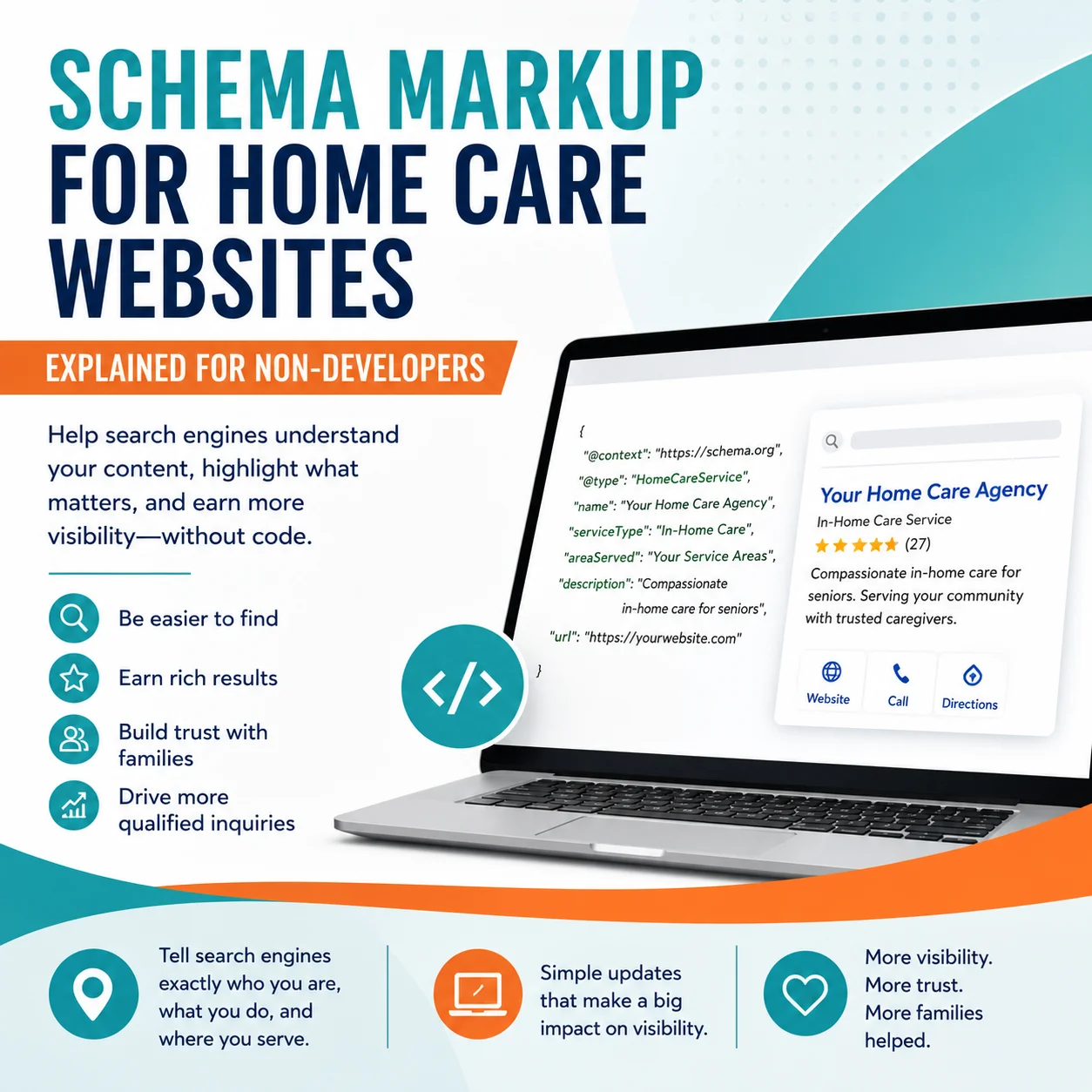
TL;DR: Schema markup is structured data that helps machines understand what information on a webpage represents. It is useful, but it is not magic. In 2026, Google explicitly says there is no special schema required for its generative AI features, and correctly implemented structured data does not guarantee a rich result or higher ranking. For home care agencies, the practical job is to make the real business, locations, services, authors, and page content clear - then use appropriate structured data to describe what is visibly true on the page.
What schema is - and what it is not
A webpage is written for people. Structured data adds machine-readable labels to information that is already on the page.
For example, structured data can help identify:
- The organization behind the site
- A local business location
- A person or author
- A service described on a page
- A page's breadcrumb trail
- Other content types supported by schema.org or Google Search features
Schema does not replace good content. It does not create expertise that is missing from the page. It does not give a home care agency guaranteed placement in Google, ChatGPT, or an AI answer.
Google's current generative-AI guidance says there are no special additional requirements or unique schema types needed for AI Overviews or AI Mode. The fundamentals still matter.
That makes schema one supporting layer of AI and local search visibility, not the strategy itself.
For the larger context, see AI search and home care marketing and what actually works in home care marketing now.
Start with the entity: who is this business?
The most important schema question for many agencies is not "How many schema types can we add?"
It is:
Can a machine clearly identify the organization or local business represented on this site?
For a home care website, organization or local-business information may include:
- Public business name
- Canonical website URL
- Logo
- Phone number
- Real address when appropriate
- Service area information when represented accurately
- Business hours
- Social or profile links where appropriate
Google's LocalBusiness documentation says LocalBusiness structured data can tell Google about business details. Google also recommends defining each real local business location separately and using the most specific appropriate subtype available.
ASN entity consistency rule
Before touching schema, compare:
- Website footer/contact page
- Google Business Profile
- Organization/local-business structured data
- Major directory listings
If the name, location, phone, or business identity conflicts across those sources, fix the facts before adding more markup.
Use Organization or LocalBusiness intentionally
A single-location agency with a legitimate office may use LocalBusiness-related markup on an appropriate page, often alongside broader Organization information.
A multi-location organization needs a clear model for the parent brand and each legitimate location.
The implementation depends on the site's architecture. The important part is not to create schema entities for offices, departments, or locations that do not actually exist.
Question for your web company
"Show me which entity represents the parent organization and which entities represent our real operating locations."
If the answer is "we put the same LocalBusiness block on every page," ask for a more careful explanation.
What about Service schema?
Schema.org includes a Service type that can describe a service being offered. A home care agency may use structured data to describe visible service information when the implementation is technically appropriate.
But two distinctions matter:
- A schema.org type can exist even when Google does not offer a special rich-result feature for it.
- Adding structured data does not mean a page will rank for the service.
The visible service page still needs to explain who the service helps, what it includes, how care starts, where it is offered, and why the agency is credible.
ASN service-markup rule
Never use schema to claim a service, credential, award, location, review, or capability that a visitor cannot verify from the visible page or the real business.
What about FAQPage schema in 2026?
This is where old SEO advice can cause confusion.
Frequently asked questions are still valuable content when they answer real family questions.
However, Google phased out FAQ rich results, and its 2026 documentation updates state that the FAQ rich-result feature is no longer shown in Google Search results.
So if your content management system still generates FAQPage markup from visible FAQs, treat that as descriptive structure - not a promise of expanded Google results and not an AI-search shortcut.
Do not write filler FAQs simply to create markup.
What about Person and author markup?
Real authorship is useful because it helps readers understand who created or reviewed the content.
Google's people-first content guidance strongly encourages clear, accurate authorship information when readers would expect it. Google also supports ProfilePage structured data for pages primarily focused on a person or organization that is affiliated with the overall website.
For ASN-style publishing, a strong author system includes:
- Real byline
- Author bio page
- Relevant professional background
- Consistent author identity across articles
- Person information nested appropriately in supported structured data when technically useful
The goal is not to manufacture an "expert entity." The goal is to accurately connect real people to the work they created or reviewed.
Do not confuse schema with rich-result eligibility
Google supports specific structured-data features for specific search appearances. The supported gallery changes over time.
That means your web team should separate three questions:
Question 1: Is this valid schema.org vocabulary?
Question 2: Does Google currently support a special search feature for it?
Question 3: Does this markup accurately describe visible content on our page?
Those are not the same question.
Google's general structured-data guidance also says that valid markup does not guarantee a rich result.
The five-minute schema inventory
Ask your web provider for a list like this:
| Template/page | Structured data present | Entity described | Auto or manual | Tested? |
|---|---|---|---|---|
| Homepage | Organization / LocalBusiness | Main agency | Auto | Yes/No |
| Location page | LocalBusiness or related | Real office/location | Auto | Yes/No |
| Service page | Service or other relevant data | Visible service | Auto | Yes/No |
| Blog post | Article + author | Article and real author | Auto | Yes/No |
| Author bio | ProfilePage / Person relationship | Real author | Auto | Yes/No |
| Breadcrumbs | BreadcrumbList | Site hierarchy | Auto | Yes/No |
The exact types depend on the site. The inventory is the important part.
How to test schema without becoming a developer
Use two kinds of tools:
Google Rich Results Test Use this to test structured data that Google supports for rich-result features.
Schema Markup Validator Use this to inspect general schema.org markup beyond Google's supported rich-result types.
Also use URL Inspection in Search Console to confirm Google can access and render the page.
A clean validator does not mean the content is good. It means the markup passed a technical check.
What to ask your web company
Use these questions:
- What structured data types are currently implemented?
- Which templates create them?
- Which business entity does the homepage describe?
- How are multiple locations handled?
- Does the markup match visible content?
- Are author pages and article bylines connected?
- Are we using any obsolete rich-result tactics?
- How do you test after a site update?
- Are you adding schema because it clarifies the page, or because someone promised an AI-ranking shortcut?
A strong provider should be able to answer without hiding behind jargon.
Schema should support strong home care website design, not distract from weak pages.
Frequently asked questions
Does schema improve rankings?
Do not treat schema as a ranking switch. Structured data helps machines understand page information and may enable supported search features, but Google does not guarantee rich results or higher rankings because markup is present.
Do we need special AI schema?
No for Google's generative AI features. Google's current guidance says no special additional schema is required for AI Overviews or AI Mode.
Can I add schema without a developer?
Some platforms and plugins can generate it automatically. The harder part is making sure the entity model and data are accurate. If you are unsure, involve the person responsible for the site.
How do I test my schema?
Use Google's Rich Results Test for Google-supported features and Schema.org's validator for broader schema markup. Test representative templates, not just the homepage.
Should every page have every schema type?
No. Use structured data that accurately describes the content and entity represented on that page.
Primary sources
- Google Search: Generative AI optimization guide: https://developers.google.com/search/docs/fundamentals/ai-optimization-guide
- Google Search: LocalBusiness structured data: https://developers.google.com/search/docs/appearance/structured-data/local-business
- Google Search: General structured data guidelines: https://developers.google.com/search/docs/appearance/structured-data/sd-policies
- Google Search: Supported structured-data gallery: https://developers.google.com/search/docs/appearance/structured-data/search-gallery
- Google Search: Documentation updates, including FAQ rich-result retirement: https://developers.google.com/search/updates
- Google Search: ProfilePage structured data: https://developers.google.com/search/docs/appearance/structured-data/profile-page
- Schema.org validator: https://validator.schema.org/