
Why Home Care Assessments Don’t Turn Into Clients
Dawn FialaHome Care Expert, Sales and OperationsOctober 1, 2026
The family agreed to an assessment.
You went to the home, spent an hour talking, answered their questions, and thought everything went pretty well.
Then nothing happens.
No signed agreement. No start of care. Maybe the family says they need to “talk about it.”
What went wrong?
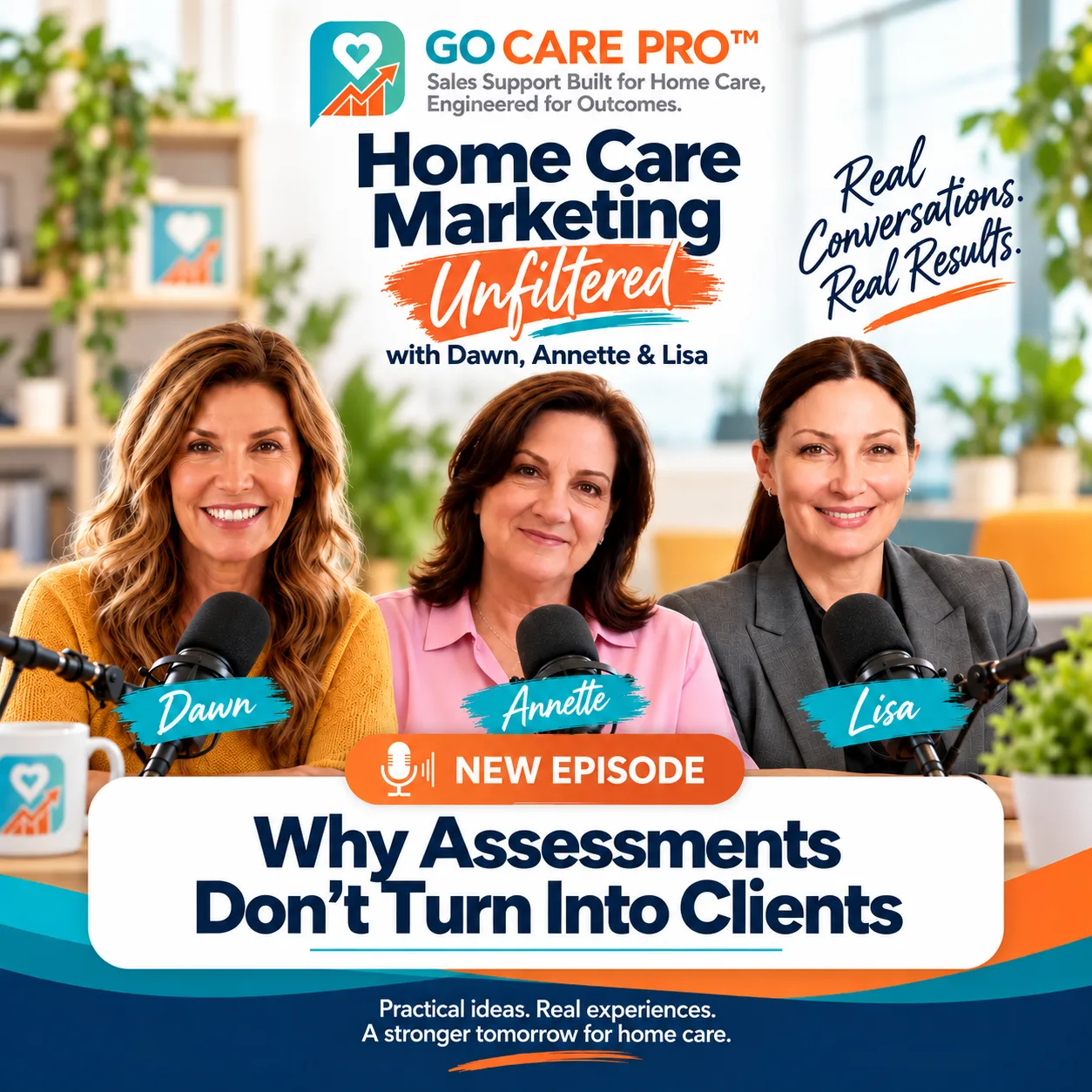
In this episode of Home Care Marketing Unfiltered, Dawn, Annette, and Lisa dig into one of the most important moments in home care growth: what happens between “Yes, come meet with us” and “Yes, let’s start care.”
One of the biggest problems they see is surprisingly simple:
The person conducting the assessment never really takes the role of the expert.
The Family Called Because They Need Your Recommendation
An assessment is not just a friendly conversation about what services your agency offers.
It is an assessment.
The family expects you to evaluate what is happening and make a recommendation.
As Dawn explains, even if someone is relatively new to home care, they likely understand more about care options than the family does. The family is looking to that person to assess the situation and explain what kind of support makes sense.
That means asking questions.
Walking through the home—with permission.
Looking at practical concerns.
If bathing is part of the care plan, which bathroom makes sense?
Will mobility equipment fit where it needs to go?
What household tasks are becoming difficult?
What is happening during the parts of the day when nobody is there?
And when you have gathered that information, the family should hear an actual recommendation.
Not:
“What do you think you need?”
Not:
“Does 20 hours sound okay?”
Instead:
“Based on what I’m seeing today, I recommend three days a week, four hours at a time, and here’s why.”
The hosts emphasize that families need both the recommendation and the reasoning behind it.
Too Many Choices Can Stop the Decision
Home care can already feel overwhelming to families.
They are often making decisions during a hospital discharge, after a fall, following a health change, or during a difficult conversation about a parent who insists they do not need help.
Giving them even more decisions may not help.
Dawn talks about the importance of avoiding an assessment that sounds like a menu:
Would you like Mondays?
Three hours or four?
Should we do bathing?
Would you like companionship?
What do you think?
The family did not invite you into the home because they already knew the answer.
They want guidance.
Your role is to say:
“Here is what I believe will work based on what you’ve told me and what I’ve seen.”
That is very different from being pushy.
It is being useful.
What If Mom Absolutely Does Not Want Home Care?
This is where home care assessments become much more complex.
Often, the adult children want care.
The older adult does not.
Annette describes one technique she used with seniors who were strongly resisting help:
Make the decision smaller.
Instead of presenting care as a permanent change, she would suggest trying it for two weeks.
A caregiver could come for a short period. Then they would reevaluate.
That gave the senior a sense of choice instead of making them feel cornered.
And sometimes, after two weeks, Mom discovered that she really liked the caregiver.
The commitment did not feel permanent.
But it created enough space for the family to experience what good care could actually look like.
Don’t Back the Senior Into a Corner
Dawn shares another approach that helped families when the older adult viewed the adult child as simply trying to tell them what to do.
She would redirect the conversation.
She might ask the parent to remember what it felt like when their child was young.
Remember worrying about them at school?
Remember wanting to know they were okay?
That is what your daughter is feeling now.
She is worried about you.
That framing sometimes completely changed the emotion in the room.
The conversation stopped being:
“My daughter is trying to control me.”
And became:
“My daughter is worried because she loves me.”
That is a very different starting point.
Sometimes Home Care Is the Step That Helps Them Stay Home
There are circumstances where safety has become a serious concern.
Dawn describes situations where essentially everyone in the room recognizes that something needs to change except the senior.
In the appropriate situation, she would bring up the reality that the next step after home care might eventually be moving somewhere with more support.
Not as a threat.
But as context.
If staying home is important, then accepting some help may be what makes staying home possible.
That conversation needs judgment.
As Dawn says in the episode, you have to read the room.
Not every technique belongs in every assessment.
An Assessment Is a Little Like a Game of Chess
One of the best descriptions in the episode is that an assessment can feel like a game of chess.
You walk into a family dynamic.
Who wants care?
Who does not?
Who is paying?
Who is worried?
Who feels guilty?
Who thinks you should never have been invited into the house?
Sometimes the family even starts arguing while you are sitting there.
Dawn talks about viewing the opportunity to be in that room as a privilege.
The family has invited you into a major transition in their lives.
And you are also the neutral person in the room.
You cannot simply take sides.
Your role is to keep the conversation focused on the care needs and what will help this person remain as safe, comfortable, and independent as possible.
Ask the Question Behind the Question
Families sometimes say:
“We’re just thinking about home care.”
But why?
Something prompted the call.
Dawn suggests digging into that.
Was there a fall?
Did Mom break a hip?
Is showering becoming unsafe?
Is laundry getting harder?
Can she still carry the trash out?
Has she stopped going to bingo because she cannot drive?
The assessment should uncover the actual reasons the family is considering care.
Then your recommendation should connect directly to those needs.
If the family cannot clearly understand why the care you are recommending matters, it becomes much easier to postpone the decision.
The Assessment Should Not Become a Three-Hour Social Visit
Relationships matter.
Listening matters.
Talking to the senior matters.
But at some point, the assessment has to move forward.
Annette and Dawn both describe trying to keep most assessments to roughly an hour, allowing additional time when circumstances legitimately required it.
They also recall marketers who would spend two or three hours in a home, come out talking about how lovely the client was—and still not have an agreement signed.
As Dawn puts it:
“This is not social hour.”
The point is not to rush people.
The point is to lead the process.
You should know where you are in the assessment.
You should know the next step.
And the family should know what comes next too.
You Have to Close
This is where some otherwise excellent marketers struggle.
They build rapport.
They explain the service.
The family seems interested.
Then the marketer gets uncomfortable when it is time to ask for the agreement.
So they soften everything:
“Why don’t you think about it?”
Or:
“I can leave this here and you can call me.”
The hosts are clear about this:
You need a natural transition into the agreement.
Dawn describes moving into it as the obvious next step:
“So we’re probably going to want to start on Thursday, right?”
Then:
“Once the agreement is signed, we can start working on your caregiver match.”
From there, she reviews the agreement while placing it in the family’s hands.
Annette describes a similar approach: summarize the schedule you have agreed on, explain that the paperwork needs to be completed before the office can begin scheduling, review the important terms, and show them where to sign.
You are not suddenly changing personalities and becoming a salesperson.
You are simply moving the assessment to its logical next step.
Make the Agreement Feel Understandable, Not Scary
A care agreement can feel significant to a family.
So explain it.
Go through the rates.
Cancellation policy.
Holiday rates.
Important terms.
Make sure they understand what they are signing.
Dawn would even remind people:
“You’re not buying a house.”
It is an agreement for care, not a lifetime commitment.
Lisa discusses the same idea with electronic agreements. If DocuSign or a tablet is unfamiliar to an older adult, walk them through it.
Show them where to initial.
Explain each section.
Then explain what happens after they sign.
When will the scheduler call?
How will the caregiver be selected?
Will someone introduce the caregiver?
When does care begin?
Uncertainty decreases when the family knows the next steps.
One Rule From All Three: Do Not Leave the Agreement Behind
Dawn asks Lisa and Annette directly:
Do you ever leave an unsigned agreement in the home?
The answer from both is immediate:
Never.
Their reasoning is practical.
If the family will not sign while you are there answering questions and discussing their needs, leaving the agreement behind rarely improves your chances.
Once you leave, the urgency disappears.
The conversation disappears.
The agreement ends up sitting on a table.
The hosts describe this as one of the reasons some assessments fail to close.
If there is a genuine issue preventing the family from proceeding, understand it.
But do not use “I’ll leave this here” as an escape because asking for the signature feels uncomfortable.
Being the Expert Is Not the Same as Being Pushy
That may be the biggest lesson in the episode.
The family has already taken a significant step by asking you to come into the home.
They are telling you:
We need help figuring this out.
Your job is not simply to describe home care.
Assess.
Recommend.
Explain why.
Address concerns.
Help the senior maintain a sense of control.
Then confidently guide the family through the next step.
If assessments repeatedly end with:
“We’ll think about it.”
it may be worth examining what happened between the initial conversation and the close.
Were you truly conducting an assessment?
Or were you having a very nice conversation and waiting for the family to tell you what they wanted?
Because as Dawn, Annette, and Lisa make clear:
Families often do not know exactly what they need. That is why they invited the home care expert into the room.
Listen to “Why Assessments Don’t Turn Into Clients” on Home Care Marketing Unfiltered for the full conversation with Dawn, Annette, and Lisa.
Assessment and closing skills are part of sales training in home care through GoCarePro.