
Your Brochure Isn’t a Referral Strategy: What Actually Gets Home Care Referrals
Dawn FialaHome Care Expert, Sales and OperationsSeptember 18, 2026
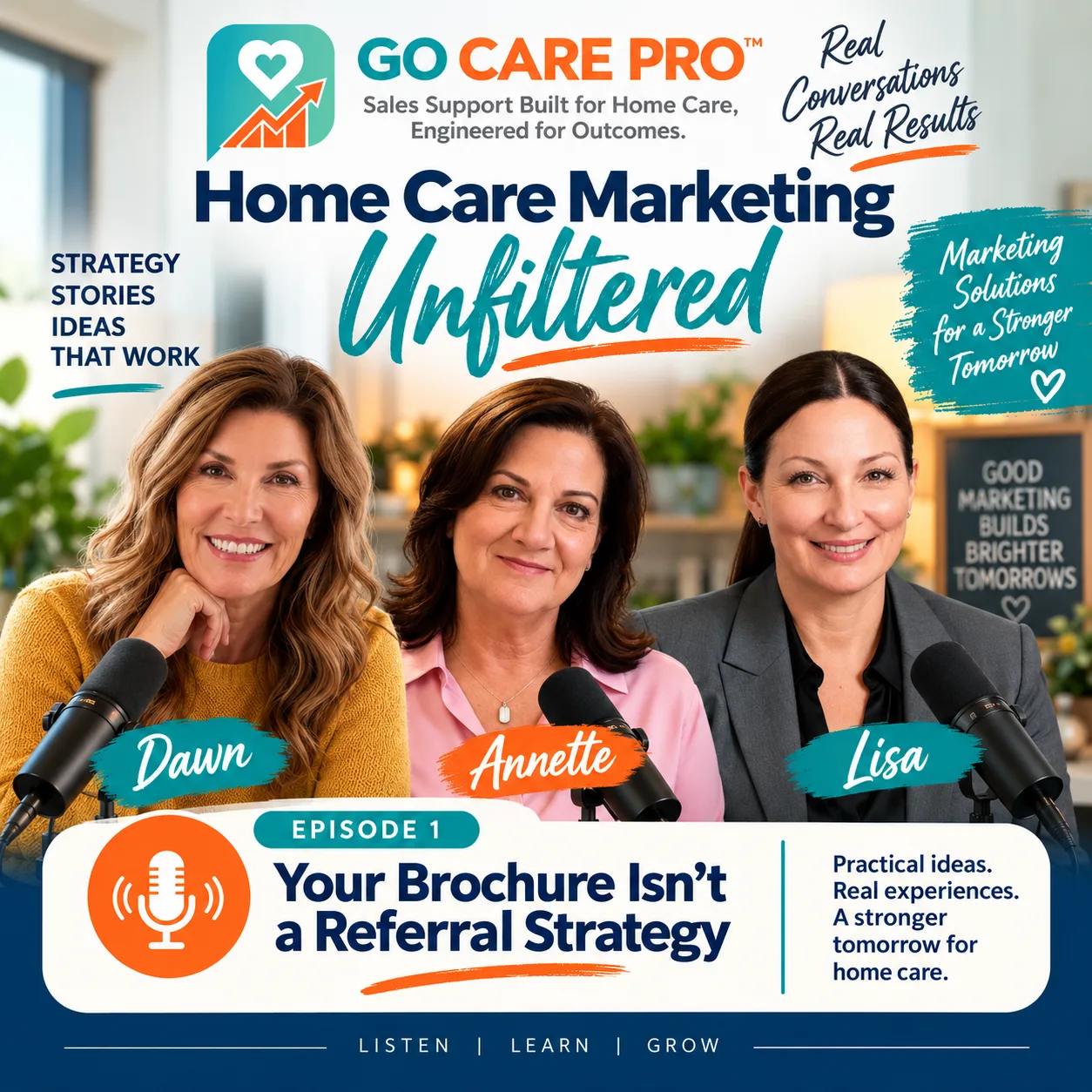
Listen to the Podcast Here: https://podcasts.apple.com/us/podcast/home-care-marketing-unfiltered-your-brochure-isnt-a/id933678323?i=1000789823501
If your home care marketer is spending the week driving around town dropping off brochures, you may technically be “marketing.”
But you probably don't have a referral strategy. What one looks like is laid out in home care referral development.
There is a big difference.
Home care agencies tell us all the time:
“We're out marketing, but we're not getting referrals.”
The first questions should be:
Where are you going?
How often are you going?
What are you bringing?
What are you saying when you get there?
And, most importantly, are you giving that referral source any reason to remember you after you leave?
Because another stack of brochures probably isn't going to do it.
Referral Sources Already Know What Home Care Is
Think about the people you're trying to reach.
Hospital discharge planners, social workers, rehabilitation centers, skilled nursing facilities, assisted living communities, physicians' offices and other senior care professionals see home care companies all the time.
They know what home care is.
They probably already have a drawer full of brochures from agencies that offer:
- Personal care
- Companion care
- Meal preparation
- Transportation
- Respite care
- Help around the home
If your marketing strategy is simply walking in and handing them another brochure describing roughly the same services as everyone else, you haven't given them much reason to remember you.
The goal isn't merely to show up.
The goal is to become memorable.
Give Yourself a Reason to Walk Through the Door
One of the biggest mistakes in referral marketing is visiting a referral source without a purpose.
Instead, create a reason for each visit.
September is Fall Prevention Month?
Great.
You could bring a simple fall-prevention resource for families along with an inexpensive pair of non-slip socks.
Now the visit has a theme.
The information is useful.
The small item reinforces the message.
And the referral source is far more likely to remember the person who brought the clever fall-prevention package than the person who dropped off brochure number 47.
This is what we often call situational referral marketing.
You connect your visit to something timely, relevant or useful.
It doesn't need to be expensive.
In fact, it shouldn't be.
Thoughtfulness matters far more than price.
Small, Creative Leave-Behinds Work
You don't need elaborate gifts.
You need something that makes someone stop for a second and think:
“That was clever.”
Or:
“They always bring the best stuff.”
Useful items work particularly well.
Think:
- Hand sanitizer
- Non-slip socks
- Seasonal items
- Small desk items
- Inexpensive treats tied to a theme
- Educational resources for patients or families
The item itself isn't really the strategy.
The memory is the strategy.
You are creating a small mental cue connecting your agency with that referral source.
And when a family suddenly needs home care?
You want your agency to be one of the first names that comes to mind.
Personalization Beats Price Every Time
Sometimes the best referral marketing idea costs almost nothing.
Dawn shared the story of a referral source who collected Pez dispensers.
While on vacation, she happened to see a Snoopy Pez dispenser and remembered that conversation.
It cost practically nothing.
But when she brought it back to the referral source, it meant something because she had remembered.
That says:
“I listened to you.”
“I remember you.”
“You aren't just another stop on my route.”
And that is exactly what relationship marketing is supposed to accomplish.
Home care is an incredibly personal, trust-driven business.
Referral relationships aren't much different.
Don't Try to Buy Referrals
There is an important distinction here.
Thoughtful is good.
Expensive is not.
Your goal should never be to buy someone's attention or make someone feel obligated to refer to you.
Large gifts can also create compliance issues for healthcare organizations and their employees.
The best leave-behinds are generally inexpensive, useful and tied to a legitimate relationship-building purpose.
You want referrals because professionals trust your agency and believe you will take good care of the people they send to you.
The little item simply helps make the interaction memorable.
Consistency Matters More Than One Great Visit
Another problem home care marketers face is discouragement.
You visit.
Then you visit again.
And again.
Nothing happens.
No referrals.
No calls.
Then suddenly you receive three assessments in one week.
What happened?
Often, the work you did several weeks ago is finally paying off.
Referral marketing has a lag.
That's why stopping when things feel slow can be so damaging.
Consistency matters.
Visiting important referral sources every 8 to 10 days keeps your agency visible without requiring a lengthy meeting every time.
And no, you don't need to speak with the decision-maker on every visit.
Sometimes a brief drop-off is enough.
Other times you'll want a conversation.
The goal is to become pleasantly persistent rather than becoming the salesperson everyone hides from.
Plan Your Marketing Before You Need It
Creative referral marketing is difficult to do when you're already overwhelmed.
That's why planning matters.
If it's September, you should already have October and November mapped out.
What are you bringing?
What theme are you using?
What needs to be ordered?
What needs to be printed?
What needs to be assembled?
Keep basic supplies in the car, too:
Tape.
Scissors.
Thank-you cards.
Business cards.
Labels.
A few simple items you can use for an unexpected visit.
The easier you make it to execute your strategy, the more likely your marketer will actually do it.
Your Marketer Should Be in the Field
One of the most important points in referral marketing is surprisingly simple:
Your marketer cannot generate referrals while sitting in the office all day.
Preparation matters, but preparation shouldn't consume selling time.
One strategy is turning staff meetings into an assembly line.
Someone cuts.
Someone hole-punches.
Someone attaches the cards.
Someone organizes the finished pieces.
Fifty leave-behinds can be assembled during a meeting while your marketer remains free to spend their working hours where they belong:
In the community.
Eventually, You Have to Ask for the Business
Relationship building does not mean avoiding the sale forever.
At some point, you have to ask.
That may sound like:
“Do you have anyone discharging this week who might need some help at home?”
Or:
“Is there anyone you're worried about going home alone?”
The exact conversation will vary depending on the referral source.
But simply dropping off cute items forever isn't enough either.
The relationship opens the door.
Trust keeps the door open.
Asking for the business gives the referral source an opportunity to actually use your services.
The Best Home Care Marketing Doesn't Feel Like Selling
Great home care marketers rarely come across as aggressive salespeople.
They believe in what they're offering.
They genuinely want to help.
They know their agency provides good care, and they want families to have access to it.
Referral sources can usually tell the difference between someone who walks into the building thinking:
“I need a referral today.”
And someone thinking:
“How can we help you and the families you're serving?”
Ironically, the second person is often much better at generating business.
Brochures Still Have a Place. They Just Aren't the Strategy.
You should have professional brochures.
You should have business cards.
You should have information explaining your services.
But those things are tools.
They aren't the referral strategy.
Your real strategy is:
Be visible. Be useful. Be memorable. Be consistent. Build relationships. Ask for the business. And then provide care worthy of the trust you've earned.
That's how referral relationships grow.
And that's how a home care agency becomes the company referral sources actually remember when someone says:
“We need help at home.”
For a referral strategy your marketer can follow week to week, see GoCarePro sales training.