
How to check your agency's AI search visibility in 30 minutes a month

Valerie VanBoovenFounder and Co-OwnerAugust 19, 2026
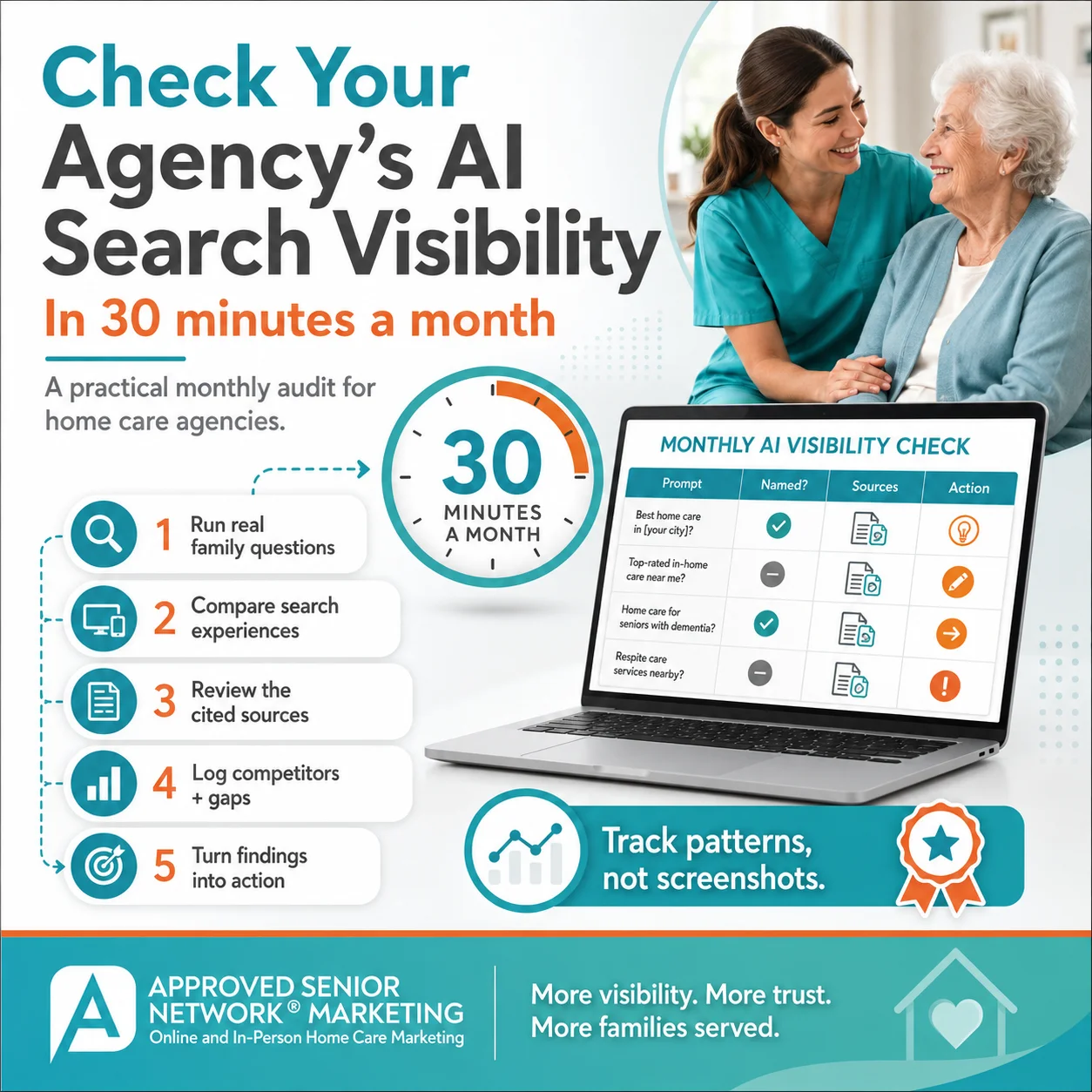
TL;DR: AI-search visibility should be audited like a recurring market-research exercise, not treated as a one-time screenshot. Once a month, run a consistent prompt set based on real family questions, record which agencies and sources appear, check whether your agency information is accurate, inspect cited pages, review Google's generative-AI Search Console data, and turn gaps into specific website, local, review, or authority tasks. Approved Senior Network recommends tracking patterns, not chasing individual answers.
Start with the right question
The old search question was often:
Do we rank on Google?
That still matters.
ASN's newer search-visibility question is:
Can search systems clearly understand who we are, what we do, where we serve, and why our information is trustworthy?
That framing matters because families now encounter information through traditional search results, Maps, Google AI features, ChatGPT search, other AI assistants, directories, review sites, and referral recommendations.
For the strategic foundation, read AI search and home care marketing and what actually works in home care marketing now.
Do not begin with your business name
If you ask an AI tool, "Tell me about ABC Home Care," you are testing whether it can find ABC Home Care.
That is not the same as testing whether an unfamiliar family will discover ABC Home Care.
Begin with non-branded family questions.
Use the ASN AI-visibility prompt matrix
Run a small, repeatable set. Replace bracketed text with the agency's real market and services.
Category + location
- "Home care agencies in [city]"
- "In-home care near [city]"
Service + location
- "Dementia home care in [city]"
- "Overnight home care in [city]"
- "Respite care for seniors in [city]"
Problem-based
- "Who can stay overnight with my elderly mother in [city]?"
- "My dad is coming home from rehab in [city]. What kind of home care should I look for?"
- "My mother has dementia and refuses help. What are our home care options in [city]?"
Evaluation
- "How do I choose a reliable home care agency in [city]?"
- "What should I ask before hiring a home care company?"
Cost/payment
- "How much does home care cost in [city/state]?"
- "Does Medicare pay for non-medical home care?"
For benefits and payment questions, the agency's own published content should use current primary sources and careful review because financial and health-related information can change.
Run the same prompts across multiple search experiences
At minimum, use the major products your prospects are likely to encounter and that your team can access consistently.
Examples may include:
- Google Search with AI features
- ChatGPT search
- Perplexity or another AI answer engine used by your market
Use the same prompt wording where possible.
Do not expect identical answers. The differences are useful evidence.
Record the result in a simple worksheet
| Date | Platform | Prompt | Agency named? | Competitors named | Sources cited | Accuracy | Action |
|---|---|---|---|---|---|---|---|
| Yes/No | Good/Mixed/Poor |
Add two optional fields:
- Source type: agency site, directory, review site, local organization, media, government, other
- Gap type: content, local, review, authority, technical, inaccurate third-party data
You do not need a complicated AI-visibility SaaS tool to start learning.
Read the citations before judging the answer
The cited or linked sources are often more actionable than the generated wording.
For each important source, ask:
- Does the page answer the question directly?
- Is the answer near the top?
- Is the business/location information specific?
- Does it show real expertise or simply repeat generic advice?
- Is the source an agency, directory, review platform, local organization, or primary authority?
- Does the page have a strong internal-link relationship to related topics?
- Is the information current?
Google's 2026 guidance says unique, non-commodity, expert-led content is likely to matter more for generative AI visibility over time than superficial optimization tactics. That aligns with the ASN strategy: build pages worth using and citing.
Compare the competitor evidence, not just the competitor name
If a competitor appears repeatedly, do not conclude, "The AI likes them."
Investigate what evidence is available.
ASN competitor audit
Website clarity
- Better service pages?
- Better location pages?
- Direct answers to common questions?
Local entity
- More complete GBP?
- More accurate service information?
- Stronger review profile?
Third-party authority
- Local media mentions?
- Professional directory profiles?
- Community organization references?
- Relevant backlinks?
Content usefulness
- Guides, tools, checklists, calculators, original explanations, or expert commentary?
The goal is not to copy the competitor. It is to identify the evidence environment around the query.
Check Google's actual generative-search performance data
Google introduced Generative AI performance reports in Search Console in June 2026. Use that data alongside manual prompt checks.
Look for:
- Visibility trends
- Pages receiving generative-search exposure
- Query themes when available in the reporting experience
- Changes after major content or site improvements
Manual prompts show what a person can encounter. Search Console shows performance data from your own property. Use both.
Check ChatGPT crawl eligibility
OpenAI's current publisher guidance says public websites can appear in ChatGPT search and recommends allowing OAI-SearchBot if publishers want content discoverable for ChatGPT search summaries, snippets, citations, and links.
OpenAI also distinguishes OAI-SearchBot from GPTBot, which is associated with potential model training.
Question for your web company
"Are we intentionally allowing OAI-SearchBot to crawl public content we want eligible for ChatGPT search?"
Do not assume the answer. Check the site's robots.txt and related controls.
Audit the website with the GoCareSignal six-step lens
Approved Senior Network's GoCareSignal framework is:
- Fix the foundation - make the site accessible and understandable.
- Build the right pages - useful service and location content.
- Make the agency clear - consistent business, service, and location information.
- Connect the expertise - internal links among related services, guides, FAQs, and articles.
- Build trust signals - real expertise, reviews, local relevance, mentions, and authority.
- Measure and improve - use data and repeated audits to choose the next work.
This is intentionally less exciting than "hack ChatGPT." It is also more durable.
A deeper AI and local search visibility program should connect the same elements rather than treating AI as a separate channel. Use the Google Business Profile guide when the audit identifies local-profile or service-area gaps.
Turn every gap into a task
A useful audit ends with work.
Gap: competitor is cited for overnight care
Possible findings: Your overnight-care page is thin and never explains awake overnight versus other scheduling models.
Task: Expand the service page with accurate scheduling definitions, family situations, FAQs, service-area links, and a direct answer near the top.
Gap: AI answer says you do not serve a city you actually serve
Possible findings: GBP, website, and directories show inconsistent service areas.
Task: Correct the source-of-truth data and major public sources.
Gap: no agency pages are cited for a family question
Possible finding: The search ecosystem is relying on government, health, or directory sources.
Task: Decide whether the agency can add a genuinely useful expert resource rather than merely trying to force a brand mention.
The 30-minute monthly agenda
Minutes 0-10: Run 8-12 saved prompts.
Minutes 10-18: Open the most important citations and record patterns.
Minutes 18-23: Review Search Console generative-AI performance and ChatGPT referrals in analytics.
Minutes 23-27: Check GBP, reviews, and the top service/location pages connected to the findings.
Minutes 27-30: Create no more than three priority tasks.
The audit is not successful because you collected screenshots. It is successful because you improved the evidence available about the agency.
Frequently asked questions
Why does ChatGPT name my competitor and not me?
There may be multiple reasons. Compare the sources available for the query, your website clarity, service-area information, reviews, third-party mentions, and whether your pages directly answer the question. One answer is not enough evidence; look for repeated patterns.
Do AI search answers change?
Yes. Search products, models, retrieval systems, indexes, and available web information change. That is why a repeatable monthly method is more useful than one screenshot.
Can I pay to be included in an organic AI answer?
Do not build an organic visibility strategy around guaranteed placement. Google says there are no special AI optimization requirements for its generative search features, and reputable providers should not promise control over a specific generated answer.
Should we create an llms.txt file for Google AI visibility?
Google's 2026 generative-AI optimization guidance explicitly says you can ignore unnecessary AI text files such as llms.txt for Google Search. Focus on accessible, useful, well-structured content.
What should I track each month?
Prompt, platform, agencies named, sources cited, accuracy, source type, gap type, Search Console trend, analytics referrals, and the action you plan to take.
Primary sources
- Google Search: Generative AI optimization guide: https://developers.google.com/search/docs/fundamentals/ai-optimization-guide
- Google Search: AI features and your website: https://developers.google.com/search/docs/appearance/ai-features
- Google Search: Generative AI performance reports in Search Console: https://developers.google.com/search/blog/2026/06/gen-ai-performance-reports
- OpenAI: Publishers and Developers FAQ: https://help.openai.com/en/articles/12627856-publishers-and-developers-faq