
How to Generate Home Care Leads With SEO

Valerie VanBoovenFounder and Co-OwnerSeptember 21, 2026
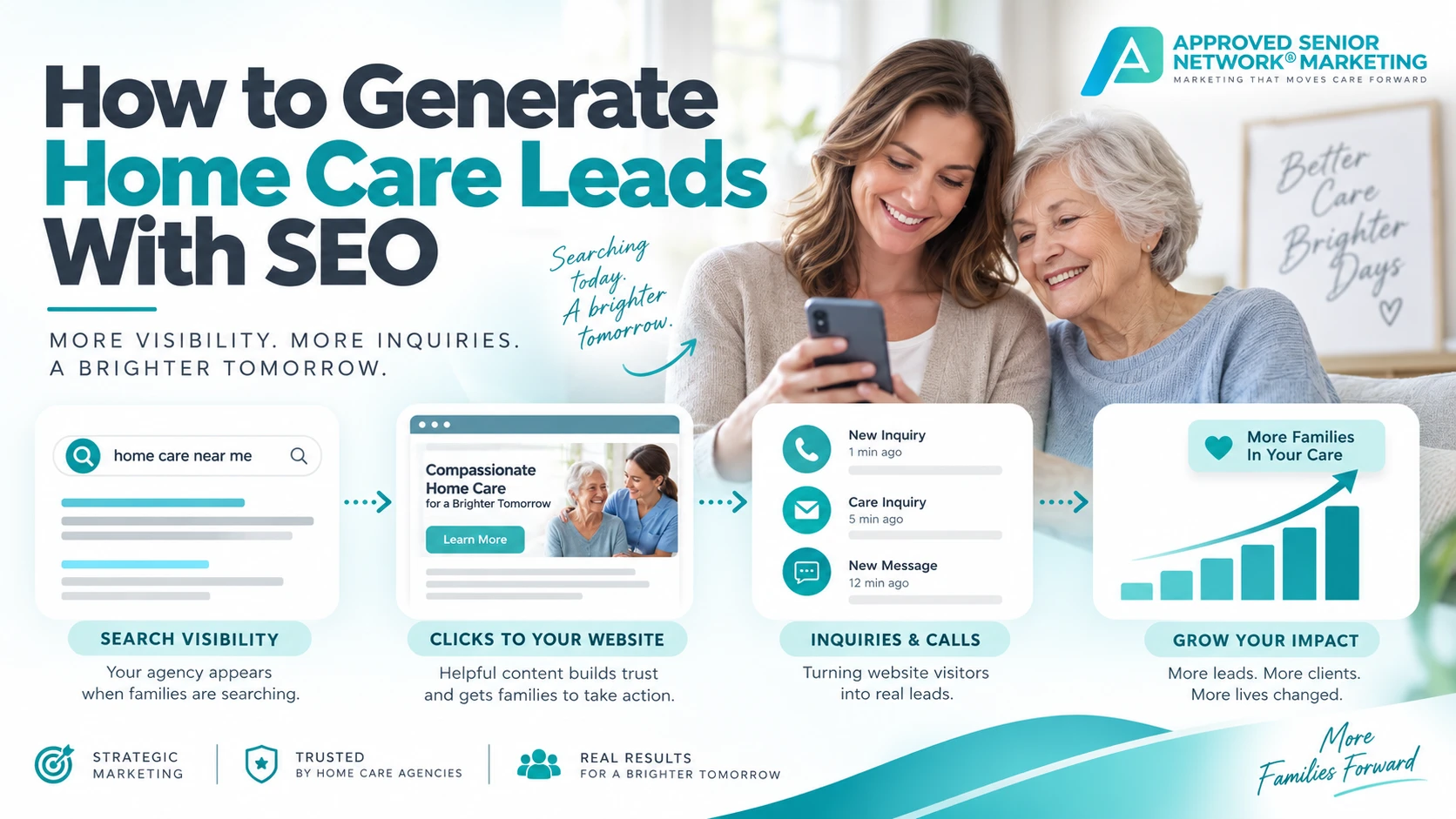
SEO generates home care leads through a four-link chain: your pages become visible for searches families run, the listing earns the click, the page makes it easy to inquire, and someone responds fast enough to matter. Most agencies measure only the first link, which is why so many are paying for rankings and not getting calls. This post covers where the chain breaks and what to do at each point. For the strategy that sits underneath it, see home care SEO, and for how search fits alongside referrals, paid, and follow-up, see home care lead generation.
The uncomfortable version: an agency ranking in position three with slow follow-up loses to an agency ranking in position six that calls back in ten minutes.
Why SEO leads behave differently in home care
Three things make this industry unusual.
The trigger is a crisis. Most home care inquiries follow a fall, a hospital discharge, a diagnosis, or a caregiver who quit. Families are not shopping leisurely. They search, they contact two or three agencies, and they decide within days.
The searcher is usually not the client. It is an adult daughter in another state, researching on her phone between meetings. She is evaluating trust signals, not service descriptions.
The research phase starts months earlier. Long before anyone is ready to hire, the same family was searching "signs my mother needs help" and "how much does home care cost." An agency visible only for commercial terms never enters that conversation.
That last point is why content built around family questions produces leads, even though none of those searches convert on the day they happen.
Link one, visibility for searches that produce calls
Not all visibility is worth having.
Ranking for a national informational term brings traffic from people who will never be your clients. Ranking for a service plus city phrase in a market you staff brings calls.
The three categories that actually produce home care leads:
Local commercial. "Home care [city]," "senior care agency near me," "in home care [county]." Highest intent, resolved largely through Google Business Profile and location pages. Covered in local SEO for home care agencies.
Service commercial. "Dementia care at home," "24 hour home care," "respite care services." Someone knows what they need. These live on service pages.
High-intent questions. "How much does home care cost in [city]," "what should I ask a home care agency," "how fast can home care start." These sit between research and hiring, and they convert better than most agencies expect.
Lower-intent question content still belongs on the site. It earns the relationship, feeds AI citations, and builds the topical authority that makes the commercial pages rank. It just should not be the only thing you have.
Link two, earning the click
Visibility without a click is nothing, and this is the link agencies have least visibility into.
Three things decide it.
Review volume beside your listing. Two agencies appear in the map pack. One shows 14 reviews, the other 173. The family reads both and calls one. Position does not save you here. This is why review generation is a lead generation activity, not a reputation activity, and why ASN runs it as a system through the review program.
The title and description in the result. Does it name the city? Does it answer the question, or does it say "Home Care Services | Compassionate Care You Can Trust"? Generic titles get scrolled past.
Whether the answer appeared without you. If an AI Overview answered the question and your agency was not cited, the click never existed. That is a visibility problem that only shows up as flat traffic.
Check Search Console for pages with high impressions and low click-through. That gap is usually a title problem or a review problem, and both are fixable in an afternoon.
Link three, making the inquiry easy
Here is where good SEO work dies on a bad page.
A family lands on your dementia care page from a phone, in a hospital corridor, after a hard week. What happens next depends on things that have nothing to do with rankings.
Is the phone number visible without scrolling, and tappable? The most common failure on home care sites, and the cheapest to fix.
Does the form ask for three fields or eleven? Name, phone, and what is going on. Everything else you can get on the call. Every extra field costs submissions.
Is there a clear next step, stated plainly? "Contact us" is not a next step. "Call us and we can usually have someone out for an assessment within 48 hours" is.
Does the page answer the question it ranked for? If someone searched about overnight dementia supervision and the page is a service list, they leave. Match the page to the query that brought them.
Is there proof? Reviews, a client story, named leadership, real photographs, credentials. Google's quality guidance emphasizes experience, expertise, authoritativeness, and trustworthiness, and says these matter most for topics affecting health and safety. Families apply the same test whether or not Google does.
Does it work on a phone? Most of these searches do not happen on a desktop.
Link four, the response, where most SEO spend evaporates
This is the least glamorous link and the one that decides the most outcomes.
A family fills out your form at 7 p.m. If they hear back at 10 a.m. the next day, they have already called two other agencies. They may have already signed with one.
Speed to lead decides more home care cases than ranking position does.
What a working response system looks like:
- Every inquiry gets an immediate automated acknowledgment confirming it arrived and saying when a human will call
- A real person calls back within minutes during business hours, not hours
- After-hours inquiries have a defined path, whether that is an answering service or a next-morning commitment stated clearly in the auto-reply
- Every inquiry is logged, assigned, and followed up more than once, because most families do not answer the first call
- Nothing lives in an inbox that one person checks
The follow-up sequence matters as much as the first call. A family that did not answer on Tuesday is not a dead lead. Most agencies treat them like one.
This is why ASNSpark CRM belongs in the same program as the search work rather than bolted on afterward. Visibility that produces inquiries nobody answers fast enough is expensive and pointless.
Tracking the chain instead of the rankings
If you are buying SEO and receiving a report about keyword positions, you are receiving a report about link one of four.
What to measure at each link:
Visibility. Organic impressions, Google Business Profile views and searches, map pack position for your core service plus city terms, AI citations in Search Console and Bing Webmaster Tools.
Clicks. Click-through rate by page in Search Console, Google Business Profile click actions, review count and recency.
Inquiries. Calls tracked to source, form submissions, chat conversations, consultation requests. Conversion rate per page, so you can see which pages earn traffic and which earn inquiries.
Response and outcome. Time to first contact, contact rate, assessments booked, cases started, revenue.
Then connect them. A page with 4,000 impressions, 40 clicks, and zero inquiries has a different problem than a page with 400 impressions, 90 clicks, and zero inquiries. The first has a click problem. The second has a page problem. Rankings alone cannot tell you which.
Call tracking is worth setting up if you have not. Without it, you are guessing about which half of the marketing is working, and in home care most inquiries still arrive by phone.
What SEO leads cost, and how they compare
A fair comparison, without overselling the channel.
Paid search produces leads immediately and stops the day the budget stops. Cost per lead in home care is meaningful and rising, and you are bidding against franchises with larger budgets.
Referral relationships produce the highest-quality cases and take the longest to build. They also do not scale without people, which is a hiring and training problem more than a marketing one.
SEO produces leads slowly at first and compounds. A page that earns visibility keeps producing long after it was published, though competitive content still needs review and updating.
The honest tradeoff: SEO is the cheapest channel per lead over a multi-year horizon and the slowest to start. An agency that needs cases this month should not be relying on it alone. An agency that only ever buys clicks is renting its lead flow permanently.
Most agencies that grow well run all three, with SEO as the foundation that lowers the cost of the other two over time. You can see what that has looked like for other agencies in our client results.
Why leads stall even when rankings improve
Four patterns worth checking if traffic is up and calls are not.
You rank for the wrong things. Informational traffic from outside your service area looks like growth in analytics and produces nothing. Segment by geography before celebrating.
The pages that rank are not the pages that convert. Blog posts drawing traffic with no path to a service page or a phone number. Fix the internal links.
Review volume is behind your competitors. You are visible and they are getting the click. This is the most common version of this problem and the most fixable.
Inquiries are arriving and dying. Check your actual response times before assuming the marketing failed. Agencies are often surprised by what they find here.
Common questions about SEO and home care leads
How long before SEO produces home care leads?
It depends on the starting point. An established agency with a healthy site and existing reviews can see local visibility improve within weeks of Google Business Profile work. Content and organic authority build over months. Anyone quoting a specific timeline without reviewing your site is guessing.
Are SEO leads better than purchased leads?
They are usually more qualified and always more exclusive. A purchased lead has often been sold to three agencies simultaneously, which means you are competing on response speed against people who received the same inquiry. An SEO lead came to you specifically. The tradeoff is that purchased leads arrive today and SEO leads take time to build.
How many leads should a home care website produce?
There is no benchmark that survives contact with reality. It depends on market size, competition, service lines, and how much of the local search landscape you occupy. A more useful question is whether your conversion rate from visitor to inquiry is improving, and whether your cost per admitted client is falling.
Does blog content actually produce leads?
Indirectly, and more than agencies expect. Question content rarely converts on the visit. It builds the topical authority that makes commercial pages rank, earns AI citations, and puts your agency in front of families months before they are ready. Content with no path to a service page or a phone number does not produce leads, which is a linking problem rather than a content problem.
What is the fastest way to increase leads from an existing home care website?
Usually three things, in this order: fix response time on inquiries you already receive, get the phone number visible and tappable above the fold, and start asking every family for a Google review. None of these require new content and all of them can start this week. If your site makes even these changes hard, that points to home care website design work rather than more content.
Getting traffic but not enough calls?
We look at the whole chain: what you rank for, whether you earn the click, whether the page converts, and what happens after the form gets filled out. You get the findings either way.