
Home care FAQ content worth citing: turning intake calls into useful answers

Valerie VanBoovenFounder and Co-OwnerAugust 19, 2026
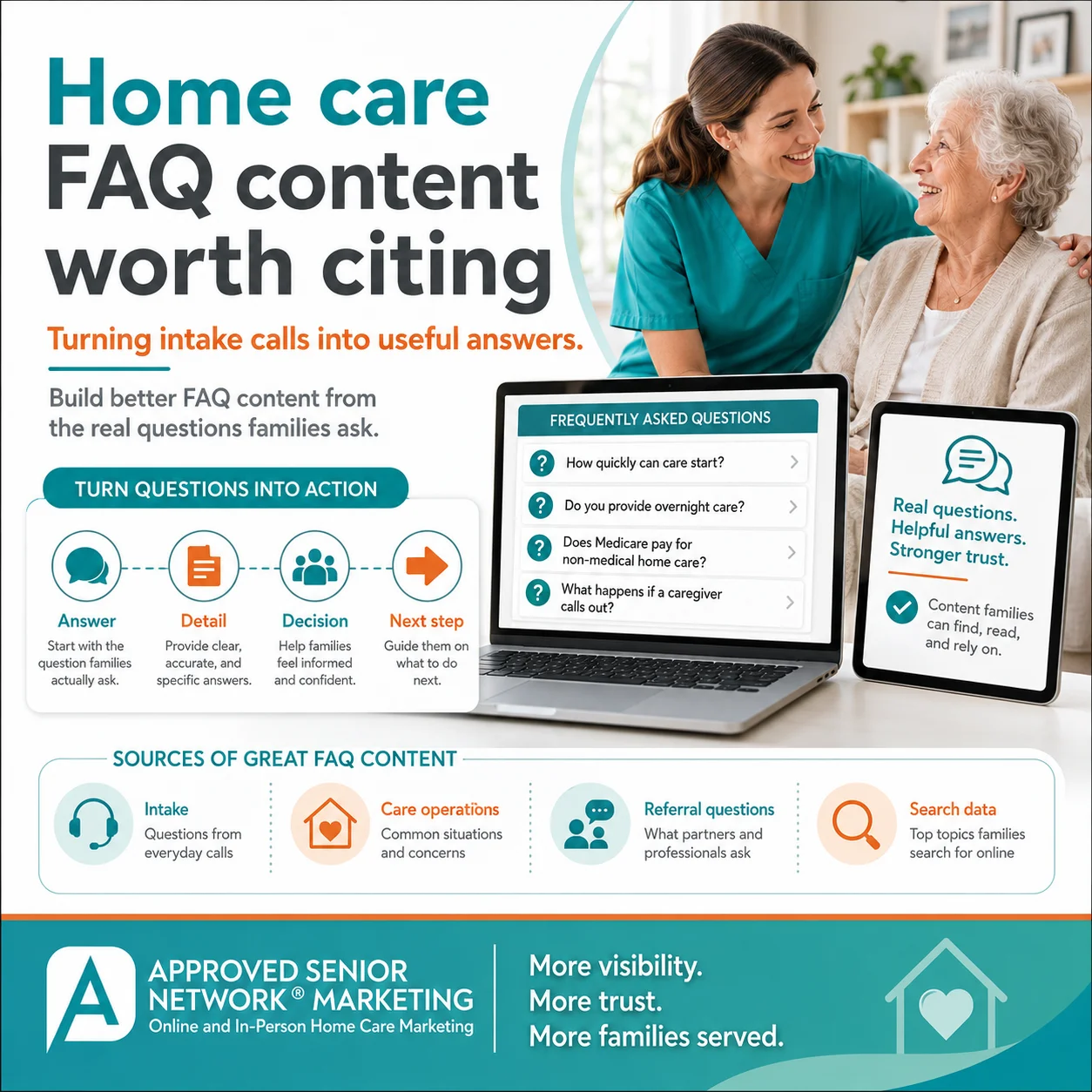
TL;DR: The best FAQ content begins with actual uncertainty, not keyword research alone. Your intake team, care coordinators, community liaisons, and sales staff hear the language families use every day. Capture those questions, answer the question in the first sentence, add the details required to make the answer genuinely useful, place it on the page where the family needs it, and expand high-value questions into full resources. In 2026, this strategy should be justified by usefulness and expertise - not by an outdated promise of FAQ rich results or an AI-citation trick.
Questions are the raw material of home care content
Families do not naturally think in marketing categories.
They ask:
- Can someone stay with Mom overnight?
- What happens if Dad refuses care?
- How quickly can care start?
- Do you have a minimum number of hours?
- Who supervises caregivers?
- What happens when a caregiver calls out?
- Does Medicare pay for this?
- Can we use long-term care insurance?
- What if my mother lives alone but does not think she needs help?
Those questions reveal what the family is trying to decide.
For the broader AI strategy, see AI search and home care marketing and what actually works in home care marketing now.
Build the FAQ library from real conversations
Approved Senior Network recommends using four sources:
Intake Questions families ask before scheduling.
Care operations Questions that create confusion after service begins.
Referral development Questions hospitals, rehab teams, senior communities, care managers, elder-law professionals, and other partners ask.
Search data Queries and pages already creating visibility, plus gaps found in search and AI audits.
The 30-day question harvest
Ask intake and sales staff to keep a running note for one month.
Capture:
- Exact wording of the question
- Where it appeared: phone, email, form, referral conversation
- Stage: research, urgent need, assessment, after start of care
- Service connected to the question
- Whether the current website answers it
At the end of the month, group the questions into themes.
You now have an editorial calendar based on real market language.
Decide whether the question needs an FAQ or a full article
ASN decision rule
Use a short FAQ when:
- The answer is stable.
- The answer can be useful in a few sentences.
- The visitor mainly needs clarification.
Use a full article or guide when:
- The answer has meaningful options or tradeoffs.
- The question needs examples.
- The question depends on service type or family situation.
- The topic needs authoritative external sourcing.
- The answer can support several related questions.
Example
FAQ: "Do you provide overnight care?"
A direct answer plus a short explanation of the agency's real scheduling model may be enough.
Full resource: "What is the difference between overnight care, 24-hour care, and live-in care?"
That deserves definitions, scheduling examples, decision factors, and agency-specific availability.
Write the first sentence so it can stand alone
A "liftable" answer is useful because the first sentence directly resolves the question.
Weak
"When it comes to choosing care for a loved one, every family is different, and there are many factors to consider."
Stronger
"Yes. [Agency] provides awake overnight care in [service area] when staffing and the client's care needs are a fit."
Then explain:
- What "awake overnight" means in this agency's service model
- Typical family situations
- How scheduling works
- How to confirm availability
The direct first sentence helps people. Any search or AI benefit is secondary.
Add specificity after the direct answer
Use the Answer -> Detail -> Decision -> Next step framework.
Answer: Give the direct response.
Detail: Explain what it means.
Decision: Tell the family what factors matter.
Next step: Show where to learn more or how to contact the agency.
Example
Question: "How quickly can home care start?"
Answer: "Start time depends on the care needed, location, schedule, and caregiver availability."
Detail: "An agency may be able to evaluate an urgent request quickly, but a complex schedule or specialized case may require more staffing time."
Decision: "Families should share the desired start date, hours, location, mobility needs, and any dementia or safety concerns during the first call."
Next step: "Call [Agency] to discuss current availability in your area."
No fake guarantee. No filler.
Put the answer where the question naturally occurs
Do not send every question to one giant FAQ page.
Service-page FAQs
Dementia care page:
- What if my parent refuses help?
- Can a caregiver provide redirection and companionship?
- Is dementia home care available overnight?
Personal care page:
- Can caregivers help with bathing and toileting?
- What if my parent is embarrassed to accept personal care?
24-hour/overnight page:
- Is the caregiver awake overnight?
- How are shifts scheduled?
- Is live-in care the same as 24-hour care?
Location-page FAQs
- Do you serve [community/neighborhood]?
- How do we start care in [city]?
- What services are available in this area?
Central FAQ page
Use it for broad organizational questions and as a navigation hub, not as a dumping ground.
Treat YMYL questions differently
Some family questions touch health, safety, benefits, insurance, or finances.
Examples:
- Does Medicare pay for home care?
- What veterans benefits may help pay for care?
- What does Medicaid cover in this state?
- What are signs someone is unsafe living alone?
Google's people-first guidance notes that trust is especially important for topics that can significantly affect health, financial stability, or safety.
ASN sourcing rule
For these questions:
- Use primary government or authoritative sources whenever possible.
- State what the source actually says.
- Distinguish general information from agency-specific advice.
- Add a review date when the rule or program can change.
- Avoid broad promises such as "Medicare pays for home care" when the reality is conditional.
That is how content becomes more trustworthy and more cite-worthy.
Do not build the strategy around FAQ schema
A useful FAQ section can still be marked up when the site's system generates appropriate structured data, but the business case is the content itself.
Google's 2026 documentation updates say FAQ rich results are no longer shown in Google Search. Google also says generative AI features do not require special schema.
So the right sequence is:
Real question -> useful answer -> correct page placement -> internal links -> accurate markup if appropriate.
Not:
Schema -> filler questions -> hope for an AI citation.
For the technical distinction, read schema markup for home care websites.
Turn intake questions into a monthly content system
ASN's connected-content philosophy works well here.
Suppose the recurring question is:
"How do families pay for home care?"
That one question can support:
- A payment-options article
- A downloadable paying-for-care guide
- Service-page FAQs
- A newsletter
- A Google Business Profile post
- A short video
- An email follow-up sequence
- Referral-partner talking points
- Internal links from relevant service pages
The point is not to copy the same paragraph across channels. The point is to build one strong information asset and distribute the useful ideas around it.
The FAQ quality checklist
Before publishing an answer, ask:
- Is this a question families actually ask?
- Does the first sentence answer it?
- Is the answer specific to home care rather than generic senior care?
- Does it reflect this agency's real service model?
- Does it need a primary source?
- Is the source current?
- Does the answer belong on this page?
- Is there a deeper page we should link to?
- Does it tell the family what to do next?
- Would a staff member be comfortable saying the same answer on the phone?
If not, keep working.
That is the content standard behind AI and local search visibility: make real expertise easier to find and understand.
Frequently asked questions
How many FAQs should a service page have?
Enough to answer recurring questions that genuinely matter for that service. Do not add questions simply to make the page longer.
Should FAQ answers be short or thorough?
Start direct, then add the detail needed for a safe and useful decision. Some answers need two sentences. Others deserve a full article.
Can FAQs cannibalize other pages?
Yes, if several pages are trying to fully answer the same search intent. Give each page a clear job and link to the deeper resource when appropriate.
Where do the best FAQ topics come from?
Intake calls, consultations, care-management conversations, referral-source questions, email, sales objections, Search Console data, and repeated gaps found during search/AI audits.
Do FAQ sections guarantee AI citations?
No. No page format guarantees citation. The goal is to publish accurate, direct, useful, well-sourced answers that are worth referencing.
Primary sources
- Google Search: Creating helpful, reliable, people-first content: https://developers.google.com/search/docs/fundamentals/creating-helpful-content
- Google Search: Generative AI optimization guide: https://developers.google.com/search/docs/fundamentals/ai-optimization-guide
- Google Search: Documentation updates, including FAQ rich-result retirement: https://developers.google.com/search/updates
- Google Search: General structured-data guidelines: https://developers.google.com/search/docs/appearance/structured-data/sd-policies