
How to set home care marketing and sales goals your marketer can actually execute in 90 days

Annette ZieglerLead Sales and Marketing TrainerAugust 22, 2026
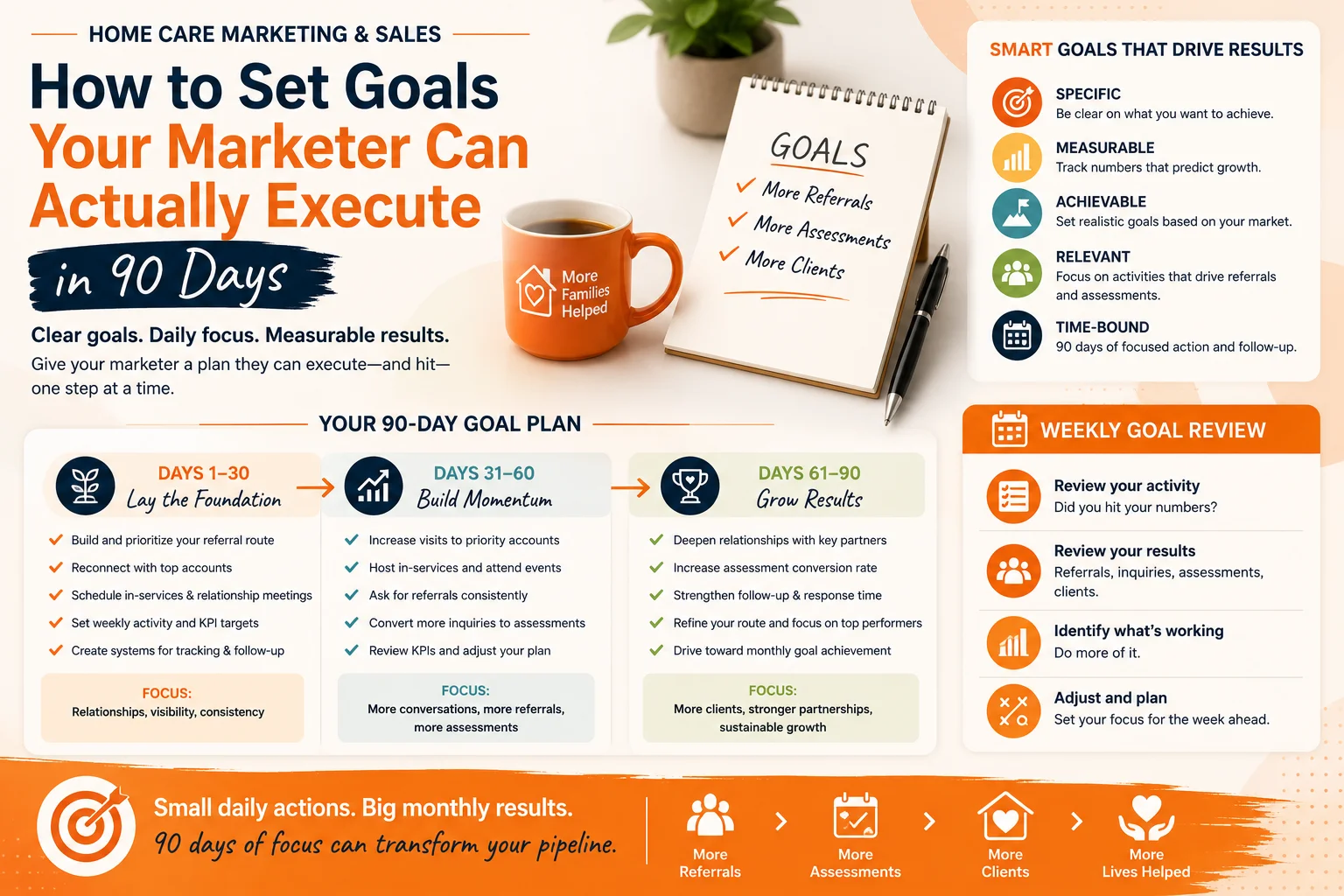
TL;DR: A useful home care marketing and sales goal connects a business outcome to a small set of weekly behaviors. "Get more referrals" is not a plan. Start with the outcome you want, signed clients, new hours, or private-pay revenue, work backward through assessments and referrals, then decide which accounts and activities can realistically produce those opportunities. GoCarePro uses 90-day training, weekly planning, route sheets, assignments, KPIs, and ongoing coaching because sales improvement is easier when the salesperson knows exactly what to do next.
Why most home care marketing and sales goals fail
The goal is usually too vague.
"Grow census."
"Get more referrals."
"Build relationships."
"Visit more facilities."
All four describe a direction. None tells the salesperson what success looks like this week.
A better sales goal has three levels:
- Business outcome: what the agency needs
- Pipeline outcome: what must happen before the business outcome
- Weekly behavior: what the salesperson can control
Example:
Business outcome: Add 120 new weekly care hours within 90 days.
Pipeline outcome: Sign enough new clients to create those hours.
Weekly behavior: Build and advance a defined group of referral relationships, ask for business, respond to opportunities quickly, and track every next step.
That is a plan a manager can coach.
Use the 90-day horizon
Ninety days is long enough to build habits and see movement, but short enough to create urgency.
It also mirrors the structure of GoCarePro's 12-week live sales training, which takes participants from referral-source strategy and route building through facility relationships, in-services, asking for the business, and inquiry conversion.
Learn more about the full program at GoCarePro sales training.
Step 1: choose one primary business goal
Do not give a salesperson seven equal priorities.
Choose one primary growth outcome for the next 90 days.
Examples:
- Add ___ new weekly private-pay hours
- Sign ___ new private-pay clients
- Generate ___ qualified professional referrals
- Develop ___ producing referral accounts
- Increase assessment bookings from referral-source inquiries
- Grow a specific service such as dementia care, 24-hour care, post-rehab support, or respite care
Then define one or two guardrails.
Example:
Primary goal: Add 100 weekly private-pay hours.
Guardrail 1: Focus on cases with a schedule the agency can staff.
Guardrail 2: Do not create growth in a geography operations cannot reliably cover.
Sales and operations must agree on what kind of growth the business actually wants.
Step 2: reverse-engineer the goal
Do not guess the number of visits first.
Work backward.
Suppose the agency wants 100 additional weekly hours.
If the average new client in your own historical data starts at 20 weekly hours, you need approximately five net new clients to reach 100 hours.
Then use your own conversion data.
If your assessment-to-start rate is 50%, you may need about 10 completed assessments to create five starts.
If 60% of qualified referral inquiries become completed assessments, you may need about 17 qualified referral inquiries.
The math is:
Business goal → clients needed → assessments needed → qualified referrals needed → referral relationships needed → weekly activity needed
Use your actual historical conversion rates whenever possible. If you do not have them, begin tracking now rather than inventing industry benchmarks. Our guide to home care marketing and sales KPIs covers the numbers worth tracking.
Step 3: define the accounts that can produce the goal
A goal without an account strategy becomes random driving.
Ask:
- Which referral-source types see the clients we want?
- Which accounts are inside a practical territory?
- Which contacts can influence a referral?
- Which organizations have needs our agency can solve?
- Where do we already have some access or credibility?
- Which relationships are worth deepening instead of constantly chasing new names?
GoCarePro teaches marketers to qualify referral sources and build a route sheet rather than trying to market to everyone. The referral route strategy covers account selection in depth.
The 20-account focus list
As a planning exercise, identify 20 accounts in four buckets:
5 priority accounts Strong fit, real opportunity, active follow-up.
5 development accounts Good fit but relationship is still early.
5 reactivation accounts Previously engaged or referred, but the relationship has gone quiet.
5 discovery accounts New accounts worth researching and testing.
The exact number is flexible. The point is to make the territory visible and intentional.
Step 4: convert the 90-day goal into weekly commitments
A salesperson should know what needs to happen before Monday morning begins.
GoCarePro teaches participants to complete a Weekly Marketing Plan, plan routes, schedule meaningful face-to-face time, prepare materials, and define weekly goals.
A simple weekly plan can include:
Relationship goals
- Priority accounts to advance: ___
- New decision-makers to meet: ___
- Follow-up conversations due: ___
- Reactivation accounts: ___
Opportunity goals
- In-services to schedule: ___
- Direct asks for business: ___
- Qualified referrals to generate: ___
- Assessments to book: ___
Activity commitments
- Total strategic touches: ___
- Face-to-face conversations: ___
- Calls/texts/emails with a defined purpose: ___
Skill goal
- One skill to practice this week: ___
Examples:
- Getting past gatekeepers
- Elevator speech
- Asking for the referral
- Booking an assessment
- Handling pricing questions
- Following up without "just checking in"
The Friday planning ritual
One of the most practical habits in the GoCarePro training is planning the upcoming week before it begins.
Use 30 minutes on Friday to:
- Review the route sheet.
- Identify the accounts that need a touch.
- Schedule face-to-face conversations and presentations.
- Map travel logically.
- Prepare leave-behinds and materials.
- Review open referrals and assessments.
- Write the three outcomes that would make next week successful.
A planned week protects sales time from becoming whatever seems urgent on Monday morning.
Step 5: set goals for account movement, not only visits
A visit is not always progress.
Create simple account stages:
- Target identified
- Correct contact identified
- Initial introduction completed
- Meaningful conversation completed
- Value delivered
- Referral ask made
- Referral received
- Producing relationship
Now the weekly goal can be:
Move three priority accounts from Stage 3 to Stage 4.
That is much more meaningful than:
Visit 15 buildings.
Step 6: give the manager a job too
Sales goals fail when the marketer is held accountable for things management has made impossible.
The owner or manager should ask:
- Is the service area clear?
- Do we know our ideal cases?
- Can operations staff what sales is pursuing?
- Does the salesperson have leave-behinds and in-service tools?
- Is the CRM or tracking system usable?
- Are leads answered quickly?
- Does the salesperson have protected field time?
- Are they being coached on actual opportunities?
GoCarePro's ongoing coaching concept matters because skills often break down in implementation, not in the classroom.
Use a 30-60-90 day scorecard
Days 1-30: build the foundation
Focus:
- Territory research
- Referral-source qualification
- Route sheet
- Elevator speech
- Gatekeeper strategy
- Baseline KPIs
Success evidence:
- Priority account list is complete
- Correct contacts are being identified
- Weekly planning habit is established
- Face-to-face access is improving
Days 31-60: create opportunities
Focus:
- In-services
- Consistent value touches
- Account advancement
- Direct referral asks
- Reactivation
Success evidence:
- More meaningful conversations
- Presentations are scheduled
- Referral asks are happening
- First referrals are appearing from target accounts
Days 61-90: convert and refine
Focus:
- Referral conversion
- Assessment booking
- Signing ratio
- High-value account concentration
- Dropping low-value activity
Success evidence:
- Referrals connect to specific accounts
- Assessments and signed clients are increasing
- Management knows which accounts deserve more investment
Decision rule: when should a goal change?
Do not change the goal because one week feels hard.
Change or revise it when the evidence says one of these is true:
- The target market cannot realistically produce the desired cases.
- Operations cannot support the kind of growth being pursued.
- Conversion assumptions were materially wrong.
- The territory has changed.
- The salesperson is executing the plan consistently and the hypothesis is not working.
Otherwise, coach the execution before abandoning the strategy.
Frequently asked questions
What is a good 90-day goal for a new home care marketing and salesperson?
A good goal combines business results and skill development. For example: build a qualified referral route, establish consistent weekly activity, develop several active referral relationships, generate the first qualified referrals, and improve assessment-booking skills. Avoid holding a brand-new salesperson accountable only for revenue before the pipeline exists.
Should home care marketing and sales goals be based on revenue or referrals?
Use both, but at different levels. Revenue or weekly hours can be the business outcome. Referrals, assessments, account movement, and sales activity are the leading indicators that tell you whether the outcome is likely to happen.
How many accounts should one marketer target?
There is no universal number. The right portfolio depends on account quality, geography, sales-cycle length, and job responsibilities. A smaller list of strategically selected accounts with disciplined follow-up can outperform a huge database of names with shallow contact.
How often should goals be reviewed?
Review weekly execution every week. Review the full 90-day plan monthly. Avoid changing the main goal every few days; use weekly reviews to adjust tactics and monthly reviews to adjust strategy.
What if the salesperson is missing the goal?
Determine whether the issue is activity, access, relationship quality, asking, lead handling, conversion, or operational capacity. "Work harder" is not a diagnosis.