
Home care referral route strategy: how to choose the right accounts instead of visiting everyone

Annette ZieglerLead Sales and Marketing TrainerAugust 21, 2026
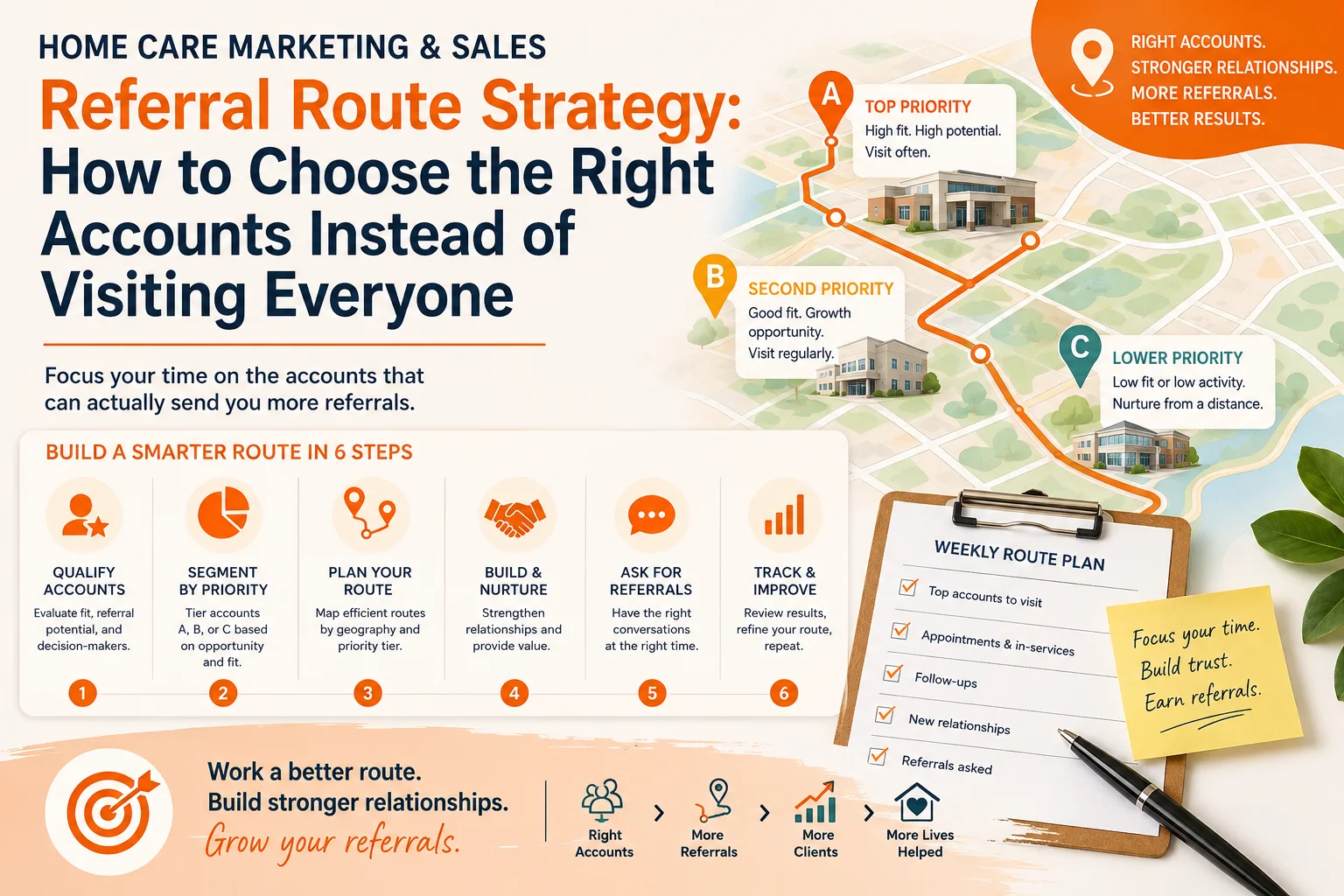
TL;DR: The best home care referral route is not the longest list of facilities. It is a prioritized group of accounts that regularly encounter the types of families your agency can serve, are geographically practical, have accessible decision-makers, and have a problem your agency can solve. GoCarePro teaches marketers to qualify referral sources, research the territory, organize accounts by geography, build relationships with the right professionals, and use consistent touches to move accounts toward referrals. Account targeting and the route are the foundation of home care referral development.
Stop confusing a database with a sales strategy
A spreadsheet with 300 facilities is not a referral plan.
A referral plan tells the salesperson:
- Which accounts matter most
- Why they matter
- Who the decision-makers are
- What problem the agency solves for them
- What the next action is
- When to follow up
- What success looks like
That is why GoCarePro begins with referral-source qualification and route building before spending weeks talking about scripts and closing.
If you want the full training framework, see GoCarePro sales training.
Start with referral-source fit
Home care referrals can come from many places:
- Skilled nursing facilities
- Hospitals
- Rehabilitation centers
- Assisted living
- Independent living
- Memory care
- Home health agencies
- Hospice agencies
- Geriatric care managers
- Elder-law attorneys
- Senior advisors
- Physicians and clinical practices
- Veterans organizations
- Community organizations
- Faith communities
- Existing clients and families
But not every source deserves the same amount of field time.
The ASN five-part account fit test
Score each potential account from 1 to 5 on these dimensions.
1. Client fit Does this organization regularly encounter people who fit the agency's services, payer mix, schedule requirements, and geography?
2. Opportunity frequency How often could a realistic referral situation occur?
3. Access Can your marketer identify and eventually build a relationship with the right professional?
4. Problem-solution match Does the account have a problem your agency can genuinely help solve?
5. Operational fit If they refer a case tomorrow, can your agency actually staff and serve it well?
Total the score. The number is not a scientific prediction. It forces the team to explain why an account belongs on the route.
Research before you drive
One of the GoCarePro field-research tools is Medicare Care Compare. Medicare's official Care Compare system can be used to identify and compare Medicare-certified provider types such as nursing homes, home health agencies, hospitals, hospice providers, and rehabilitation facilities.
For a home care marketing and salesperson, the goal is not to use a government rating as a simplistic "good account/bad account" score.
Use available public information to understand the market:
- Facility location
- Provider type
- Ownership information where available
- Services
- Quality information
- Relative size or relevance
Then combine that research with local knowledge.
A salesperson may learn that a particular rehab center has strong discharge volume, a senior living community is expanding, or a home health agency lacks non-medical support resources. That context shapes the approach.
Build account tiers
A practical route can use three tiers.
Tier A: active growth accounts
Characteristics:
- Strong client fit
- Good access or relationship momentum
- Referral potential is high
- Needs match your capabilities
Contact strategy: Frequent, purposeful touches with a clear next step.
Tier B: development accounts
Characteristics:
- Strong fit
- Relationship is early
- Decision-maker access is limited or still developing
Contact strategy: Consistent education, introductions, light touches, and opportunities to provide value.
Tier C: nurture or monitor
Characteristics:
- Lower opportunity frequency
- Weak fit
- Long travel time
- Limited access
- Not currently strategic
Contact strategy: Occasional contact, email/newsletter, LinkedIn, or periodic reassessment rather than heavy field time.
This prevents the salesperson from spending equal energy on unequal opportunities.
Organize the territory geographically
A good referral route protects selling time.
GoCarePro teaches participants to group referral sources geographically, including by ZIP code, so multiple quality interactions can happen during one field block.
A simple weekly map might look like:
Monday, North territory
- Priority SNF
- Rehab center
- Assisted living
- Home health partner
Tuesday, West territory
- Hospital campus
- Memory care
- Senior living community
- Elder-law office
Wednesday, In-services / assessments / follow-up
Thursday, South territory
Friday, planning, reactivation, calls, LinkedIn, next-week scheduling
The point is not to rigidly assign every day. It is to stop wasting two hours driving across town for a five-minute drop-off.
Identify the real decision-makers
"Facility" is not a contact.
For each account, document:
- Primary decision-maker or influencer
- Secondary contact
- Gatekeeper
- Role/title
- Preferred communication method
- Best time to reach them
- Last meaningful interaction
- What matters to them
- Current opportunity
- Next step
In a skilled nursing facility, the key relationship may be a social worker, discharge planner, case manager, administrator, or another professional depending on the organization.
In assisted living, it may be an executive director, wellness director, resident care leader, sales director, or family-facing professional.
Do not assume the same title controls referrals everywhere.
Give every visit a purpose
A weak visit goal:
Stop by and say hello.
A stronger visit goal:
Ask the social worker how weekend discharges are handled and determine whether rapid-start non-medical home care is a recurring gap.
Another:
Confirm the date for a fall-prevention in-service and identify who else should attend.
Another:
Follow up on last week's family situation and ask whether similar residents need supplemental one-on-one support.
The purpose determines the conversation. When the relationship is ready, how to ask referral sources for the business covers the ask itself.
Use a multi-touch relationship strategy
Referral relationships usually develop across repeated useful interactions, not a single brochure drop.
The ongoing GoCarePro coaching materials emphasize an important nuance: consistent contact does not mean demanding a face-to-face meeting every time.
A referral source might receive a mix of:
- Brief in-person visit
- Useful leave-behind
- Email with a relevant resource
- LinkedIn engagement
- Invitation to an in-service
- Quick follow-up after a referral
- Thank-you note
- Community resource introduction
- Case-capacity update
The exact cadence should fit the account and relationship. The goal is to remain useful and memorable without becoming a burden.
Build value around the referral source's problem
Do not lead with your agency's brochure.
Ask what the referral source is trying to accomplish.
SNF or rehab
Possible problems:
- Difficult discharges
- Families who need private-duty support quickly
- Weekend transitions
- High-support cases
- Family confusion about what happens after rehab
Assisted living
Possible problems:
- Residents needing more one-on-one help
- Family requests for supplemental support
- Residents at risk of moving to a higher level of care
Independent living
Possible problems:
- Residents struggling with daily routines
- Families trying to keep a parent independent
- A gap between "fully independent" and assisted living
Memory care
Possible problems:
- Need for additional one-on-one attention
- Family desire for more individualized engagement
- Challenging schedules or behaviors requiring extra support
Home health and hospice
Possible problems:
- Non-medical needs outside their covered service model
- Family caregiver strain
- Gaps in supervision and daily living support
When the salesperson understands the other organization's pressure, the conversation becomes more relevant.
The referral route worksheet
For each account, track:
| Field | Example |
|---|---|
| Account | Oak Ridge Rehabilitation |
| Tier | A |
| Geography | North route |
| Contact | Jane Smith, social worker |
| Client fit | Post-rehab private-pay support |
| Current problem | Weekend discharge support |
| Last touch | August 12 |
| Next step | Deliver discharge guide and ask about Friday discharges |
| Referral history | 2 referrals YTD |
| Status | Developing/Producing/Inactive |
Now the route sheet is a decision tool, not merely an address list.
When to remove an account from the priority route
Salespeople often keep low-value accounts because they are familiar and easy to visit.
Reconsider priority status when:
- The client fit is poor.
- Operations cannot serve the referrals.
- The account has very low opportunity frequency.
- The marketer cannot identify a realistic decision-maker after sustained effort.
- The organization has repeatedly demonstrated no need or no strategic fit.
- Travel cost is disproportionate to opportunity.
Do not "fire" every account that has not referred yet. Long-cycle relationships can be valuable. The goal is to allocate scarce field time intentionally.
Frequently asked questions
What are the best referral sources for a home care agency?
The best sources depend on the agency's services, geography, staffing capacity, payer mix, and ideal clients. Common sources include skilled nursing and rehab, hospitals, senior living, memory care, home health, hospice, care managers, elder-law professionals, senior advisors, and community organizations.
How do I find referral sources in my market?
Use local knowledge, professional networks, web research, facility websites, LinkedIn, and public provider tools such as Medicare Care Compare for relevant Medicare-certified provider types. Then qualify each source based on actual fit rather than simply adding every organization to a list.
How often should a home care marketer visit referral sources?
Cadence should depend on account priority and relationship stage. Consistent contact may include face-to-face visits plus lighter touches such as resources, email, LinkedIn, or follow-up. Do not assume every touch requires a sit-down meeting.
Should a marketer visit every facility in the service area?
No. Prioritize accounts based on client fit, opportunity, access, problem-solution match, and operational capacity. A focused route of high-value accounts usually gives management more useful information than random broad coverage.
How do we know when a referral relationship is working?
Look for movement: stronger access, more meaningful conversations, requests for help, introductions to colleagues, invitations to educate, actual referrals, repeat referrals, and a growing level of trust. The home care marketing and sales KPIs article turns that movement into a scorecard.
Primary source
- Medicare Care Compare: official provider comparison tool for Medicare-certified providers: https://www.medicare.gov/care-compare/