
Keyword Research for Home Care Websites

Valerie VanBoovenFounder and Co-OwnerSeptember 21, 2026
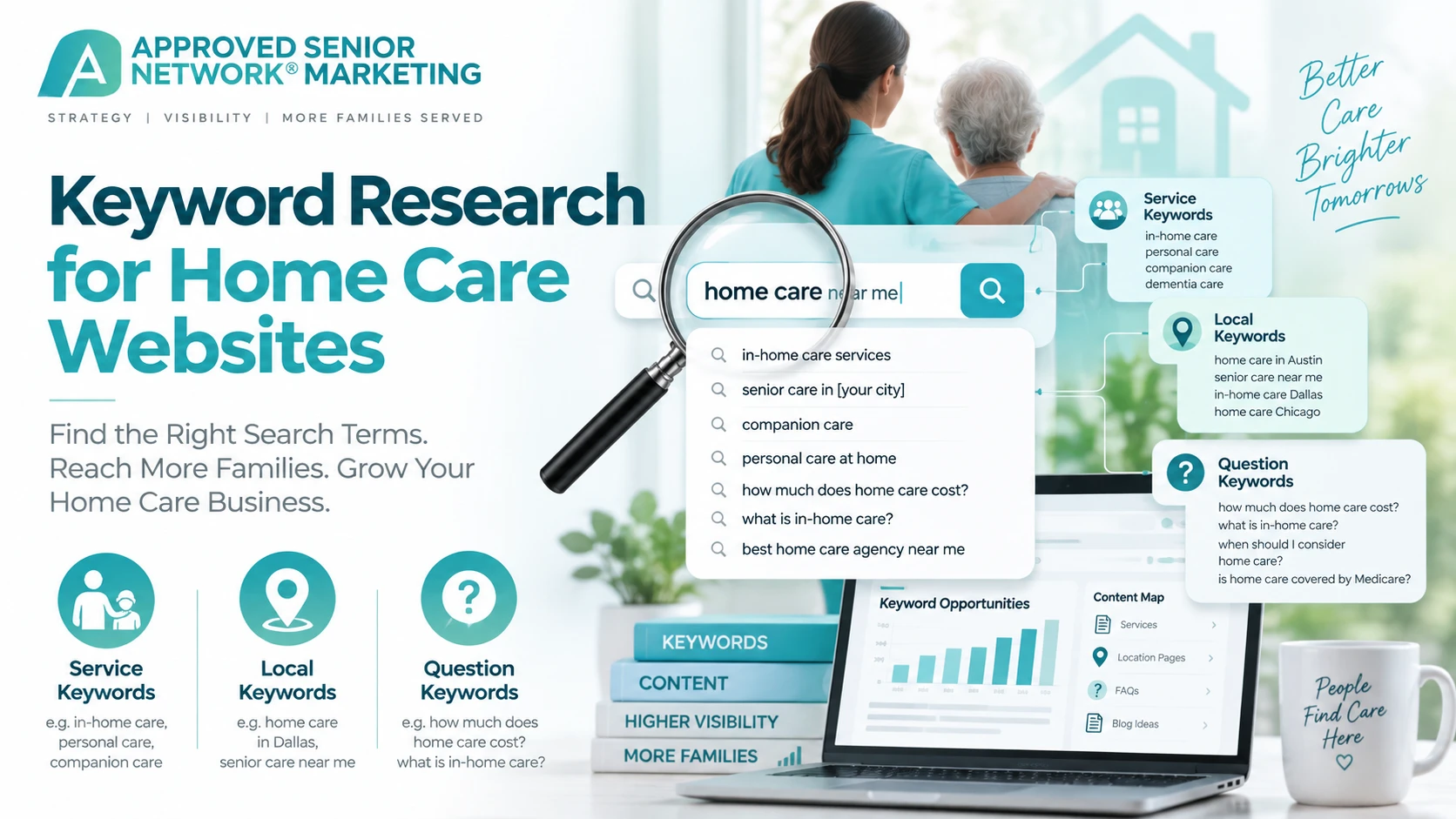
Keyword research for a home care agency is the work of finding the phrases families and referral sources actually type, then deciding which page should own each one. The method has four steps: list what you sell, layer in the markets you serve, add the questions families ask before they are ready to hire, then group everything into clusters and assign one page per cluster. The step most agencies skip is the last one, and skipping it is why so many home care sites have dozens of pages and nothing ranking. This fits inside the broader home care SEO approach.
One thing to set aside before starting: search volume is not the ranking criterion. A phrase with 90 searches a month in your county and clear buying intent is worth more than a national term with 5,000 searches you will never rank for and would not want traffic from anyway.
The three kinds of home care searches
Every keyword worth your attention falls into one of three groups, and they need different pages.
Service searches. Someone knows what they need and is looking for a provider. "Personal care services," "dementia caregivers," "24 hour home care." These convert. They go on service pages.
Local searches. Service plus place. "Home care Webster Groves," "senior care agency near me," "in home care St. Charles County." These convert fastest of all, and they go on location pages or your Google Business Profile.
Question searches. Someone is earlier in the process, sometimes months earlier. "How much does home care cost," "does Medicare pay for home care," "how do I convince my mom to accept help." These do not convert today. They build the relationship that converts later, and they are where AI search is pulling from most heavily. These go in content.
An agency that only targets the first two groups is invisible during the research phase, which is where most families now spend their time before they call anyone.
Step one, list what you actually sell
Start offline. Write down every service line you provide and would accept a case for.
Typical home care list:
- Companion care
- Personal care
- Dementia and Alzheimer's care
- Respite care
- 24-hour care
- Live-in care
- Post-hospital or transitional care
- Hospice support
- Specialty conditions you actually handle: Parkinson's, stroke recovery, post-surgical
Each of these is a distinct search intent and usually deserves its own page. A family searching "respite care" and a family searching "live-in care" want different things, and a combined page serves neither well.
Two cautions.
Do not build pages for services you do not provide. It produces inquiries you have to turn down and content you cannot write credibly.
Do not split services so finely that you end up with five thin pages. "Bathing assistance," "dressing assistance," and "toileting assistance" are sections of a personal care page, not separate pages.
Step two, layer in geography honestly
This is where home care agencies overreach more than anywhere else.
The instinct is to list every city within an hour's drive. The result is a site full of location pages for markets where you have no caregivers, generating calls you cannot staff.
Pick markets by a simple filter:
- Do you currently have clients there, or caregivers who live there?
- Would you accept a case there tomorrow?
- Can you write something true and specific about that community?
If the answer to any of those is no, skip it for now. You can add markets as coverage grows.
For each market you keep, the keyword pattern is usually one of these:
- home care [city]
- senior care [city]
- in home care [city]
- [service] [city], for example "dementia care Kirkwood"
- home care agencies near [landmark or hospital]
You do not need a page for every one of those combinations. One strong location page can hold the city variants. A separate service-plus-city page only makes sense when you have enough distinct content to justify it, usually in your largest market.
Step three, add the question layer
This is the part agencies underinvest in and the part that matters most for AI search.
The questions families ask fall into predictable buckets.
Cost and payment. How much does home care cost, does Medicare pay for home care, does insurance cover in home care, what is the hourly rate, how do people pay for this.
Getting started. How do I find a home care agency, what should I ask before hiring, how fast can care start, what does an assessment involve.
Care decisions. Live-in versus 24-hour, how many hours do we need, when is home care not enough, what is the difference between home care and home health.
The hard conversations. How do I convince my mom to accept help, my dad refuses care, is it normal to feel guilty about this.
Condition-specific. Dementia wandering at night, sundowning, Parkinson's fall risk, recovery after a hip replacement.
Where to find your actual list: your intake calls. Every question a family asks on the phone before they sign is a keyword. Write down ten of them and you have a year of content that no competitor can copy, because it came from your cases.
Step four, cluster and assign one page per cluster
This is the step that separates a keyword list from a site plan.
Take everything from steps one through three and group phrases that mean the same thing to a search engine. Then assign each group exactly one page.
Example cluster:
- dementia care at home
- alzheimer's home care
- in home dementia care
- home care for dementia patients
- dementia caregivers
These are one page. Not five. The primary phrase becomes the H1 and title tag. The variants appear naturally in headings and body copy.
Separate cluster:
- dementia wandering at night
- sundowning home safety
- overnight dementia supervision
These are different intent. They are supporting content that links up to the dementia care service page.
The rule: one primary phrase per page, everything else in the cluster supports it on that same page or in a post that links to it.
The test that prevents cannibalization
Before you build separate pages for two phrases, run this check.
Open an incognito window. Search both phrases. Compare the top five results.
- Same URLs ranking for both, one page. Google already decided these are the same question.
- Mostly different URLs, two pages. Google sees different intent.
Thirty seconds per pair, and it prevents the most expensive structural mistake in home care SEO.
The mistake looks like this. An agency builds a homepage optimized for "home care in Springfield," a Springfield location page targeting the same phrase, a "senior home care Springfield" page, and three blog posts using "home care Springfield" throughout. Four pages competing for one query. Google has to pick one and often picks the weakest. This is keyword cannibalization, and it is quiet enough that agencies live with it for years.
The fix is usually not deletion. It is giving each page a clearly different job and consolidating the ones that genuinely overlap.
Reading the numbers without being misled
Whatever tool you use, three columns matter.
Search volume. Estimated monthly searches. Treat it as directional, not exact. National tools report national volume, which tells you very little about your county.
Keyword difficulty. An estimate of how hard it is to rank organically. Useful for sorting. It does not account for your existing authority or how relevant you are to the topic, so treat a low number as a signal to investigate rather than a promise.
Intent. Whether the searcher wants information, is comparing options, or is ready to act. A high-volume informational phrase and a low-volume commercial phrase are not interchangeable.
Two traps.
Zero-volume phrases are not worthless. Long conversational strings like "how do I get my mother to accept a caregiver" often report no measurable volume, because they are phrased a hundred different ways. They are also close to exactly what someone types into ChatGPT. Content answering them earns AI citations that never show up in a volume column.
High-volume national terms are usually a trap. "Home care" gets enormous volume. A local agency ranking for it nationally would gain nothing. Volume without geographic or commercial relevance is a distraction.
Turning the research into a build order
You will end up with more clusters than you can build at once. Sequence them.
Build first: your highest-revenue service, in your strongest market. The page that makes money if it ranks.
Build second: the remaining service pages, one per service line.
Build third: location pages for the three to five markets where you already have clients and reviews.
Build fourth and ongoing: the question content, one piece at a time, each linking up to the relevant service or location page.
An agency that builds ten strong pages in this order will outperform one that generated ninety thin pages in a weekend. Google's spam guidance specifically warns about producing large numbers of unoriginal pages, including with generative AI, and thin location pages are the version of that mistake home care agencies make most. If the site itself cannot support that structure, that is a home care website problem to solve first.
Keeping the map current
Keyword research is not a one-time project. Revisit it when:
- You add a service line
- You expand into a new market
- A new question starts coming up on intake calls
- Search Console shows you ranking for something you never targeted, which happens more than people expect and often points to content worth building out
That last one is the most useful ongoing source. The queries in Search Console are real searches from real people that already brought someone to your site. No tool estimate beats that.
Common questions about home care keywords
How many keywords should a home care website target?
Fewer than most agencies think. One primary phrase per page, with each page covering a cluster of related variants. A well-built agency site might have 25 to 40 pages, each owning one cluster. The number of individual phrases covered will be several hundred, but the number of pages stays manageable.
Should I target "near me" keywords?
Not directly as a page target. "Near me" searches are resolved by Google using the searcher's location, so you cannot optimize a page for the literal phrase. What wins these is a complete Google Business Profile, accurate service areas, and review volume. See local SEO for home care agencies.
What keyword tool should a home care agency use?
Any of the major ones will do the job. The tool matters far less than the method. Google Search Console is free, shows real queries that already reached your site, and is more useful for an established agency than a paid tool used without a plan.
Do keywords still matter with AI search?
Yes, with a shift. Google has described query fan-out, where a complicated question generates multiple related searches behind the scenes to assemble an answer. That rewards comprehensive topical coverage more than exact-match pages. You still need to know what people search. You just build fewer, deeper pages around it.
How do I know if I have a cannibalization problem?
Search your own site for a phrase using site:yourdomain.com plus the keyword. If several of your own pages come back and Google seems unsure which to show, you have overlap. Search Console also shows it: multiple URLs receiving impressions for the same query, none ranking well.
Not sure which pages your site should actually have?
We map your keywords to pages, flag the cannibalization already on the site, and give you a build order. You get the map whether or not we do the work.