
Positioning a home care agency: how to stop sounding like everyone else

George NovosonCo-OwnerAugust 19, 2026
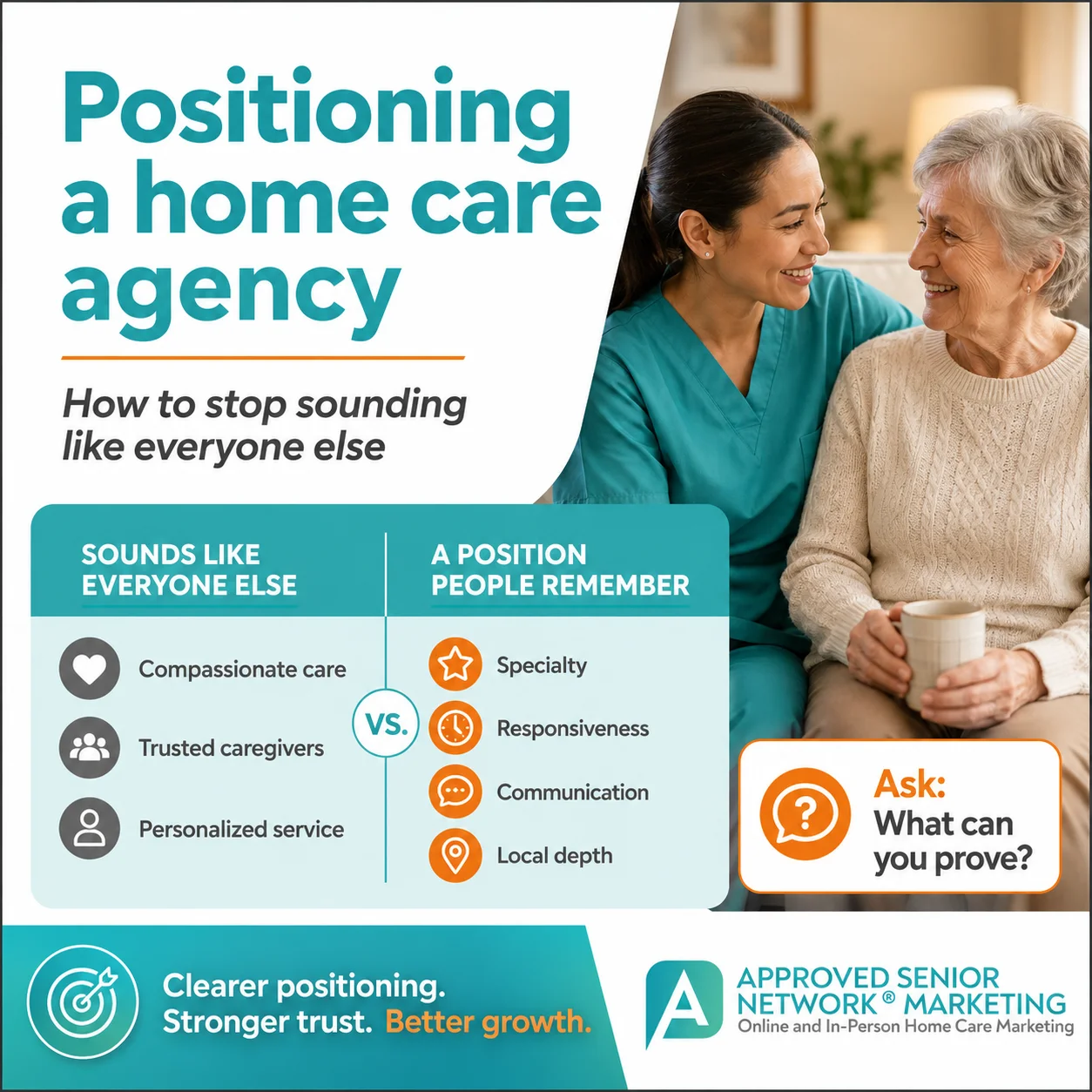
TL;DR: "Compassionate, experienced, trusted care" is not a position because nearly every agency can claim it. Positioning is the clear, believable reason a family or referral source should remember your agency instead of treating it as interchangeable with five others. Approved Senior Network recommends finding the difference in operations first - specialty, response, communication, caregiver development, service experience, or local expertise - then proving it across the website, Google Business Profile, reviews, intake calls, and referral conversations.
The sameness problem is expensive
Open five home care websites in one market and you may see the same language:
- Compassionate care
- Personalized care
- Trusted caregivers
- Quality service
- Dedicated team
- Peace of mind
Those ideas are positive. They are not distinctive.
If the message could be copied onto a competitor's homepage without changing anything important, it is not doing much positioning work.
Positioning matters across home care marketing because paid ads, SEO, referral development, reviews, website conversion, and sales follow-up all become easier when the agency has a clear reason to be remembered.
Find the difference in operations, not in a brainstorming session
Start with evidence.
Ask the people who interact with the market:
- Why do families choose us?
- Why do referral partners call us again?
- What situations are we unusually good at handling?
- What do clients compliment repeatedly?
- What does our intake team do differently?
- What does our care team do that families can actually feel?
- Where do competitors struggle that we handle well?
Five common positioning territories
Specialty The agency has meaningful depth in dementia, complex schedules, post-hospital support, veterans care, or another defined need.
Responsiveness The agency has a real process for answering, assessing, and coordinating care quickly.
Communication Families receive a specific communication experience: defined check-ins, care-management updates, accessible leadership, or another real system.
Caregiver development Training, supervision, recognition, matching, or retention practices create a noticeable service difference.
Local depth The agency has unusually strong relationships, market knowledge, or community presence in a specific service area.
A position can combine two ideas, but it should still be easy to explain.
Use the truth test
For every proposed position, ask:
What would we show someone who said, "Prove it"?
Claim: "We communicate better"
Possible proof:
- Defined family update process
- Care manager contact expectations
- Escalation procedure
- Review language mentioning communication
Claim: "We specialize in dementia care"
Possible proof:
- Training details
- Dedicated dementia content library
- Care-planning process
- Appropriate leadership experience
- Service-specific FAQs
- Referral relationships or community education, when truthful
Claim: "We respond quickly"
Possible proof:
- Defined lead-response process
- After-hours coverage model
- Intake ownership
- CRM workflow
If you cannot show the proof, do not make the claim yet.
Use the ASN positioning sentence
Try this structure:
"For [specific family/referral situation], [Agency] is the home care agency that [meaningful difference], because [proof]."
Example:
"For families coordinating dementia care from out of town, ABC Home Care is the agency built around proactive family communication, with scheduled care-manager updates and a defined escalation process."
That is more useful than:
"ABC Home Care provides compassionate, personalized care you can trust."
The first sentence may not become the final homepage headline. It helps the team discover the actual position.
Choose a position with the four-part scorecard
Score each possible position 1-5.
| Test | Question |
|---|---|
| True | Do we actually operate this way? |
| Valuable | Does the market care? |
| Distinctive | Is it meaningfully different locally? |
| Provable | Can we show evidence? |
A position scoring high on all four deserves testing.
A clever phrase that is not true fails immediately.
Carry the position through the website
A position should appear in the whole experience, not just the H1.
Homepage
State the difference clearly enough to be understood quickly.
Service pages
Show how the difference applies to care.
About/team pages
Explain the people, process, or history behind the position.
Reviews
Highlight authentic review themes that support the position. Do not script or manufacture proof.
FAQs
Answer questions that naturally arise from the position.
Calls to action
Make the next step fit the promise.
For the strategic framework connecting this to content and visibility, see what actually works in home care marketing now and the home care marketing plan.
Carry the position into Google Business Profile
The Business Profile description, services, photos, updates, and review responses should feel like the same organization as the website.
Google's Business Profile guidelines emphasize accurate representation and useful business information. That is exactly the guardrail positioning needs: communicate a real distinction without stuffing the profile with exaggerated claims or unsupported superlatives.
A family should not encounter one brand in Maps and another after clicking the website.
Carry it into referral conversations
A community liaison should be able to explain the agency's difference in one natural sentence.
Generic referral message
"We provide quality home care and would love your referrals."
Stronger referral message
"We are especially useful when a family needs dementia support and the adult children live out of town, because our care-management process is built around consistent family communication."
Now the referral source knows when to remember you.
Test before you rebrand
Do not redesign the website around a positioning idea the market has never heard.
ASN 30-day positioning test
Use the proposed position in:
- Intake conversations
- Referral visits
- Email introductions
- Networking conversations
- Website callouts
- Sales materials
Track:
- Do people understand it without explanation?
- Do they ask useful follow-up questions?
- Does the message match what staff can deliver?
- Do current clients recognize it as true?
- Do referral sources connect it to real cases?
If the position requires five minutes of explanation, simplify it.
What if the agency has no dramatic specialty?
Position around execution.
Examples:
- A defined communication model
- Strong start-of-care coordination
- A caregiver matching process
- Reliable overnight staffing in a limited market, if true
- A family caregiver education system
- Deep service in a smaller geographic footprint
Distinctive does not have to mean exotic.
It has to mean specific, valuable, and provable.
Frequently asked questions
What if we do not have a specialty?
Use another operational difference: response, communication, caregiver development, start-of-care process, local focus, or another experience the agency can prove.
Should we niche down to one type of care?
Only if the business can operationally support the focus and the market opportunity makes sense. You can emphasize a strength without refusing every other appropriate case.
How do we test a new position?
Use it in real conversations for 30 days before making a major brand change. Listen for understanding, credibility, and case fit.
Can reviews help with positioning?
Yes. Review language can reveal what clients and families already value. Look for recurring themes as evidence, not as copy to manufacture.
Primary sources
- Google Search: Creating helpful, reliable, people-first content: https://developers.google.com/search/docs/fundamentals/creating-helpful-content
- Google Business Profile: Guidelines for representing your business: https://support.google.com/business/answer/3038177