
How to Build a Home Care Marketing Plan Your Team Will Actually Use

Dawn FialaHome Care Expert, Sales and OperationsAugust 19, 2026
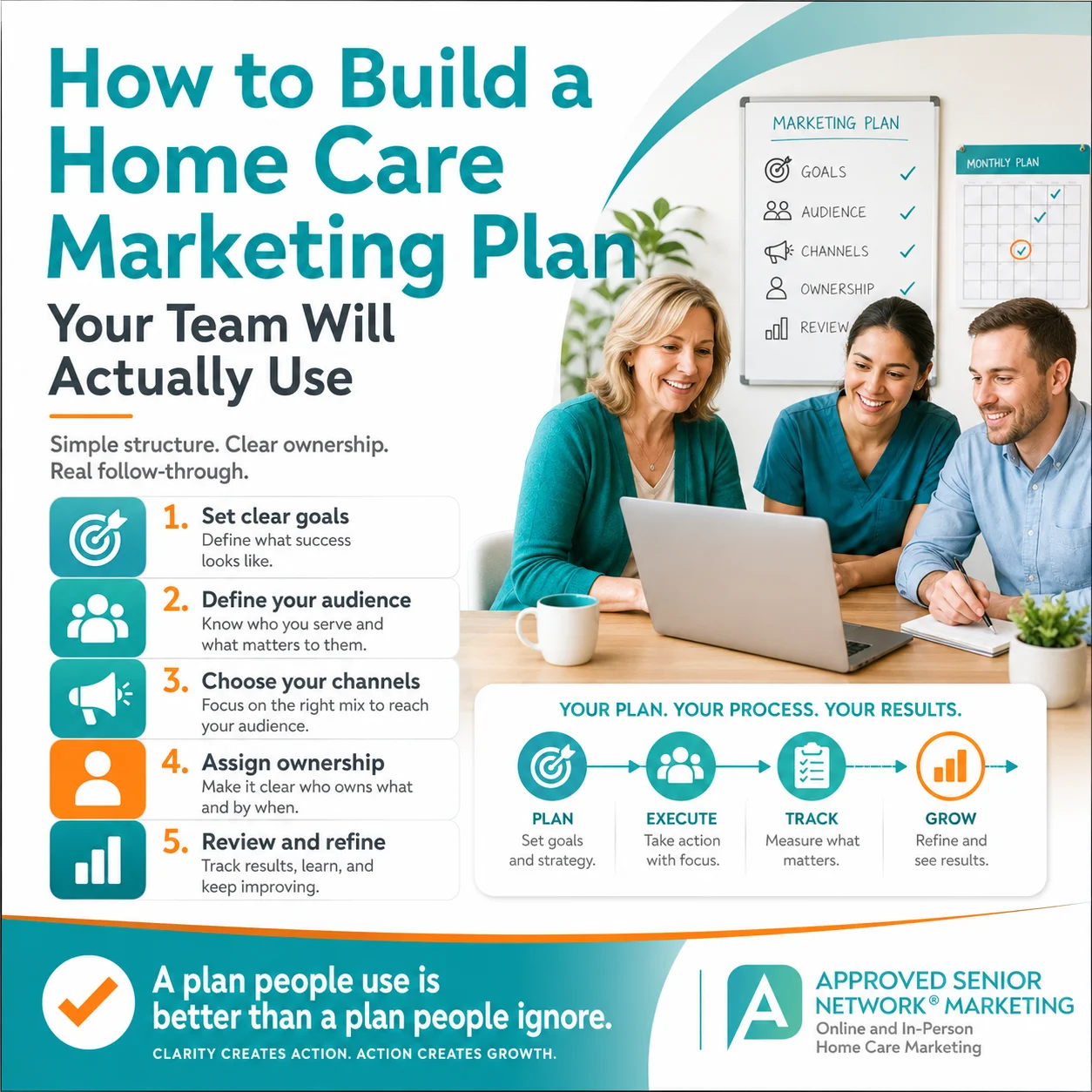
TL;DR: A home care marketing plan is not a list of channels. It is a short document that names your admissions goal, your two audiences (families and referral professionals), the activities that reach each one, who owns each activity, and how often you review the numbers. Six steps get you there, and a 90-day version beats an annual plan you never open again.
Most agencies we talk to have marketing activity. Fewer have a marketing plan.
Activity looks like this: a website someone built a few years ago, a Facebook page that gets posts when things are slow, a liaison who visits referral partners when the schedule allows, and a stack of business cards from a conference.
None of that is wrong. It just isn't connected to anything. Nobody can say which of it produced last month's admissions, so nobody can say what to do more of.
A plan fixes that. Not a 40-page document. A short one your team will actually open on Monday morning.
Step 1: start with admissions, not traffic
Marketing plans usually start in the wrong place: impressions, followers, website visits. Those numbers move without a single new client showing up.
Start with the number your agency actually runs on. How many new admissions do you need each month to hit your census and revenue goals? Work backward from there. If you know roughly how many inquiries it takes to produce one admission at your agency, you now know how many inquiries your marketing has to generate. That is your target, and every activity in the plan exists to feed it.
If you don't know your inquiry-to-admission ratio yet, that is finding number one. Start counting this month.
Step 2: name your two audiences
Home care agencies market to two very different groups at the same time.
Families are searching online, usually under stress, often at night, comparing two or three agencies before they call anyone. They find you through Google, your home care website, your Google Business Profile, and your reviews.
Referral professionals are hospital discharge planners, social workers, elder law attorneys, senior living staff, hospice teams, and physicians. They are not searching Google for you. They refer to the agency they know and trust, which is built in person, over time.
A plan that only covers one audience leaves the other to chance. Write both into the plan, with separate activities for each, because what works on one does nothing for the other.
Step 3: inventory what you already have
Before adding anything new, list what exists and grade it honestly:
- Website: does it say what you do, who you help, where you serve, and how to reach you, on every page?
- Google Business Profile: complete, active, and gathering reviews, or set up once and abandoned?
- Reviews: do you have a working way to ask for them, or do they arrive by luck?
- Content: when a family asks Google a question about care, does your site have the answer?
- Referral outreach: is there a named list of target accounts and a visit schedule, or "when we have time"?
- Follow-up: when an inquiry comes in, what happens in the first hour? The first week? Who knows?
Most agencies find the same two gaps: nobody owns review generation, and inquiry follow-up depends on whoever picks up the phone. Both are fixable, and both usually matter more than any new channel you could add.
Step 4: give every activity an owner and a rhythm
This is the step that separates plans that work from plans that decorate a shelf.
Every activity gets a name and a cadence. Not "we should post more." Instead: "Maria publishes one article and one video clip per month. James visits eight referral accounts per week and logs every conversation. Review requests go out within 48 hours of every care plan meeting, and the office manager owns it."
If an activity has no owner, it isn't in the plan. It's a wish.
The cadence matters as much as the owner. Referral relationships are built on showing up regularly, not showing up once with donuts. Content builds search visibility over months of consistency, not one burst of ten posts. Pick a pace your team can hold for a year, even if it is modest. Modest and consistent beats ambitious and abandoned.
Step 5: connect follow-up, or the rest leaks
Here is the uncomfortable part. You can execute steps one through four well and still lose growth to slow follow-up.
A family that submits a form tonight is often calling another agency tomorrow morning if nobody responded. A referral partner who sends you a case and hears nothing back sends the next case somewhere else.
Your plan needs a follow-up system with the same specificity as everything else: every inquiry gets a response within a defined time, every referral source gets a thank-you and an update, and nothing depends on someone remembering. This is the job a CRM built for home care does, and it is why we treat follow-up as part of marketing rather than a separate operations problem. The most expensive lead is the one you paid to generate and then lost to silence. Speed to lead covers the first-hour standard in detail.
Step 6: review the numbers monthly
Set one monthly meeting, 30 minutes, same day every month. Look at:
- Inquiries by source: website, Google Business Profile, referral partners, paid ads, other
- Inquiry-to-admission conversion
- Review count and rating movement
- Referral visits completed vs. planned
- Content published vs. planned
Then make one decision: what gets more effort next month, and what gets cut. That single decision, made monthly with real numbers in front of you, is the entire point of having a plan. For the numbers you should be able to pull, our post on what actually works in home care marketing now covers tracking in more detail.
The 90-day version
Annual plans age badly. Write the first version as a 90-day plan:
- Days 1 to 30: fix the inventory gaps from step 3. Website answers the four questions, Google Business Profile complete, review request process live, follow-up rule defined.
- Days 31 to 60: build the rhythm. Referral visit schedule running, first content published, every inquiry source being logged.
- Days 61 to 90: first real numbers review. Keep what produced inquiries, fix or cut what didn't, and write the next 90 days.
Three cycles of that and you will know more about what grows your agency than most competitors learn in three years.
Want help building it?
This is the work we do every day at Approved Senior Network®, from the online marketing system to in-field sales training for the person doing the referral visits. If you'd rather build the plan with someone who has done it for hundreds of agencies, schedule a strategy call.
Frequently asked questions
What should a home care marketing plan include?
At minimum: an admissions goal, the inquiry target that supports it, activities for both families and referral professionals, a named owner and cadence for each activity, a follow-up standard for inquiries, and a monthly review of results by source.
How much should a home care agency spend on marketing?
There is no single right number, and be careful with anyone who gives you one without knowing your agency. Spend follows the plan, not the other way around: decide the activities that reach your two audiences, price those activities honestly (including staff time for referral visits), and judge the spend against the admissions it produces. The monthly review in step 6 is what tells you whether to spend more or differently. The home care marketing budget conversation walks through the full framework.
Who should own the marketing plan?
One person, even in a small agency. The owner of the plan is not the person who does every activity. They are the person who runs the monthly review, holds activity owners to their cadence, and decides what changes. In many agencies that is the owner or administrator; in larger ones it is a marketing or business development lead.
How often should the plan be updated?
Review the numbers monthly and rewrite the plan every 90 days. A 90-day horizon is long enough for SEO, content, and referral relationships to show movement, and short enough that the plan reflects what you learned instead of what you guessed in January.