
Speed to lead: what happens in the first hour decides the admission
Dawn FialaHome Care Expert, Sales and OperationsAugust 19, 2026
TL;DR: The title is intentionally urgent, but the real lesson is operational: a lead is only valuable if the agency has a reliable response system. Approved Senior Network recommends treating the first hour as a protected response window, not because every family makes a decision in exactly 60 minutes, but because responsiveness is one of the first experiences a prospective client has with the agency. Assign ownership, define what happens by channel and time of day, give the first call a clear job, create a no-answer sequence, and use a CRM so every inquiry has a next action. Response speed is the half of home care lead generation that happens inside your office.
A lead is a live family situation, not a spreadsheet row
A home care inquiry often begins because something changed.
A parent fell. A hospital discharge is approaching. A spouse is exhausted. Dementia symptoms are getting harder to manage. An adult daughter is researching from another state.
The agency receiving the inquiry may not be the only agency the family contacts.
That is why fast, organized follow-up is part of home care marketing, not merely an administrative function.
Use a first-hour standard without pretending every situation is identical
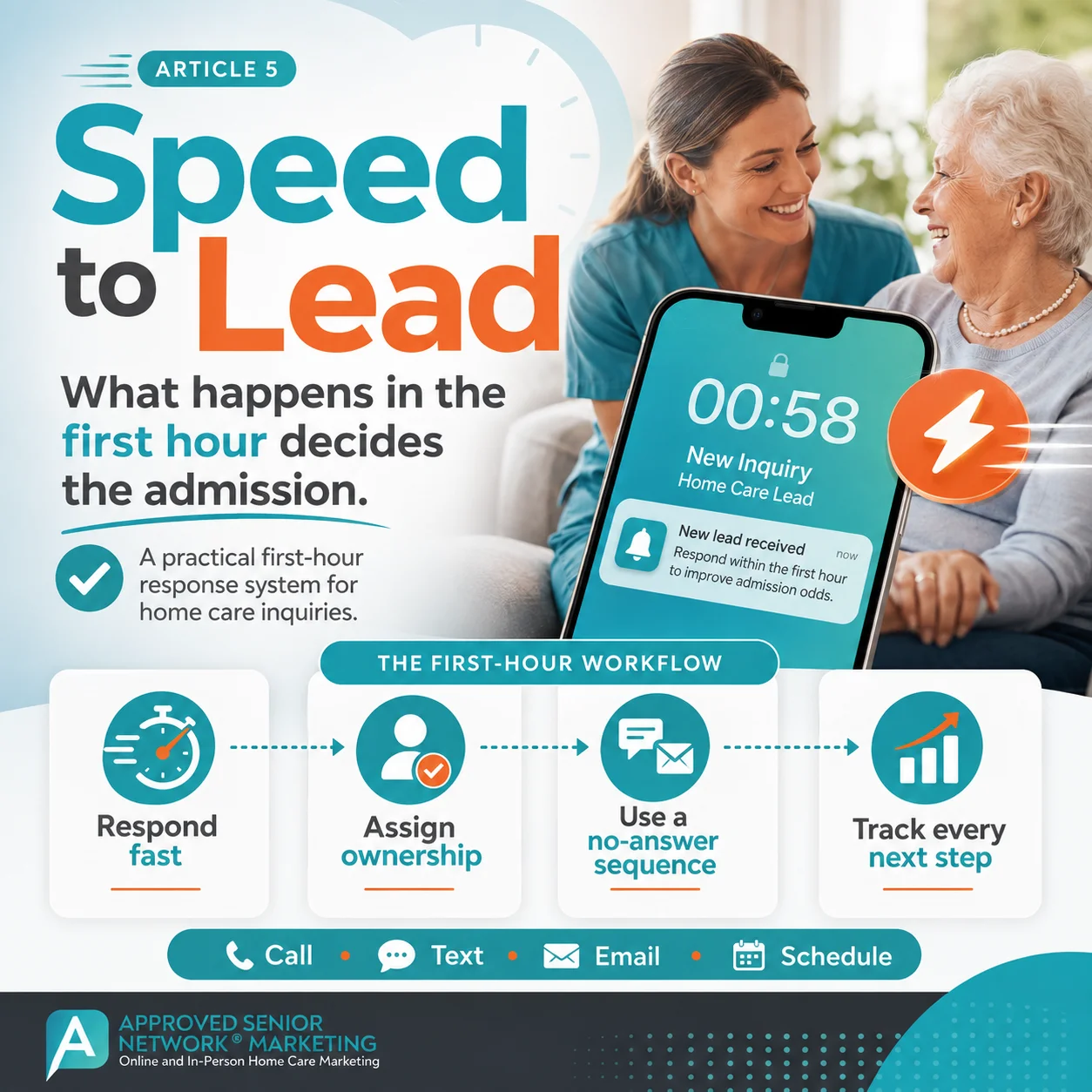
ASN recommends defining the first hour as an internal service standard: when an inquiry arrives, the team should know who owns it and what the next action is.
That does not mean promising every prospect a live consultation within 60 minutes. It means avoiding the dangerous state of "someone probably saw it."
For how this plays out in the field, including after-hours coverage and weekend handoffs, Annette and Lisa talk it through in Speed to the Lead: Why Home Care Inquiries Cannot Wait.
First-hour decision tree
If the inquiry is a live phone call:
- Answer when possible.
- If transferred, confirm the receiving person is available.
- If voicemail is necessary, trigger a callback task immediately.
If the inquiry is a website form:
- Notify the assigned intake person.
- Send an appropriate acknowledgement if configured.
- Create a call or follow-up task.
If the inquiry is text or chat:
- Follow the agency's consent and communication procedures.
- Move toward a real intake conversation when appropriate.
If the inquiry arrives after hours:
- Define whether it receives live coverage, an on-call response, or a next-business-period response.
- Set that expectation consistently.
The rule is simple: every channel needs an owner and a clock.
Give the first conversation one job
The first call is not a brochure presentation.
Its job is to understand the situation and determine the next appropriate step.
ASN first-call framework
1. Situation "Tell me what has been happening."
2. Person Who needs care? What is the immediate concern?
3. Place Where is care needed? Is the location inside the agency's service area?
4. Timing When does the family hope support can begin?
5. Support needed What help is being requested - companionship, personal care, dementia support, overnight care, respite, post-discharge support, or something else?
6. Decision process Who else is involved? Is a hospital, rehab, physician, care manager, or family member part of the decision?
7. Next step Assessment, consultation, follow-up call, document request, or another defined action.
Listen before selling.
Use a qualification framework that does not dehumanize the call
Not every inquiry is a fit. The agency needs to understand fit without making the caller feel interrogated.
Basic qualification questions
- Is the location in our real service area?
- Do we provide the type of care being requested?
- Can we realistically staff the schedule?
- Is the requested start date feasible?
- Are there safety or care needs that require another level of service?
- Is the family ready for a consultation now, or still researching?
The point is not to rush to "qualified" or "unqualified." The point is to know what happens next.
Build a no-answer sequence
A missed first connection should not become a forgotten lead.
Example sequence
Attempt 1: Call promptly. Leave a concise voicemail if appropriate.
Follow-up: Send an approved text or email when the agency has permission and the channel fits its communication process.
Attempt 2: Try again at a different reasonable time.
Helpful follow-up: Send one useful resource related to the inquiry, such as a dementia guide, paying-for-care guide, hospital discharge guide, or explanation of how care starts.
Next task: Schedule the next follow-up in the CRM.
Stop or adjust when the person asks not to be contacted or when agency policy says the sequence is complete.
The exact cadence should fit the agency's legal, operational, and consent requirements. Consistency is the goal.
Treat "just looking" as a stage
Families often begin before they are ready to start care.
The wrong response is pressure.
The better response is to identify the question behind the research.
"Just looking" may mean:
- I do not know what home care costs.
- My siblings are not convinced yet.
- Mom refuses help.
- We are waiting for surgery.
- I am comparing home care with assisted living.
- I need to know whether insurance or benefits apply.
ASN nurture rule
If the family is not ready to schedule the next sales step, give them a useful next step.
Examples:
- Send a relevant guide.
- Schedule a permission-based follow-up.
- Invite them to call after a medical appointment.
- Answer the one question preventing progress.
Helpful follow-up builds trust better than repeated "checking in" messages.
Let the CRM take over from memory
ASN's CRM philosophy is simple: marketing only works when the lead is handled properly.
A home care CRM should make it easier to see:
- Lead source
- Contact information
- Care need
- Service area
- Status
- Last contact
- Next action
- Assigned owner
- Notes
- Follow-up tasks
Minimum pipeline stages
Keep stages simple enough that staff will actually use them:
- New inquiry
- Attempting contact
- Connected / qualifying
- Consultation or assessment scheduled
- Decision pending
- Admitted / started care
- Nurture
- Closed / not a fit
The exact labels matter less than consistent use.
The daily lead huddle
For agencies with steady inquiry volume, use a 10-minute daily review.
Ask:
- What new inquiries arrived?
- Which have not been reached?
- Which have no next task?
- Which assessments are scheduled?
- Which families are waiting on us?
- Which leads need a helpful resource?
- Which lost leads teach us something about marketing, staffing, pricing, or service area?
No lead should survive the meeting without an owner and next action.
This is why the home care marketing plan needs a follow-up section. Lead generation without lead management is unfinished marketing.
For the larger framework, see what actually works in home care marketing now.
Frequently asked questions
How fast should we respond to a website inquiry?
As quickly as the agency can do so reliably. ASN recommends a defined first-hour response standard so every new inquiry receives ownership and a next action, while recognizing that staffing models and after-hours coverage vary.
What should the first call cover?
Understand the situation, location, timing, care need, decision process, fit, and next step. The goal is to move the family forward appropriately, not explain every service the agency offers.
How many follow-ups should we make?
There is no universal number. Use a documented sequence, respect consent and stop requests, vary the channel appropriately, and make follow-up useful rather than repetitive.
What if the family is not ready?
Move the inquiry to nurture rather than treating it as dead. Give the family a relevant resource and a reasonable next point of contact.
ASN field-source note
This article's operating frameworks are based on Approved Senior Network's current connected marketing and CRM model: lead capture from phone, forms, text/chat, guide downloads, and campaigns should create notifications, tracking, and follow-up rather than ending at the form submission.