
Tracking home care marketing: the numbers that matter and the ones that don't

Dawn FialaHome Care Expert, Sales and OperationsAugust 19, 2026
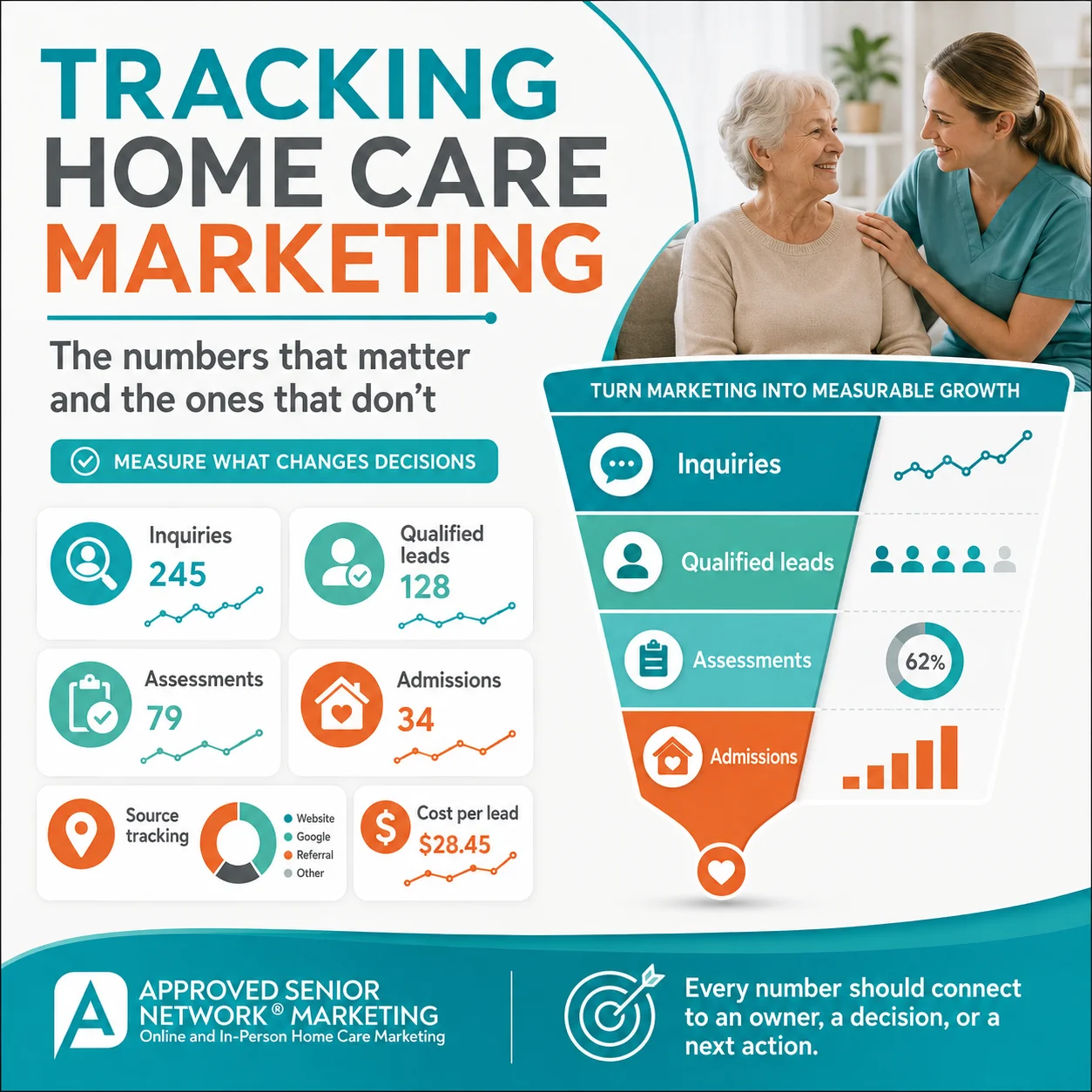
TL;DR: Marketing measurement is useful when it changes a decision. A home care agency should know which sources create inquiries, which inquiries are qualified, which move to consultations or assessments, which become clients, what those channels cost, and where leads are lost. Approved Senior Network recommends one simple rule: every meaningful marketing number should connect to an owner, a decision, or a next action. Traffic, impressions, rankings, and engagement can provide context; admissions and economics tell you whether the system is working.
Stop asking dashboards to make decisions for you
A dashboard can show 50 numbers and still answer nothing.
Website traffic may rise while admissions fall. A referral source may produce only a few inquiries but convert exceptionally well. A paid campaign may produce many form fills that never become qualified conversations.
Measurement starts with the business question.
Examples:
- Which channels produce qualified family inquiries?
- Which service areas produce admissions?
- Are leads being lost because of marketing or follow-up?
- Is a campaign creating enough value to continue?
- Which referral relationships deserve more attention?
Tracking belongs inside what actually works in home care marketing now because reporting should lead to action. It is also the measurement layer of home care lead generation: without it, there is no way to tell which sources produce clients.
Use a simple funnel
ASN recommends starting with a funnel the team can maintain consistently.
Impression / visit -> Inquiry -> Qualified inquiry -> Consultation or assessment -> Admission / start of care
Do not add 14 stages unless the sales process truly uses them.
Core definitions
Inquiry: A person or referral source initiates contact.
Qualified inquiry: The opportunity meets the agency's minimum fit criteria, such as service area and care type.
Consultation/assessment: The family advances to the agency's formal sales or care-evaluation step.
Admission: The opportunity becomes an active client under the agency's chosen definition.
Write these definitions down. Otherwise every staff member will count differently.
Build source tracking into intake
Use three layers together:
- Digital source data from analytics and advertising platforms.
- Call/form tracking where appropriate.
- Human source capture: ask "How did you hear about us?"
Google Analytics uses source and medium dimensions to help categorize where website sessions originate. UTM parameters can help identify campaigns and channels when links are tagged consistently.
But analytics cannot replace intake data.
A daughter may click Google after a discharge planner already gave her the agency name. A caller may say "Google" even though a friend recommended the agency first. Attribution is evidence, not omniscience.
ASN source taxonomy
Keep the list manageable:
- Google organic
- Google Business Profile / Maps
- Google Ads
- Other paid media
- ChatGPT / AI search
- Social media
- Email / newsletter
- Referral partner - hospital/rehab
- Referral partner - senior living
- Referral partner - professional
- Client/family referral
- Community/event
- Directory
- Other
- Unknown
Then allow a secondary detail field for the specific organization or campaign.
Track ChatGPT and generative AI separately when possible
OpenAI says ChatGPT referral URLs include utm_source=chatgpt.com, which gives publishers a way to identify referral traffic in analytics.
Google also introduced Generative AI performance reporting in Search Console in June 2026, giving site owners another source of visibility data for Google's generative search experiences.
That means the 2026 measurement stack can include:
- Traditional Google organic performance
- Google generative AI performance
- ChatGPT referral sessions
- Lead-source self-reporting
- CRM outcomes
Do not confuse visibility with revenue. Connect the data to the funnel.
Use the five calculations that matter
1. Inquiry-to-qualified rate
Qualified inquiries / total inquiries x 100
Example: 40 inquiries, 28 qualified.
28 / 40 = 70%
If this rate is weak, investigate targeting, service-area mismatch, staffing constraints, or confusing offers.
2. Qualified-to-assessment rate
Assessments / qualified inquiries x 100
Example: 28 qualified inquiries, 16 assessments.
16 / 28 = 57%
A low rate may point toward sales follow-up, pricing objections, response speed, or fit.
3. Assessment-to-admission rate
Admissions / assessments x 100
Example: 16 assessments, 8 admissions.
8 / 16 = 50%
Now the question becomes what happened during or after the assessment.
4. Cost per qualified inquiry
Channel cost / qualified inquiries from that channel
If a channel costs $3,000 and generates 15 qualified inquiries:
$3,000 / 15 = $200 per qualified inquiry
5. Cost per admission
Channel cost / admissions attributed to that channel
If that same channel produces 5 admissions:
$3,000 / 5 = $600 per admission
These numbers are examples to demonstrate the math, not ASN benchmarks.
Add staff time when comparing channels
A "free" channel may require a large amount of owner or liaison time.
A paid channel may cost more cash but less internal labor.
For a truer comparison, capture:
- Media spend
- Vendor fees
- Software directly tied to the campaign
- Event or print costs
- Estimated staff hours
You do not need accounting-level precision. You need enough consistency to make a useful decision.
Use a one-page monthly scorecard
| Metric | This month | Prior month | Question |
|---|---|---|---|
| Total inquiries | Are we creating enough opportunities? | ||
| Qualified inquiries | Are we attracting the right people? | ||
| Assessments | Are qualified leads advancing? | ||
| Admissions | Is the sales process converting? | ||
| Cost per qualified inquiry | Which channels are efficient? | ||
| Cost per admission | What does acquisition actually cost? | ||
| Top 5 sources | Where is growth coming from? | ||
| Unworked leads | Is follow-up failing? | ||
| Unknown source % | Is attribution discipline slipping? |
A home care CRM makes this easier when source, status, notes, and next actions are captured in the same process.
Use a monthly decision meeting, not a reporting meeting
ASN recommends ending the review with decisions.
Agenda:
- What generated qualified inquiries?
- What generated admissions?
- Where did leads stall?
- Which sources improved or declined?
- What did we spend in cash and staff time?
- What did we learn about service area, staffing, pricing, or messaging?
- What are we changing next month?
If the meeting ends without an owner and an action, the dashboard won.
The same discipline belongs in the home care marketing plan.
Know when to cut a channel
Do not cut a channel because of one weak week. Do not keep one forever because it produced a client two years ago.
ASN channel decision rule
Before cutting a channel, check five things:
- Targeting: Did we reach the right market and audience?
- Offer/page: Did the destination answer the visitor's need?
- Follow-up: Were inquiries handled consistently?
- Volume/time: Did we collect enough evidence to judge fairly?
- Economics: Do qualified inquiries and admissions justify the cost?
Sometimes marketing is the problem. Sometimes intake is the problem. Tracking should help you tell the difference.
Frequently asked questions
What is a good cost per lead in home care?
There is no universal benchmark that is useful across every agency, market, service mix, and channel. Calculate cost per qualified inquiry and cost per admission, then compare those numbers with your agency's economics.
Which free tools cover the basics?
Start with Google Analytics, Google Search Console, Business Profile reporting, advertising-platform reporting, and the CRM or lead tracker you already use. Consistent source capture is more important than adding another dashboard.
How do we track referral-source inquiries?
Use a required referral-source field with standardized organization names. Track both referral count and downstream conversion.
How should we track AI search?
Use available Search Console generative AI reporting, analytics referrals such as chatgpt.com, manual AI visibility checks, and CRM source capture. Treat all of these as complementary evidence.
Primary sources
- Google Analytics: Traffic-source dimensions: https://support.google.com/analytics/answer/15567068
- Google Analytics: Manual campaign tagging / UTM parameters: https://support.google.com/analytics/answer/11242870
- Google Search: Generative AI performance reports in Search Console: https://developers.google.com/search/blog/2026/06/gen-ai-performance-reports
- OpenAI: Publishers and Developers FAQ, including ChatGPT referral tracking: https://help.openai.com/en/articles/12627856-publishers-and-developers-faq