
From inquiry to admission: a home care marketing and sales conversion system for booking more assessments

Annette ZieglerLead Sales and Marketing TrainerAugust 21, 2026
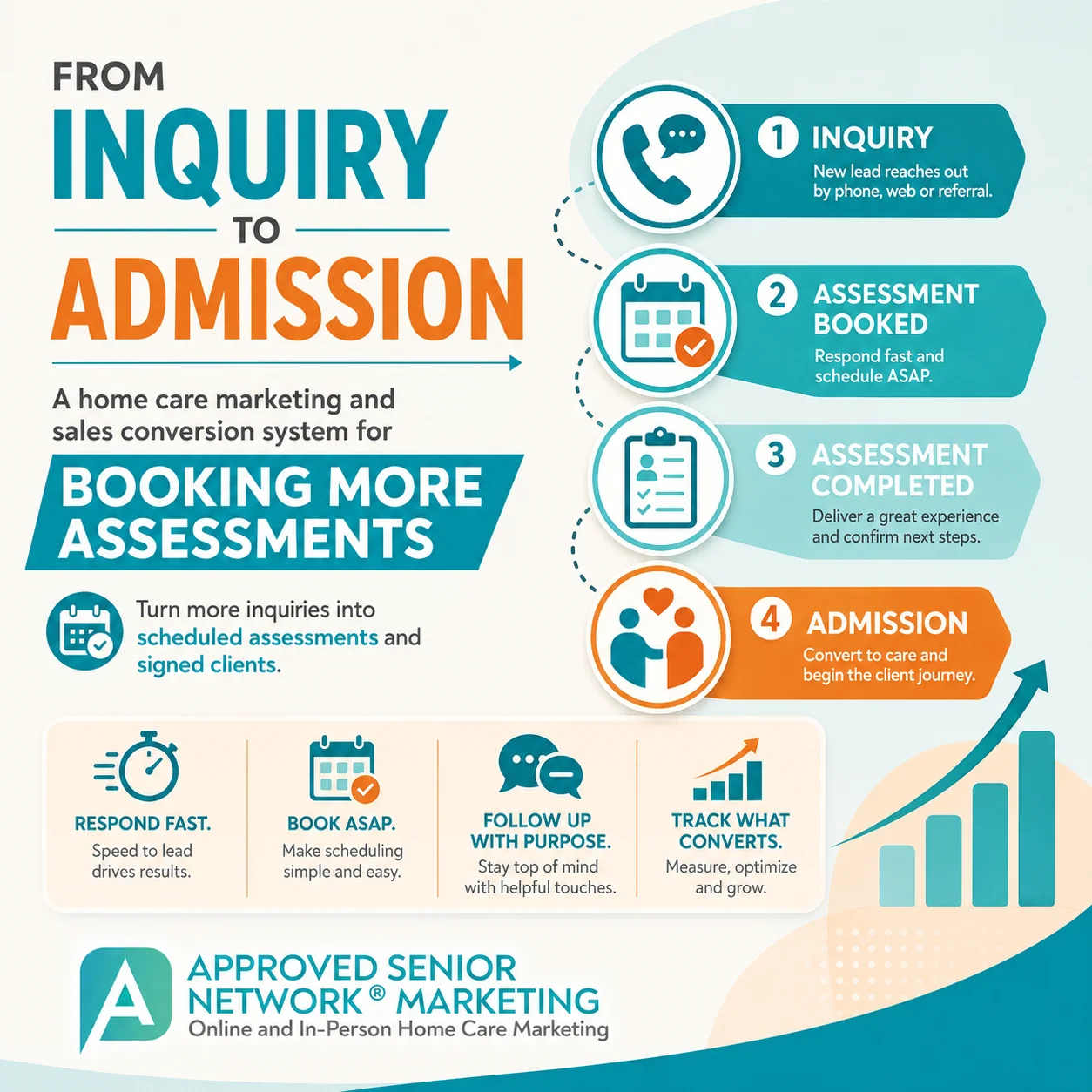
TL;DR: Home care agencies lose sales when a qualified inquiry is treated like a generic lead. The first conversation should create emotional trust, understand the immediate situation, establish the agency as a capable guide, and move the family to the next appropriate step, usually an assessment or consultation. GoCarePro trains marketers to respond quickly, capture useful details, book the assessment promptly, make a clear recommendation, and track the conversion funnel from inquiry to signed client.
A referral is not a client yet
Referral-source marketing can do everything right and still fail at the last mile.
A skilled nursing social worker sends a family.
A hospital discharge planner gives them your number.
An elder-law attorney recommends your agency.
A daughter completes the website form.
Then the phone rings and no one answers.
Or the call is returned four hours later.
Or the family receives a 20-minute explanation of every service without being asked to schedule anything.
Sales training must connect referral generation to inquiry conversion.
That is why GoCarePro includes training on both referral relationships and booking service inquiries. Learn more about GoCarePro sales training.
The first goal is not to explain everything
On the first inquiry call, the goal is usually to move the family to the next appropriate conversation.
For many home care agencies, that means an in-home, virtual, or facility-based assessment or consultation.
The intake person does need enough information to determine basic fit. They do not need to conduct the entire care assessment over the phone before asking for an appointment.
Use this sequence:
- Connect emotionally.
- Understand what changed.
- Clarify immediate care needs and timing.
- Establish confidence that the agency understands the situation.
- Schedule the next step.
- Capture details for the care team.
The 10-second emotional connection
GoCarePro teaches a simple opening question:
"What prompted your call today?"
Then listen.
A family member may say:
- "Mom fell again."
- "Dad is coming home from rehab Friday."
- "My sister cannot keep staying overnight."
- "The memory care community says Mom needs more one-on-one help."
- "We are exhausted and do not know what to do."
Do not immediately interrupt with your service list.
Acknowledge the situation first.
"I'm sorry your family is dealing with that. Let me ask a few questions so I can understand what would make the transition easier."
That sounds different from a call-center script because it responds to what the person actually said.
Ask enough questions to understand urgency and fit
Useful initial questions include:
- Who needs care?
- Where are they now?
- What changed recently?
- What help is needed with daily activities?
- Is there a discharge date?
- Are there mobility or fall concerns?
- Is dementia or cognitive impairment involved?
- Is overnight supervision needed?
- Where will care be provided?
- When does the family want care to begin?
- Who else is involved in the decision?
The exact questions depend on the agency's intake and clinical process.
The goal is to understand enough to guide the family and prepare the next team member.
Book the next step promptly
GoCarePro encourages participants to move qualified families toward an assessment quickly, often today or tomorrow when the situation is urgent and the agency can support that timing.
A direct booking statement:
"The next best step is for us to meet, understand the care needs in more detail, and build a recommendation. I have an opening this afternoon at 3:00 or tomorrow at 10:00. Which works better?"
Specific options are easier to act on than:
"Call us back whenever you are ready."
Do not manufacture urgency. Use the urgency already present in the family's situation.
Speed matters most when several agencies are competing
A family requesting home care may contact multiple providers.
That is especially common with paid directory leads and urgent post-discharge situations.
Build a response standard by channel:
Phone inquiry
- Answer when possible.
- If missed, return quickly.
- Leave a concise voicemail.
Web form
- Immediate confirmation message.
- Assigned owner.
- Prompt call.
- Text or email follow-up when appropriate and permitted.
Paid lead
- Rapid multi-channel response can be appropriate when the person has requested contact and your communication practices comply with applicable consent and messaging rules.
Professional referral
- Acknowledge the referral to the professional when appropriate.
- Contact the family quickly.
- Close the loop with the referral source within privacy and authorization boundaries.
The important operational point is ownership: every inquiry should belong to someone.
Use a conversion funnel with four rates
1. Contact rate
Inquiries reached ÷ total qualified inquiries
If this is weak, review response speed, contact attempts, phone coverage, and lead quality.
2. Assessment booking rate
Assessments scheduled ÷ qualified inquiries reached
If this is weak, review the first-call conversation, appointment ask, pricing handling, and fit criteria.
3. Assessment completion rate
Assessments completed ÷ assessments scheduled
If this is weak, review confirmations, scheduling delays, family readiness, and no-show follow-up.
4. Signing rate
Clients signed ÷ assessments completed
If this is weak, review the assessment process, recommendations, value conversation, objections, and closing.
These four numbers tell you where sales leakage occurs, and they plug into the broader home care marketing and sales KPI scorecard.
Do not use an industry "good signing ratio" without context
Agencies often ask, "What should our close rate be?"
The honest answer is that conversion depends on:
- Lead source
- Qualification rules
- Price point
- Service minimums
- Market competition
- Staffing availability
- Payer type
- Response speed
- Assessment method
- Case complexity
Build a baseline from your own data first.
Then improve it by source.
Example:
| Source | Qualified inquiries | Assessments | Signed clients | What to learn |
|---|---|---|---|---|
| Professional referrals | 20 | 15 | 10 | Strong fit and trust |
| Website | 30 | 15 | 7 | Improve booking and qualification |
| Paid directory | 40 | 10 | 2 | Response speed or lead quality issue |
The numbers are examples, not benchmarks. The value comes from comparing your own sources.
The assessment should produce a recommendation
Families do not always know exactly what schedule or service they need.
The assessor should gather information and then make an appropriate recommendation based on the agency's real service model.
Instead of:
"How many hours do you want?"
Try:
"Based on what you described, I would recommend starting with three four-hour visits each week so we can address bathing, meals, laundry, mobility support, and give your family predictable relief. Let me explain why."
The family can accept, decline, or modify the recommendation. But the professional should not force the family to design the care plan without guidance.
Create a clear close
At the end of the assessment, avoid vague language.
Weak:
"Think it over and call us."
Clearer:
"If you are comfortable moving forward, the next step is to complete the agreement so our team can begin caregiver matching. Would you like to start that now?"
If the family is not ready, schedule a specific follow-up.
"I understand you want to speak with your brother. Would it be helpful if I called you tomorrow at 4:00 after you have talked?"
Now the opportunity has a next action. The same discipline applies upstream when asking referral sources for the business.
Capture lost-opportunity reasons
Every lost qualified opportunity should have a reason.
Examples:
- Price
- Minimum hours
- Could not staff requested schedule
- Outside service area
- Family chose facility placement
- Chose competitor
- Not ready
- No response
- Needed skilled services outside scope
- Timing changed
Review these monthly.
If "price" dominates, you may have a value or target-market issue.
If "could not staff" dominates, sales and recruiting/operations need to align.
If "no response" dominates, improve follow-up.
If "chose competitor" dominates, case your market and review positioning.
The manager's weekly conversion audit
Select five recent inquiries and review:
- How fast did we respond?
- Did we reach the person?
- What did they tell us?
- Did we clearly ask for an assessment?
- Was the assessment scheduled promptly?
- Was it completed?
- Was a recommendation made?
- Was the business requested?
- What happened next?
- What does the salesperson need to practice?
That is sales coaching based on real work, not a generic motivational meeting.
Use CRM automation without automating empathy
A CRM can help:
- Assign leads
- Create tasks
- Send confirmations
- Trigger follow-up sequences
- Track source
- Track stage
- Store notes
- Schedule appointments
- Report conversion
Automation should prevent leads from being forgotten. It should not turn a worried daughter into a sequence of impersonal messages.
GoCarePro focuses on the sales skill; ASNSpark! CRM can support the tracking and follow-up system when technology is needed.
Frequently asked questions
How fast should a home care agency respond to a new inquiry?
As quickly as the agency can do so reliably, especially for urgent or competitive inquiries. Define a response standard, assign ownership, and measure actual response time rather than relying on "we usually call quickly."
What is the goal of the first home care inquiry call?
Understand the family's immediate situation, establish trust, determine basic fit, and move the person to the next appropriate step. For many agencies, that means booking an assessment or consultation rather than trying to complete the entire sales process on the phone.
What is a good home care assessment signing rate?
There is no universal rate that applies to every agency or lead source. Track your own assessment-to-client rate by source, service, and market, then improve the process based on where opportunities are being lost.
Should we give pricing over the phone?
That depends on the agency's pricing model and market. If pricing is straightforward, transparency may help. If it genuinely depends on care level, schedule, location, or other factors, explain those factors clearly and give the family a direct path to an accurate quote. Avoid using an assessment merely to hide basic information a consumer reasonably needs.
How do we improve home care marketing and sales conversion?
Improve the full chain: response speed, emotional connection, qualification, appointment setting, assessment quality, clear recommendations, asking for the business, follow-up, and measurement by lead source.