
How to ask referral sources for home care business without sounding pushy

Dawn FialaHome Care Expert, Sales and OperationsAugust 24, 2026
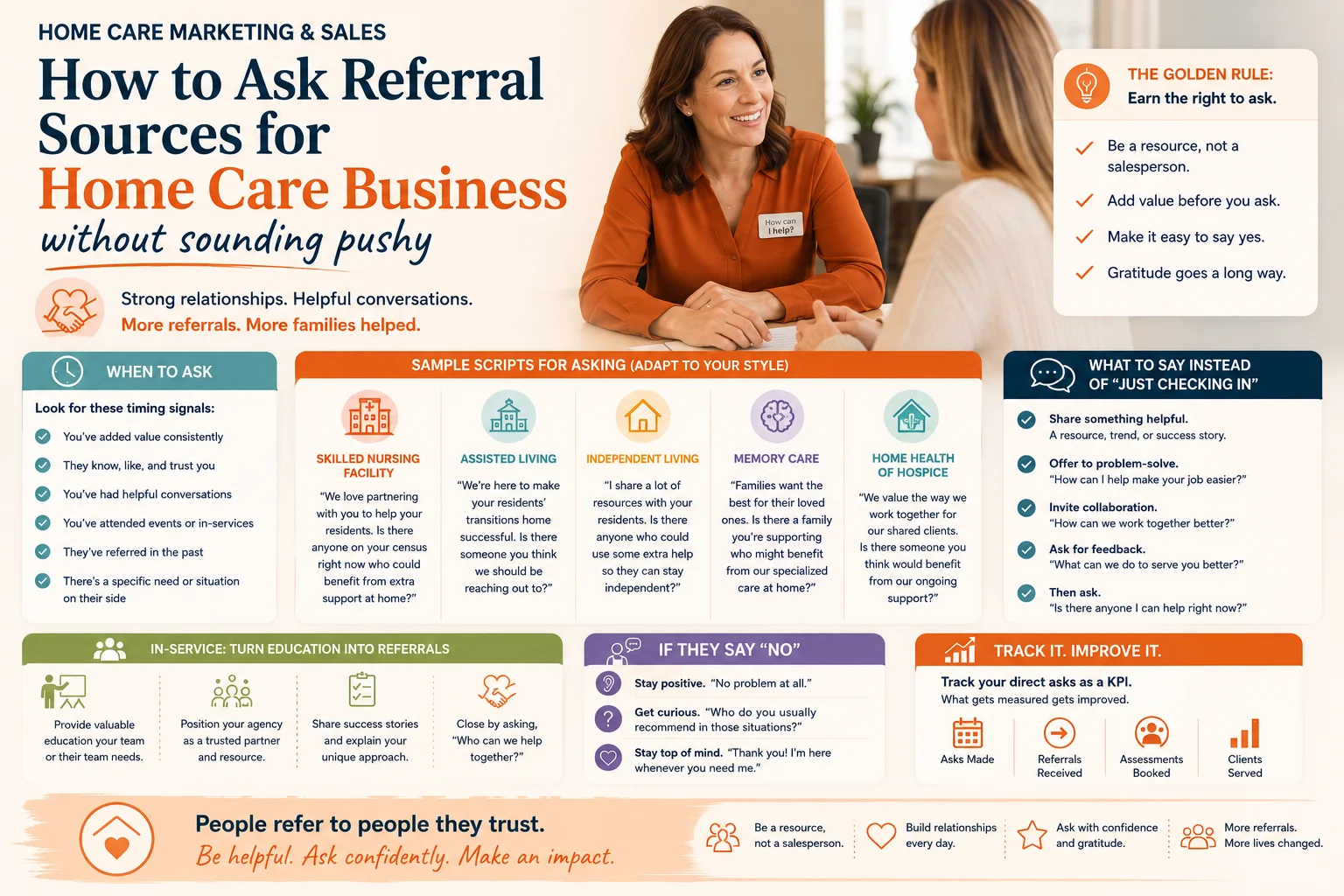
TL;DR: Asking for a referral is not the first step in a referral relationship, but it cannot be skipped forever. The best ask comes after the salesperson has established relevance, learned something about the referral source's needs, and provided useful value. Then the ask should be direct, specific, and easy to act on. GoCarePro trains marketers to stop relying on "just checking in" and confidently ask for the business because relationships only create growth when someone knows exactly how to engage your agency. The ask is one part of home care referral development; targeting, routing, follow-up, and loop closure are the rest.
Home care marketers often do everything except ask
They bring coffee.
They deliver brochures.
They remember birthdays.
They attend events.
They send newsletters.
They become friendly with the receptionist.
Then they leave without asking for a referral, a patient opportunity, a resident need, an in-service, a next meeting, or any other concrete next step.
The relationship may be pleasant. It is not yet a sales process.
GoCarePro dedicates an entire part of its curriculum to confidently asking for business across referral-source types because the skill is both simple and uncomfortable. See the full GoCarePro sales training program. This also assumes the right accounts are on the route to begin with, which is the job of a referral route strategy.
The mindset: you are offering a solution, not requesting a favor
A referral source should never feel obligated to send a family to your agency because you brought lunch.
The salesperson's job is to become a credible option when the referral source encounters a problem your agency can solve.
That creates a healthier mindset:
Weak mindset: "I hope they like me enough to send something."
Stronger mindset: "I understand the type of situation we solve well. I am going to make it clear when and how they can use us."
That confidence should be supported by real operational capacity. Never promise starts, schedules, specialties, or outcomes the agency cannot deliver.
Earn the right to ask
Use this four-part readiness test.
1. Relevance
Do you understand why this professional would ever need your service?
2. Credibility
Have you given them a reason to believe your agency can execute?
3. Value
Have you contributed something useful, information, responsiveness, an in-service, a resource, problem-solving, or follow-through?
4. Timing
Is there a natural reason to ask now?
If all four are present, ask.
The best timing signals
Good moments include:
- After a successful in-service
- After solving a question or problem
- When a referral source mentions an upcoming discharge
- After one or two positive meaningful interactions
- After receiving positive feedback about your agency
- When someone asks about availability
- When the referral source describes a resident or patient situation that matches your service
Do not wait for a mythical moment when the relationship feels "perfect."
Five home care referral asks that sound natural
The present-need question
"Who are you working with right now who may need extra help at home?"
Why it works: It shifts the conversation from your agency to actual people and situations.
The go-to request
"Can I be one of your go-to resources when a family needs private-duty home care?"
Why it works: It asks for a role in their resource network without demanding exclusivity.
The discharge question
"Do you have any upcoming discharges where extra support at home would make the transition safer or easier for the family?"
Why it works: It is tied to a specific workflow.
The senior-living gap question
"Are there residents whose families are asking for more one-on-one help than your team can provide?"
Why it works: It identifies a common supplemental-care situation without criticizing the facility.
The next-step ask
"Would it make sense for us to schedule a short in-service for your team so everyone knows when to call us?"
Why it works: Not every conversation is ready for a referral. A presentation can be the right next commitment.
Tailor the ask to the referral source
Generic scripts become robotic because they ignore context.
Skilled nursing and rehab
Focus on transitions and family support.
Example:
"Which discharges tend to be the hardest for families to manage at home? That is where we may be able to help. Is anyone coming up this week that you are concerned about?"
Assisted living
Focus on supplemental support and aging in place.
Example:
"When a resident starts needing more one-on-one help than your staffing model can provide, can we be one of the resources you give the family?"
Independent living
Focus on preserving independence.
Example:
"Are any residents struggling with daily routines but not ready for assisted living? We can often add support without forcing a major move."
Memory care
Focus on appropriate one-on-one support.
Example:
"Do you have families asking for more individualized companionship or supervision for a resident? If so, I would be glad to talk through whether supplemental care is appropriate."
Home health or hospice
Focus on complementary rather than competing care.
Example:
"When your clinical team sees a family that needs more non-medical help between visits, can we be one of the private-duty resources you trust?"
Replace "just checking in" with a reason
"Just checking in" tells the referral source there is no particular value in the contact.
Try:
- "I wanted to share a short discharge checklist your families can use."
- "You mentioned caregiver burnout last time. We created a resource for families on respite care."
- "I wanted to let you know we currently have capacity for overnight cases in this area."
- "I saw your team is hosting a fall-prevention event. We have an educational handout that may be useful."
- "Last month you said weekend discharges were difficult. Is that still an issue?"
Then ask for a next step.
Use an in-service to create a legitimate sales opportunity
An in-service or lunch-and-learn works when it teaches something the referral source's team actually cares about.
Good topics might include:
- Preventing avoidable problems after discharge
- Signs a senior needs more support at home
- Dementia behaviors families struggle with after transitions
- Fall-risk warning signs
- Family caregiver burnout
- How private-duty home care works with home health or hospice
At the end, do not simply say, "Any questions?"
Use a transition:
"If a situation like the ones we discussed comes up, what is the easiest way for your team to get us involved?"
Now the presentation connects to an operational next step.
Track asks as a KPI
Many owners track visits but do not know whether the salesperson is ever requesting business.
Add a field:
Direct ask made? Yes / No
Then track:
- Asks made
- Referrals generated after asks
- Referral source
- Time from ask to first referral
- Repeat referrals
Do not use the metric to pressure staff into asking indiscriminately. Use it to identify whether avoidance is a pattern. And when the ask works, the inquiry-to-admission system decides whether the referral becomes a client.
What to do when the answer is no
"No" contains information.
Possible responses:
"We already have preferred agencies."
"That makes sense. What do those agencies do particularly well for your team? I would like to understand the standard we would need to meet to become another resource."
"We do not get many requests for private-duty care."
"Understood. When families do ask for extra help, who usually handles that conversation?"
"Just leave information."
"Absolutely. I will keep it brief. Before I go, is there one type of family situation where outside home care support tends to come up most often?"
A no is not permission to argue. It is an opportunity to learn.
The follow-up rule: always know the next action
A visit is incomplete if the CRM or route sheet says only:
"Stopped by. Good visit."
Better:
"Spoke with Mary, social worker. Weekend discharge support is a pain point. Bring discharge guide next Thursday. Ask whether team wants 15-minute in-service. Follow up Aug. 28."
The next action is what makes the sales process repeatable. And when a once-active source goes quiet, why your best referral source hasn't called you back covers how to restart the relationship.
Frequently asked questions
Is it okay to directly ask a referral source for business?
Yes, when the relationship is professional and the ask is appropriate. The salesperson should make clear how the agency can help, respect the referral source's policies and patient-choice requirements, avoid improper inducements, and never pressure someone to refer.
How soon should I ask for a referral?
Ask when you understand the referral source's needs and have established enough relevance and credibility to make the request logical. In some cases that may happen quickly; in others it may require several useful interactions.
What should I say instead of "just checking in"?
Lead with a reason: a useful resource, a capacity update, a follow-up to a prior concern, an educational opportunity, or a specific question tied to their workflow.
What if I am uncomfortable asking for business?
Practice out loud. Role-play the exact source and scenario. Start with simple questions such as "Who are you working with right now who may need extra support?" Confidence usually grows through repetition, not through reading more scripts.
Should I ask for referrals at every visit?
Every interaction should have a purpose and next step, but not every visit requires the exact same direct referral request. Match the ask to the relationship stage and what happened in the conversation.