
Why Is That Home Care Agency Ranking Above Mine? What to Check and What to Do Next

Valerie VanBoovenFounder and Co-OwnerOctober 26, 2026
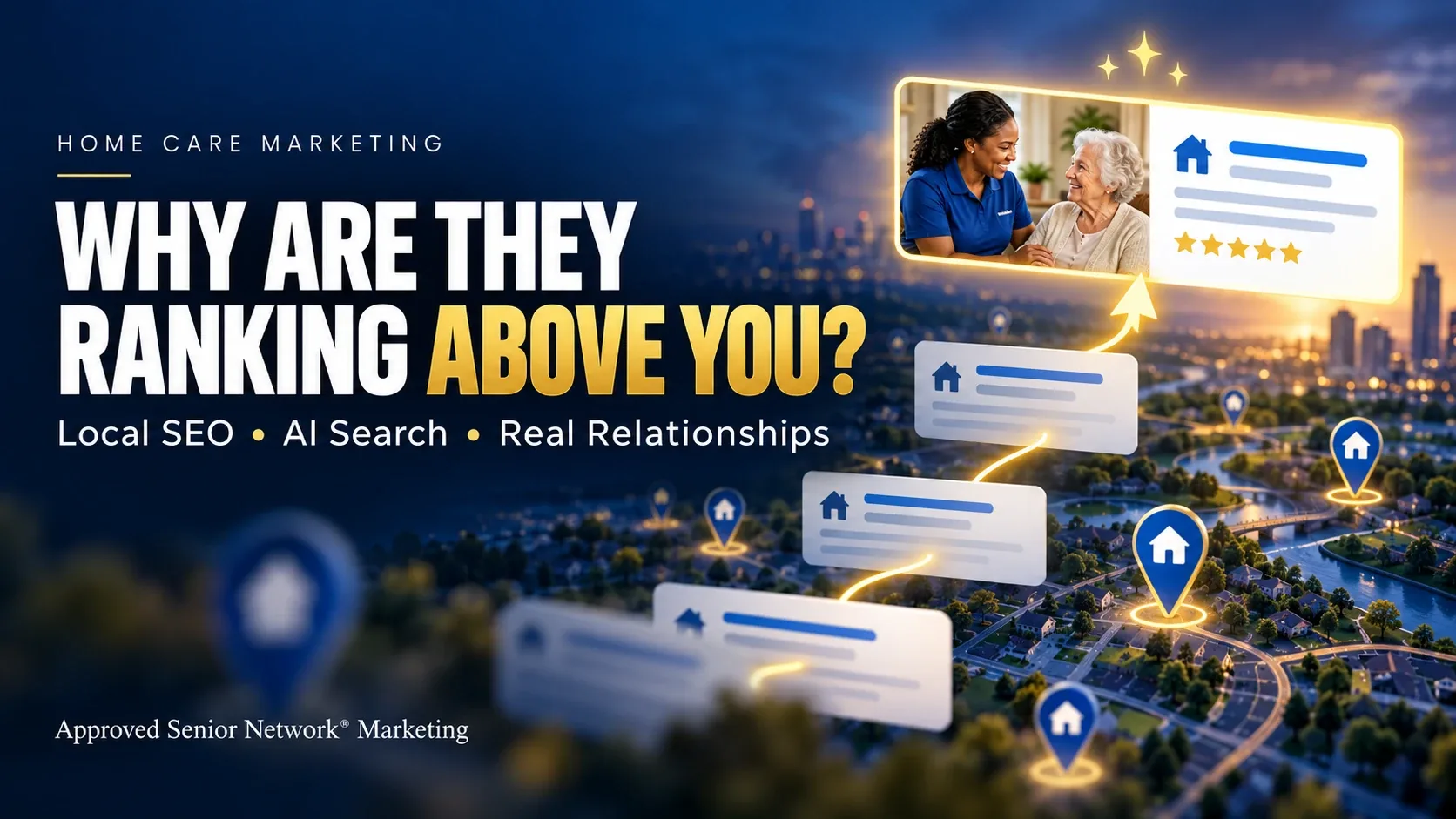
You know your agency provides excellent care. Your caregivers make a difference. Families appreciate your team.
So why does another home care agency keep showing up above yours on Google?
That question was the focus of our October 21 Approved Senior Network® Marketing Mastermind with Valerie VanBooven, RN, BSN, Annette Ziegler, and Lisa Marsolais. The discussion connected online visibility with the work agencies do every day to build trust, strengthen referral relationships, and stay involved in their communities.
The starting point: a competitor’s higher position does not automatically mean they provide better care. It means you need to understand which search you’re looking at, what influences those results, and where your agency has room to improve.
First, Understand Which Results You’re Comparing
“Ranking on Google” can mean several different things:
- Your Google Business Profile appearing in local map results.
- A page from your website appearing in traditional search results.
- Your business or content being included in an AI-generated answer.
An agency can perform well in one area and need improvement in another.
Location also matters. Searching from your office may produce different local results than searching from a family member’s home across town. Google describes relevance, distance, and prominence as key factors in local rankings. Proximity matters, but it is not the only consideration.
One screenshot of one search cannot tell the whole story of your agency’s visibility.
Families Search for Problems, Not Just Services
Home care professionals know the language of the industry. Families may be learning it for the first time.
Someone looking for help might search for “home care near me.” They might also ask:
- How much does home care cost in my town?
- Can my mom stay home alone if she has dementia?
- Who can help my dad after he leaves the hospital?
- How can I get a break from caregiving?
Your website needs to speak to those concerns.
A page that simply lists “personal care, companion care, and respite care” leaves important questions unanswered. Families need to understand what those services include, who they help, and how to get started.
As Valerie explained during the discussion, useful website content begins with understanding what the person searching actually needs.
Put the Answer Near the Top of the Page
One practical approach discussed during the Mastermind was adding a short, clear summary at the beginning of important website pages.
Before asking visitors to read several paragraphs, tell them:
- What service you provide.
- Where you provide it.
- Who it helps.
- How to contact your team.
A family caregiver may be reading on a phone between work responsibilities, medical appointments, and calls from a parent. Make the essential information easy to find.
Then use the rest of the page to explain the service, answer common questions, and describe the next steps.
This approach also fits a broader principle of search visibility: create helpful, reliable content that people can understand. Google’s guidance says foundational SEO practices remain relevant to its AI search features. A summary paragraph is useful writing, but it does not guarantee an AI recommendation.
Give Important Services and Communities Meaningful Content
During the session, Valerie encouraged agencies to look beyond a single generic services page.
Dedicated pages can give families a clearer understanding of personal care, companion care, dementia support, respite care, and help after a hospital stay.
Each page should explain what your agency actually does. What might a caregiver help with during a visit? How does care fit around the family’s routine? What happens after someone calls?
Location pages deserve the same attention.
Changing a town name while repeating the same paragraphs gives readers little useful local information. Instead, explain your service coverage and include relevant community details when they genuinely help families.
Local resources should support the page’s purpose. A list of unrelated landmarks will not explain how your agency helps someone arrange care.
Check the Basics Before Adding More Content
Sometimes the first problem to solve is a basic information gap or technical issue.
The Mastermind discussion highlighted several places to investigate:
Your Google Business Profile: Are your phone number, website, service area, and business information accurate? Do your listed hours reflect your actual availability?
Your important website pages: Can search engines access them? Have key service and location pages been indexed?
Your links and contact options: Do links work? Is your phone number easy to find and tap on a mobile device?
Your instructions for families: Does the website explain how to request care, or does someone have to figure it out?
Adding another blog post will not fix a broken contact experience or a setting that prevents an important page from being indexed.
Treat Reviews as Conversations Future Families Will Read
Reviews were another major topic.
The team emphasized asking for honest feedback and responding thoughtfully. A review response is also a message to the next family evaluating your agency.
Thank people for taking the time to share their experiences. When criticism appears, pause before responding. Keep the reply professional, protect private information, and invite the person to speak with your team directly.
If you believe a review violates platform policies, have it evaluated before reacting. Reporting a review does not guarantee removal.
The goal is to show that your agency listens and takes concerns seriously.
Turn Community Involvement Into Useful Stories
One of the strongest connections between online marketing and referral development is the work your team is already doing in the community.
Are you participating in a senior center event? Providing caregiver education? Organizing a seasonal activity with a local community?
Document it, with appropriate permission.
Share what happened, who participated, and why it mattered. Those details can become a company news article, newsletter feature, or social media post.
Real activities give families and referral partners a clearer picture of the people behind your agency.
Give Referral Partners a Reason to Keep Talking
Annette highlighted sales training and the value of learning how to build referral relationships. Lisa shared examples of agencies putting seasonal leave-behinds into action.
The discussion included pumpkin decorating activities, gratitude trees, coffee-themed outreach, and holiday coloring pages connecting local students with older adults.
The useful takeaway is the conversation surrounding the activity.
What does that referral partner need? What challenges are families bringing to them? How can your agency help? What is the next reason to reconnect?
A thoughtful activity can create an opening. Your preparation, service knowledge, and follow-through help turn that opening into a relationship.
Choose the First Gap You Can Fix
You do not have to overhaul everything at once.
Start by identifying one meaningful gap: an incomplete profile, an unclear service page, a difficult contact process, or community stories that never make it onto your website.
Then review progress over time. Consider search visibility alongside inquiries, calls, and referral conversations, rather than judging the entire program by one keyword on one day.
At Approved Senior Network® Marketing, we bring website content, SEO, AI search visibility, and practical sales training together to help home care agencies strengthen their marketing.
Need help deciding where to start? Contact our team at asnhomecaremarketing.com/contact-us to ask questions or request a review of your current marketing.
Frequently Asked Questions About Home Care SEO and Online Visibility
Why does another home care agency rank higher than mine on Google?
A competing agency may be more relevant to the search, closer to the person searching, or more established online. Its website may also answer the person’s question more clearly. A higher position does not necessarily mean the agency provides better care. Start by comparing the same search terms and locations, and distinguish local map results from website results.
Why do my agency’s Google rankings change depending on where I search?
Google uses location when choosing local results. A search from your office can show different agencies than the same search from a neighborhood several miles away. The services searched and nearby competition also affect the results. Reviewing several relevant searches across your service area gives you a more useful picture than checking from one location.
What should a home care agency’s website include to help families find and understand its services?
Your website should clearly explain your services, the communities you serve, and how families can get started. Important service pages should describe the assistance you provide and answer common questions. Make your phone number easy to find, especially on mobile devices, and include useful information about costs, scheduling, and your care-start process when available.
How can a home care agency improve its visibility in AI search?
Start with accurate, helpful content that directly answers families’ questions. Use clear headings, explain your services and locations, and keep important information current. A brief summary near the top of each page can help readers quickly understand the answer. These improvements support a stronger website, although no content format guarantees inclusion in AI-generated results.
Do more Google reviews guarantee better rankings?
No. Reviews can support trust and local visibility, but they are one part of the picture. Relevance, location, and other factors also influence local results. Ask clients for honest feedback consistently and respond professionally. Families reading your reviews should see that your agency listens and values their experience.
Does my agency need a separate website page for every town we serve?
Not necessarily. Create location pages when you have meaningful information to offer families in those communities. Explain your actual service coverage and provide relevant local details. Avoid creating numerous pages that repeat the same text with only the town name changed. Prioritize the communities that matter most to your agency.
Can community outreach support our online marketing?
Yes. Educational events, community activities, and referral outreach give you useful stories to share through your website, newsletter, and social media. With appropriate permission, include photos and explain your team’s involvement. This helps families and referral partners learn about your agency and the people behind it.
What should we check first if our home care agency is not showing up in searches?
Begin with your Google Business Profile and your most important website pages. Confirm that your business information is accurate, your profile is verified, and search engines can access and index key pages. Then check whether those pages clearly describe your services, locations, and next steps. Fixing a basic problem may be more useful than immediately adding more content.